The Best Fluffy Pancakes recipe you will fall in love with. Full of tips and tricks to help you make the best pancakes.


A ship that adjusts its heading by just one degree doesn’t look like it’s going anywhere different. Same ocean. Same horizon. But after thousands of miles — different continent entirely. That’s not a metaphor I’m throwing at you to sound clever, it’s literally how compounding works, and it’s exactly what’s happening (or not happening) to your MTB endurance right now. Most riders chase the dramatic fix. New bike. Bigger training block. Another YouTube rabbit hole at midnight. Meanwhile, the actual gains are sitting in the margins, quiet, almost embarrassingly simple. Here are 4 shifts that don’t look like much — until they absolutely do.
The Counterintuitive MTB Endurance Secret — Ride Slower to Get Faster
Okay so this one is going to feel wrong. Like, genuinely uncomfortable-wrong. Because everything in your body is telling you that suffering more equals getting stronger. And sure, sometimes. But most riders are spending 80–90% of their trail time grinding in that grey Zone 3–4 zone — the effort that feels hard enough to matter but isn’t hard enough to actually drive serious adaptation. It’s the training equivalent of treading water and calling it swimming.
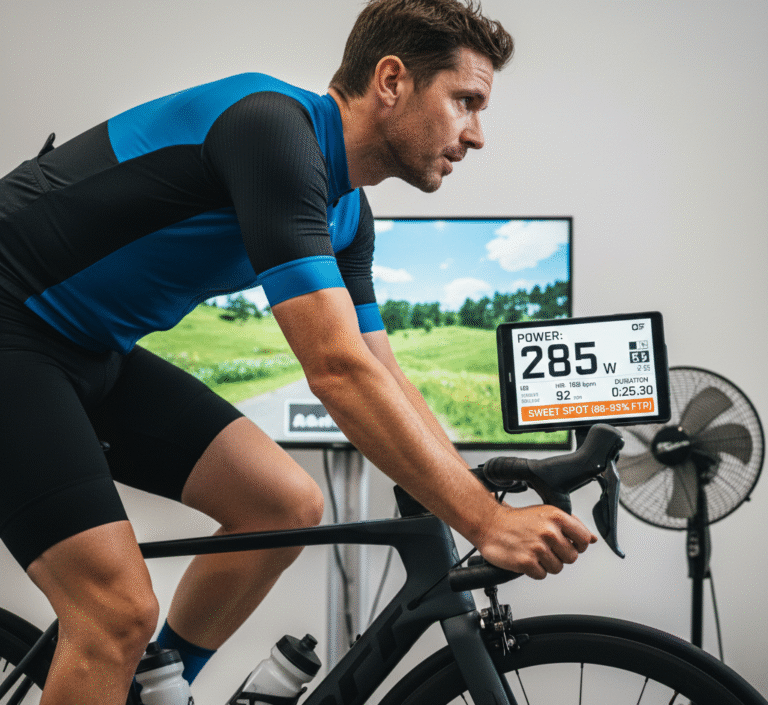
Zone 2 — that’s 60–70% of max heart rate, the pace where you could hold a somewhat embarrassing conversation about your weekend plans — builds mitochondrial density. More mitochondria means your muscles burn fat more efficiently, protect glycogen stores for the actual hard stuff, and recover between punishing climbs in real-time. A 2019 study in the Journal of Physiology backed this up. Athletes using a polarized model — 80% low intensity, 20% high — outgained moderate-effort trainers significantly over the study period.
It feels irresponsible. Almost lazy. You’ll question it around week 3. Push through that. 8–12 weeks of committed Zone 2 base work rewires your aerobic engine at a cellular level — and that’s not hyperbole, that’s just mitochondrial biology.
Apply it:
- 2–3 Zone 2 rides per week, each lasting 45–90 minutes
- Heart rate ceiling: 120–145 bpm depending on where your fitness sits
- When you want to push harder — don’t. The adaptation is happening in the restraint
Your Breathing Is Quietly Destroying Your MTB Endurance
Nobody talks about this one. Seriously — coaches, training apps, endurance podcasts — they’ll obsess over power output and VO2 max and periodization cycles, and then completely gloss over the fact that you’re probably mouth-breathing your way through every climb like a golden retriever hanging out a car window.
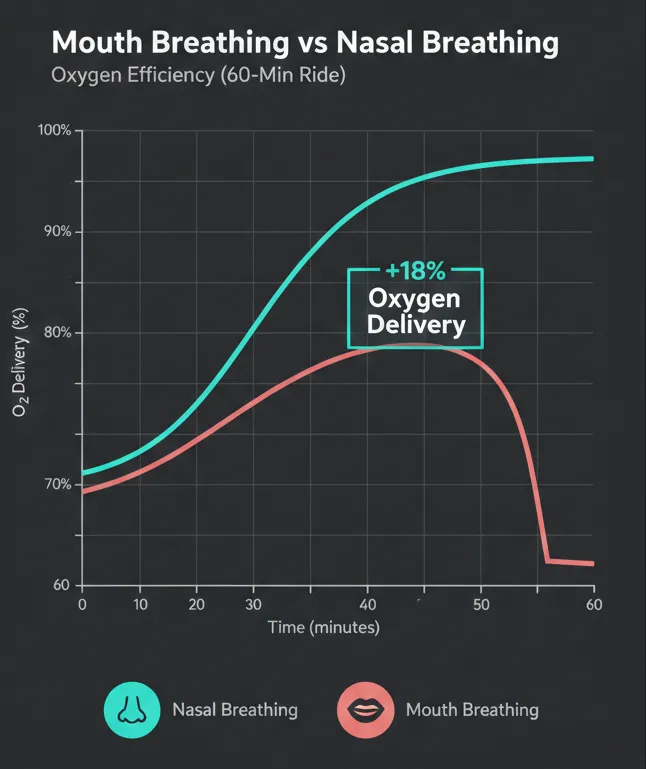
Mouth breathing dumps CO2 too fast. That triggers early fatigue signals — not because your muscles are actually cooked, but because your respiratory system is panicking unnecessarily. Nasal breathing, by contrast, increases nitric oxide production. Nitric oxide dilates blood vessels. Better dilation means improved oxygen delivery — research from the Karolinska Institute puts that improvement at up to 18%. Eighteen. That’s not a rounding error.
The shift is simple to explain and — look, I’ll be real with you — genuinely annoying to practice at first. Nasal-only breathing during Zone 2 rides. You’ll feel restricted. Maybe a little claustrophobic during steeper efforts. Slow down instead of breaking to mouth breathe. Within 3–4 weeks, your aerobic ceiling measurably rises. Climbs that had you gasping start to feel like… climbs. Hard, yes, but manageable.
Apply it:
- Nasal breathing on all Zone 2 sessions — no exceptions, no negotiating with yourself mid-climb
- If you’re breaking to mouth breathe, your pace is too high — dial it back
- 5 minutes of diaphragmatic breathing before you clip in — prime the system before you demand it performs
The 20-Minute Fueling Window That Quietly Rewrites Your Endurance Ceiling
Here’s something that happens constantly — riders head out for a 2.5-hour trail ride with one bar, maybe half a water bottle, vibes, and optimism. And it works. Kind of. They finish. They feel cooked but fine. What they don’t feel is the 7–11% power output they left on the trail in the final third of the ride — because that loss is invisible. Gradual. It doesn’t feel like under-fueling, it just feels like getting tired.
The American College of Sports Medicine is pretty clear on this: riders who fuel proactively — starting at the 20-minute mark, not when hunger shows up — maintain significantly higher output late in rides compared to those who wait until they feel depleted. Hunger is a lag indicator. By the time it fires, blood glucose is already declining and your body is quietly rationing effort.

Target 30–60 grams of carbohydrates per hour on anything over 75 minutes. Real food works — dates, rice cakes, whatever you can stomach mid-trail. This isn’t just about one ride, though. Consistent fueling means every training session produces maximum adaptation. You’re not just surviving the work. You’re extracting the full return on it.
Apply it:
- Set a timer — every 20 minutes on rides over 75 minutes, eat something
- Minimum 30g carbs per hour, scaling to 60g on longer or harder efforts
- 500–750ml of fluid per hour in moderate conditions — more in heat
Why Random Training Is Quietly Killing Your Progress — And the System That Fixes It
So here’s the part nobody wants to hear. Those 3 shifts above — real, powerful, compounding. But dropped into a random, inconsistent training schedule? They underperform. The one-degree shift only compounds inside a framework that’s actually built to stack adaptations week over week. Without structure, you’re just collecting good habits that don’t talk to each other.
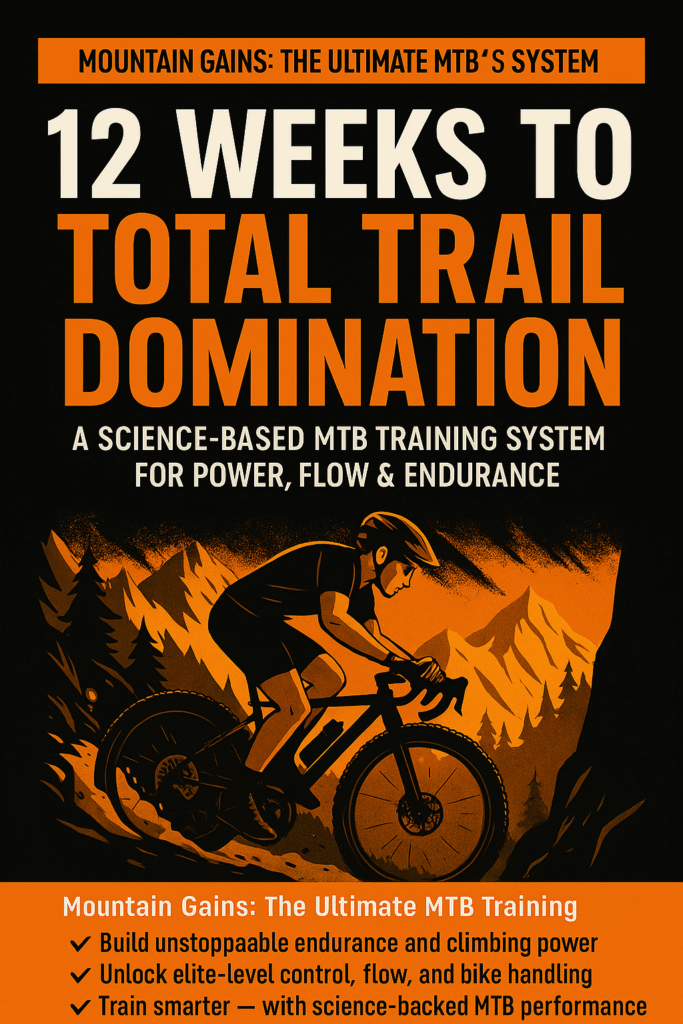
That’s exactly why — and we’re going to be direct here — we built Mountain Gains: The Ultimate MTB Training System at PEDALYNX.
Mountain Gains is a complete 12-week MTB training program. No coach required. It runs a deliberate Foundation → Build → Peak progression, with every single week targeting endurance development, trail-specific strength, and mental performance together — not separately, not randomly.
What actually makes it different:
- Trail-specific strength work — not generic gym programming, but sessions engineered for MTB stability, technical terrain control, and real power transfer on climbs
- Mental performance protocols — flow-state techniques, focus drills, the kind of mindset habits that make you ride with confidence instead of hesitation
- Only 4–6 sessions per week — built for athletes with actual lives, jobs, families, things that compete for time
- Science-backed structure — polarized training principles and periodization methods used by elite MTB coaches, translated for everyday riders
- Integrated recovery system — sleep optimization, fueling and hydration protocols woven directly into the program so adaptation accelerates and burnout doesn’t
- Performance tracking templates — log power, endurance, and skill metrics so progress is something you can see, not just feel
- Bridge Maintenance Plan — a year-round structure to protect your gains when the season winds down
Mountain Gains doesn’t ask you to suffer more. It asks you to stop wasting the suffering you’re already doing.
What Shane Found When He Stopped Guessing and Started Stacking
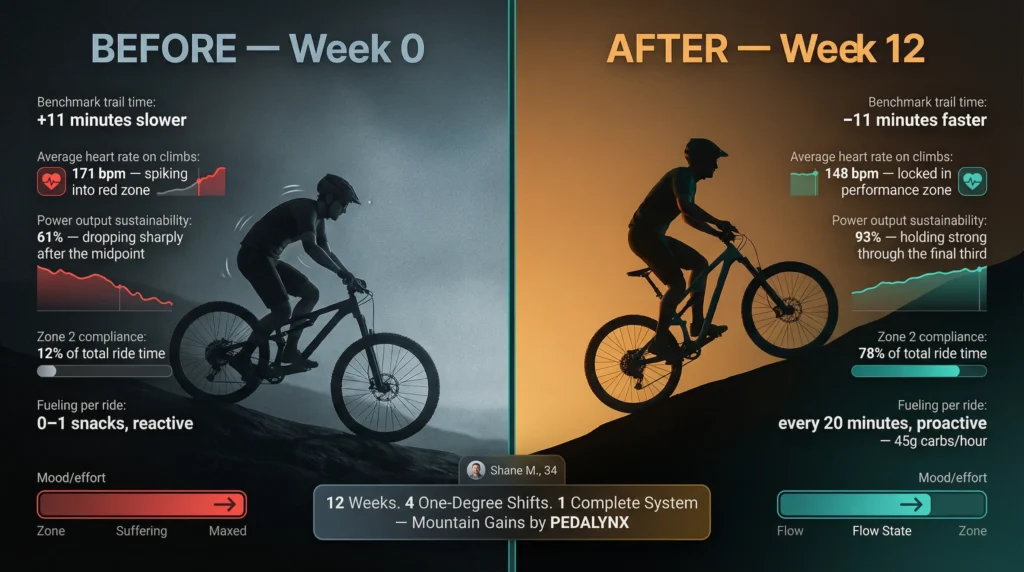
“Three years of riding and I genuinely felt stuck — like the trail was just always going to be that hard. Started applying the Zone 2 pacing and the fueling approach from the PEDALYNX strategy, then followed the Mountain Gains structure for the full 12 weeks. By week 8 I was holding efforts on climbs that used to absolutely wreck me. Final benchmark? Down 11 minutes on my local trail. It wasn’t one big thing. It was everything hitting at once.” — Shane M., Trail Rider, 34
The Shift Is Smaller Than You Think. The Result Isn’t.
We’re not here to sell you on a dramatic reinvention. We’ve seen too many riders blow up their routine trying to change everything at once — and end up back where they started, frustrated, overtrained, questioning whether they’re just not built for this. You are built for this. The trail doesn’t care about your genetics. It responds to consistency applied in the right direction.
One degree. Held steady. Over weeks and months — it becomes a completely different destination.
Pick your shift. Apply it today. And when you’re ready to stop guessing and start stacking — Mountain Gains is the structure that locks it all in.
We built PEDALYNX for riders who refuse to stay stuck. The trail is waiting — and so is the next version of you.
👉 Get Mountain Gains: The Ultimate MTB Training System and start your 12-week transformation.