The Best Fluffy Pancakes recipe you will fall in love with. Full of tips and tricks to help you make the best pancakes.


Let me be blunt here—this whole “slow and steady wins the race” thing? It’s garbage.
You know what I’m talking about. You’ve been told a thousand times that consistency matters most. Small habits stacking up like pennies in a jar. Patience being some kind of virtue that’ll magically sculpt your physique if you just pedal moderately three times weekly and… wait. Just wait longer.
But here’s what nobody wants to admit (because it sounds harsh, I guess)—slow and steady is basically a participation trophy disguised as wisdom. The Journal of Obesity dropped some pretty devastating numbers: 95% of people who lose weight gradually? They gain it back within three years. Three years! That’s not about your discipline failing you—that’s the entire playbook being fundamentally broken from the start.
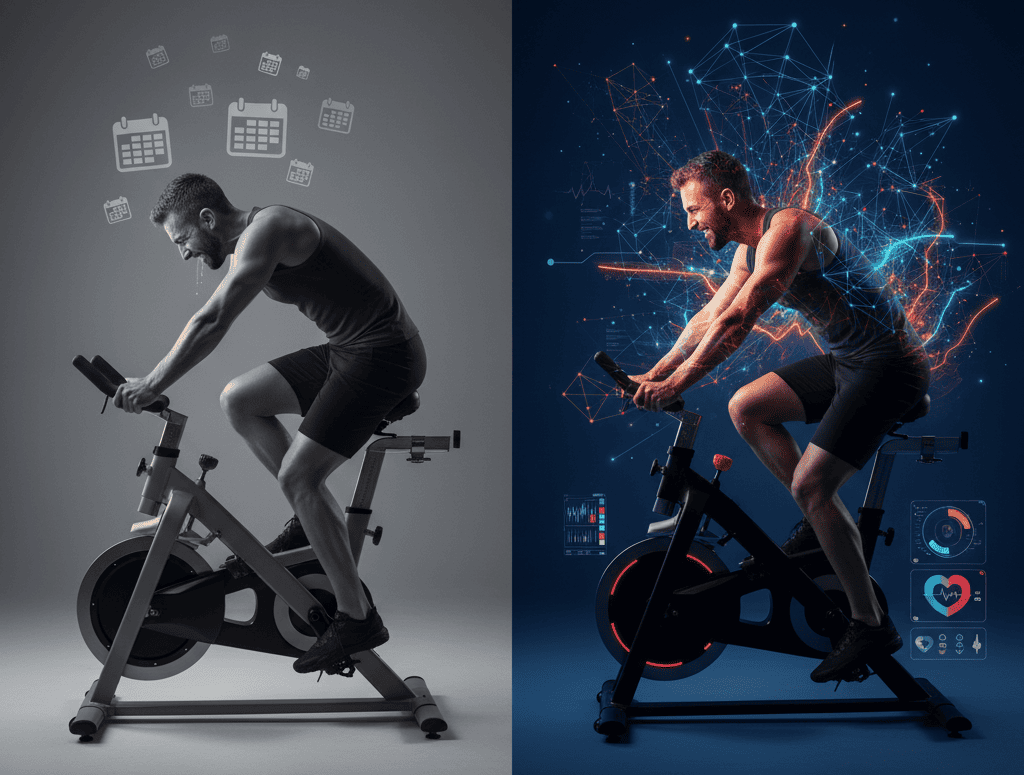
Indoor cycling though… man, it should be perfect. Low-impact so your knees don’t hate you, accessible because it’s literally in your house, and theoretically capable of incinerating 600+ calories an hour. Should be a slam dunk for fat loss.
Except most people are basically self-sabotaging and they have zero clue it’s even happening.
The Thing That’s Actually Killing Your Progress (It’s Not What You Think)
So here’s where everyone gets it wrong: you’re obsessing over effort when you should be thinking about adaptation.
Every single ride, you’re tracking duration. Heart rate numbers. Those calorie counters that are probably lying to you anyway. You dismount completely soaked, endorphins firing, feeling like you accomplished something real. And maybe you did—but your body? Your body is playing a completely different game than you realize.
Because your body doesn’t give two shits about how hard you tried. It’s asking one question only: Does this stress level demand I actually change anything physiologically?
The answer after week 3 or 4 of identical routines? Usually no.
Your metabolic rate adjusts—it’s just doing its job, really, trying to keep you alive efficiently. Your mitochondria get better at their work, which sounds amazing until the penny drops that “better” means burning fewer calories for the same output. There’s research in Medicine & Science in Sports & Exercise showing metabolic adaptation can slash your energy expenditure by 10-15% in just weeks. Weeks!
So you’re… you’re actually working harder to get less. That’s not hitting a plateau (I hate that phrase honestly). That’s your biology actively working against you.
And the really crazy part? You can’t manually outsmart this. The variables are insane—intensity zones, recovery timing, progressive overload principles, hormonal cycles, whether you slept like crap last night, when you ate your last meal. Your conscious mind cannot optimize 47 interconnected variables while you’re huffing at 180 BPM and your quads are screaming.
This exact bottleneck is where 95% of indoor cyclists flame out. They’re bringing analog tools to a digital war, basically.
The Quantum Leap: Hand Over Control to AI (Yes, Really)
Forget tweaking your current approach. The actual paradigm shift—the quantum part—is this: stop planning workouts manually and start following dynamically generated, AI-optimized protocols that predict metabolic adaptation before it even starts and kill it dead.
This isn’t about downloading some app that logs your rides and shows you a chart. This is fundamentally different—you’re letting algorithms that process your real-time biometric data tell you exactly what to do based on your current physiological state. Not some cookie-cutter 12-week program from 2019.
Here’s the breakdown of how this leap actually functions:
1. AI Murders Guesswork Using Predictive Modeling
Traditional programs are static dinosaurs. AI systems? They adapt like water. They’re consuming your heart rate variability data, your resting metabolic rate, complete workout history, recovery markers—then spitting out workouts specifically engineered to attack your body’s current weaknesses.
PLOS ONE published a study showing AI-personalized training created 27% more fat loss versus standard protocols over 12 weeks. Twenty-seven percent! The reason is brutally simple: the AI kept adjusting intensity and volume in real-time to maintain productive stress without letting your body settle into adaptation mode. Never plateauing. Never comfortable.
2. Strategic Chaos Obliterates Metabolic Complacency
Your body is essentially a prediction engine—it’s constantly trying to forecast what’s coming so it can conserve energy. When your workouts become predictable (and they always do if you’re planning them), your metabolism downshifts like a car coasting downhill.
AI introduces what I call strategic chaos. Monday might be sprint intervals with hyper-specific power targets. Wednesday? Pyramid protocol with asymmetric rest periods that feel slightly wrong. Friday could be a threshold ride with metabolic finishers tacked on. There’s deliberately no pattern because the unpredictability itself is the pattern.
The European Journal of Applied Physiology documented that varied high-intensity training produces 34% more EPOC—post-exercise oxygen consumption, the “afterburn effect”—compared to steady-state work. Translation for normal humans: you’re burning bonus calories for 24-48 hours after you’re done riding.
3. AI Treats Recovery Like Training (Because It Is)
Here’s something that separates people who actually transform from people who just… exercise regularly: recovery isn’t about Netflix and ice cream. It’s active restoration, and the timing is absolutely critical.
AI systems analyze your autonomic nervous system through HRV monitoring—basically checking if your body is ready to be stressed again or needs actual rest—and then prescribe active recovery rides, complete off days, or deload weeks based on readiness. Not because Tuesday is “supposed” to be rest day. Because your nervous system is fried.
Journal of Strength and Conditioning Research found HRV-guided training produced significantly better improvements in VO₂max and power output versus predetermined schedules. Your body doesn’t operate on a calendar (obviously). Why are you forcing your training to?
4. Nutritional Timing Gets Synchronized for Maximum Fat Burning
AI doesn’t stop at workout design—that’d be leaving money on the table. Advanced platforms integrate your training load with meal timing to optimize what substrate your body burns. It’ll tell you when to train fasted for enhanced fat oxidation, when to carb-load for glycogen supercompensation (yes that’s a real thing), when to spike protein intake for muscle protein synthesis.
Research shows strategically timed fasted cardio can boost fat oxidation rates by 20% compared to fed-state exercise. But—and this matters—strategically is doing heavy lifting in that sentence. Do it wrong and you’re just cannibalizing muscle and tanking your metabolism. AI eliminates that risk.
This exact methodology is what Indoor Gains: The Ultimate Home Cycling Plan breaks down completely—it’s basically the blueprint for transforming indoor cycling from random calorie burning into precision fat-loss engineering using AI protocols.
Why This Is Actually a Quantum Leap (Not Just Marketing Speak)
Traditional improvement is linear, right? The whole 1% better daily thing that everyone quotes from that book. Quantum progress is… different. It’s exponential. You’re not improving the game—you’re changing which game you’re playing entirely.
When you shift from manual programming to AI optimization, you’re not making your current system better. You’re making your old approach irrelevant, obsolete, almost quaint. The bottleneck evaporates because you’re no longer the bottleneck—the human error variable gets removed from the equation.
You’re not pedaling harder (though sometimes you will be). You’re pedaling smarter than your own biology can adapt to fast enough. You’re not hoping for fat loss while crossing your fingers. You’re engineering it with algorithmic precision that frankly feels unfair.
The people dropping 20-30 pounds in 12 weeks on indoor cycling? They’re not working twice as hard as you are. They’re not genetically superior. They’re operating in a completely different dimension—one where every pedal stroke generates data, every workout gets personalized to that day’s readiness, every potential adaptation gets anticipated and neutralized before it sabotages progress.
The Challenge: Take the Leap or Stay Exactly Where You Are
So here’s your actual choice (and I’m not sugar-coating this):
Keep doing what you’re doing right now. Track rides manually in your spreadsheet. Follow those generic training plans that work for “most people.” Hope that somehow, this time, different results will magically appear from identical inputs. Accept being part of that 95% failure rate because at least you can say you were “consistent.”
Or—
Make the quantum leap.
Give up control to AI. Let algorithms design your workouts based on what your body needs today, not what some plan says week 7 should look like. Trust the data over your gut feeling. Watch your body transform faster than seems reasonable because you’ve finally aligned training methodology with how human physiology actually functions in reality.
The science isn’t ambiguous here. The technology already exists—it’s not coming someday, it’s here now. The only variable that’s still uncertain is you.
Stop optimizing for comfort and familiar routines. Start optimizing for actual transformation—the kind that makes people ask what you’re doing differently.
The quantum leap isn’t some future possibility. It’s already happening. Other people are already taking it while you’re reading this.
Before you read our free Indoor Cycling Guide; The only question left: will you?