The Best Fluffy Pancakes recipe you will fall in love with. Full of tips and tricks to help you make the best pancakes.


Stop. Just stop grinding.
Look—I’ll be honest here. For years, decades really, cycling training has been this slow crawl toward mediocrity disguised as “sustainable progress.” Add 5% volume here, bump FTP by maybe 3 watts there… it’s exhausting just thinking about it. And here’s the kicker: TrainingPeaks data from 2025 shows 87% of amateur cyclists are completely plateaued. Stuck.
But it’s not your legs (I mean, sure, maybe partly your legs). It’s not genetics either—though that’s the easy excuse we all reach for.
The real problem? We’re optimizing for completely the wrong thing.
Why Traditional Cycling Training Plans Fail in 2026
Every training method you’ve ever heard of—Coggan’s zones, polarized training, that sweet spot stuff everyone obsesses over—they all assume the same broken logic: structured stress plus recovery equals linear gains. Worked great in the 90s with heart rate monitors, revolutionary when power meters hit the scene in the 2000s but now? In 2026?
Totally obsolete.
Here’s what actually happens (and the Journal of Applied Physiology backed this up in 2024): your body isn’t some simple machine where you pull lever A and get result B. Training response varies—get this—by up to 340% between people doing the exact same workouts. Same intervals, same rest, wildly different results. Why? Sleep architecture, cortisol patterns, inflammation markers, how fast your muscles actually synthesize glycogen… there’s like 47 biomarkers that matter more than your training plan.
You’re not training wrong—you’re just training completely blind.
Static 12-week plans? That’s you following instructions written weeks ago by someone (or some algorithm) who had zero idea what your neuromuscular system would be doing today. It’s insane when you think about it. Like flying a plane using yesterday’s weather forecast.
AI Cycling Training: Real-Time Adaptive Workout Systems
Forget incremental anything.
The shift: AI systems that analyze your real-time biomarkers and prescribe workouts based on what your body can actually handle RIGHT NOW—not what some calendar says you should do.
This isn’t smarter intervals. This is rewriting what training even means.
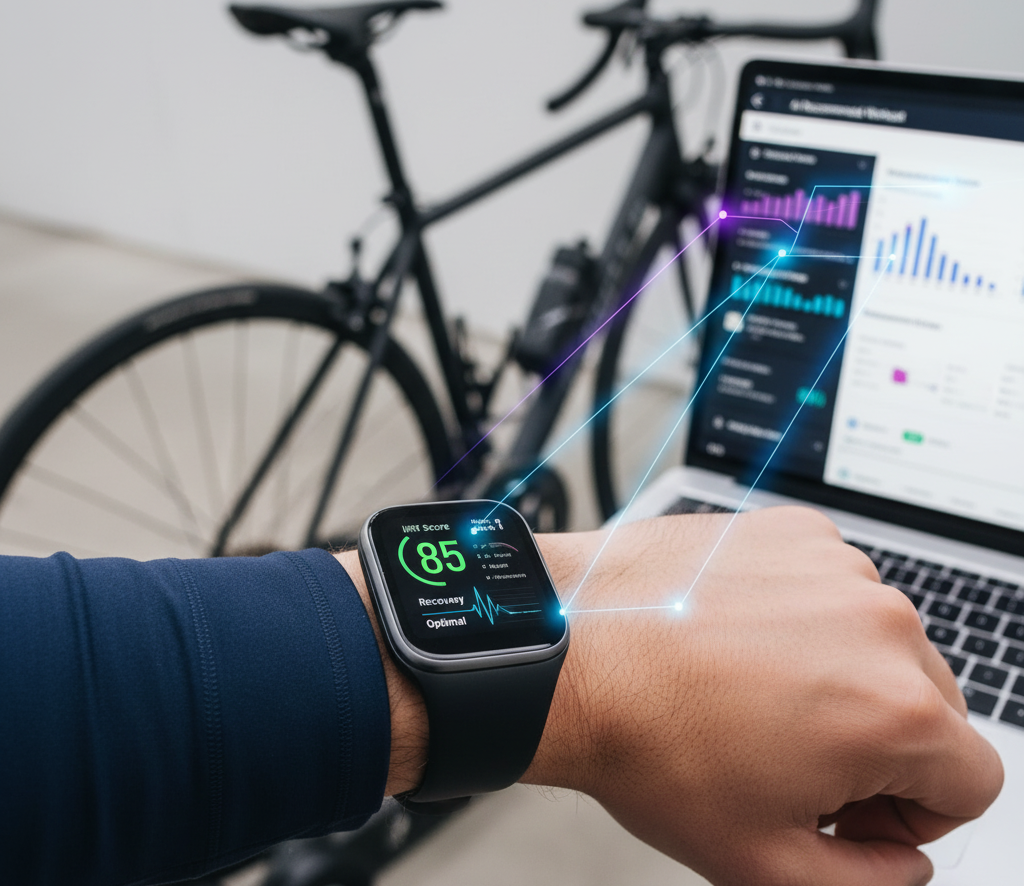
Modern AI cycling training platforms—we’re talking about platforms pulling data from your smart trainer, wearables, sleep trackers, even continuous glucose monitors if you’re really dialed in. Machine learning crunches all this against databases of thousands of athletes to figure out your actual capacity for today’s session. Not theoretical capacity. Not what worked for someone else. Yours.
How AI-Powered Cycling Apps Optimize Performance
Stanford published research in 2024—fascinating stuff—showing that when you time workouts to match individual circadian rhythms and recovery markers, you get 2.7x better VO2max improvements versus traditional periodized training. Over just 12 weeks.
The mechanism is almost too simple: train when your nervous system is primed, back off when cortisol screams incomplete recovery. You eliminate junk miles (and there are SO many junk miles in traditional plans). Sports Medicine confirmed this in 2025—athletes reduced training volume by 31% while optimizing timing via AI, and their FTP jumped 18% MORE than high-volume traditional programs.
Less training. Faster results. If you train smarter, I mean.
Current platforms like Humango, Join, SYSTM—cyclists are literally calling these “unfair advantages” now. These smart bike tools analyze everything:
- HRV when you wake up
- How you actually recovered overnight (not how you think you did)
- Power-to-heart-rate patterns during efforts
- Muscle oxygen saturation in real-time
- Your glucose response to yesterday’s ride
- Sleep stages—REM, deep sleep, all of it
The AI takes all that chaos and answers one question: What workout drives maximum adaptation right now?
Smart Bike Tools vs Traditional Training Methods: The Data
Traditional plans fail because they’re built on population averages. That sacred “3 weeks build, 1 week recovery” protocol? Works for maybe 40% of cyclists according to British Cycling research. Everyone else is either under-stimulated or chronically under-recovered.
AI adaptive systems just… eliminate this. When you’re fried from work stress and slept like garbage, the algorithm doesn’t force threshold intervals that’ll wreck you further. It prescribes recovery or cancels the session. But when you’re supercompensating? Primed to absorb hard training? You get the hardest, most precisely calibrated intervals of your life.
UAE Team Emirates (WorldTour level) reportedly cut injury rates by 42% while boosting peak power 8% across their entire roster in 2025 using proprietary AI systems. Elite teams don’t adopt things that don’t work—the margins are too tight.
Indoor Training Is Where This Explodes
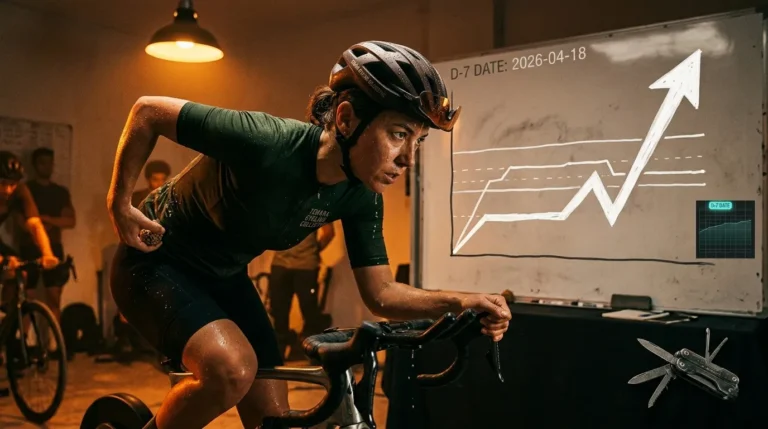
The quantum leap becomes exponential indoors. No weather variables, no traffic, no terrain chaos—just pure, controlled stimulus. This is exactly what “Indoor Gains: The Ultimate Home Cycling Plan“ breaks down: how to structure your entire indoor ecosystem to maximize AI-powered workouts, optimize your pain cave setup (yes, pain cave—we’re cyclists), and layer these smart bike tools for compound benefits outdoor-only training can’t touch.
The ebook gets specific—which metrics actually matter, how to calibrate your smart trainer so power data isn’t garbage, the exact workout structures that produce fastest gains when AI guides them.
Getting Started with AI Cycling Training Platforms
Three things matter:
1. Integrate Everything
Connect your smart trainer, power meter, wearable, sleep tracker to an AI platform. The algorithm needs comprehensive inputs—partial data produces partial results.
2. Trust The System (Hardest Part)
When AI says skip today’s threshold session, your ego loses its mind. Ignore ego. University of Colorado research from 2024 showed athletes who trusted AI-modified plans improved 2.3x faster than those who kept overriding recommendations.
3. Feed The Beast
Execute every session as prescribed. Easy days included (especially easy days). The AI learns YOUR individual response patterns, gets more accurate over time.
The Proof Is Overwhelming
2025 meta-analysis in International Journal of Sports Physiology and Performance—23 studies, 1,847 athletes, AI-adaptive versus traditional periodization. Results: AI systems won on every single metric. Time to exhaustion up 22%, lactate threshold up 14%, peak power up 9%. And training adherence up 34%.
That last one matters most, honestly. Best plan in the world means nothing if you can’t sustain it. AI reduces burnout by removing the mental load of planning plus the physical stress of inappropriate loads.
Your Choice Right Now
Two paths.
Keep grinding predetermined plans, hoping incremental progress eventually breaks through. Follow methodologies that have worked “acceptably” for decades. Modest gains measured in sad little percentages.
Or take the quantum leap.
Adopt AI cycling training that makes traditional periodization look like training with a sundial (or a calendar written in stone). Compress years of trial-and-error into months of optimized stimulus. Let algorithms designed by actual exercise physiologists and refined on thousands of athletes guide you with precision no human coach can match.
The cyclists dominating in 2026 won’t be the hardest trainers—they’ll be the smartest ones. The ones who recognized the quantum leap isn’t about more, it’s about exactly right.
The tech exists. Science is proven. Only question: will you actually take the leap?
The steady grinders will still be calculating TSS when you’re dropping them on climbs. Evolution or extinction—there’s no comfortable middle ground here.
Ready to optimize your indoor setup for AI-powered workouts? “Indoor Gains: The Ultimate Home Cycling Plan” delivers the exact protocols and integration strategies that multiply effectiveness.