The Best Fluffy Pancakes recipe you will fall in love with. Full of tips and tricks to help you make the best pancakes.


Look—most cyclists are bleeding time in the gym. Not because they’re lazy (far from it actually) but because nobody’s told them the truth to lift weights properly. You’re probably doing 3 sessions weekly right now, feeling demolished before your Tuesday intervals, wondering why your legs feel like concrete when you need them to feel like springs. Here’s the thing that frustrates me: the answer isn’t more discipline or tougher mental game, it’s just… timing. Pure and simple timing.

Every wasted gym session is stealing recovery you desperately need for the bike. But here’s the flip side—skip too many lifts and you’re leaving massive power gains on the table. Most athletes spend literally 6-12 months (sometimes more, honestly) fumbling around trying to figure this out through trial and error. That’s half a season. Gone.
This guide cuts through that noise completely. We’re talking precise lifting frequency that builds strength without turning your legs into sandbags.
Phase-Specific Frequency (The Periodization Shortcut)
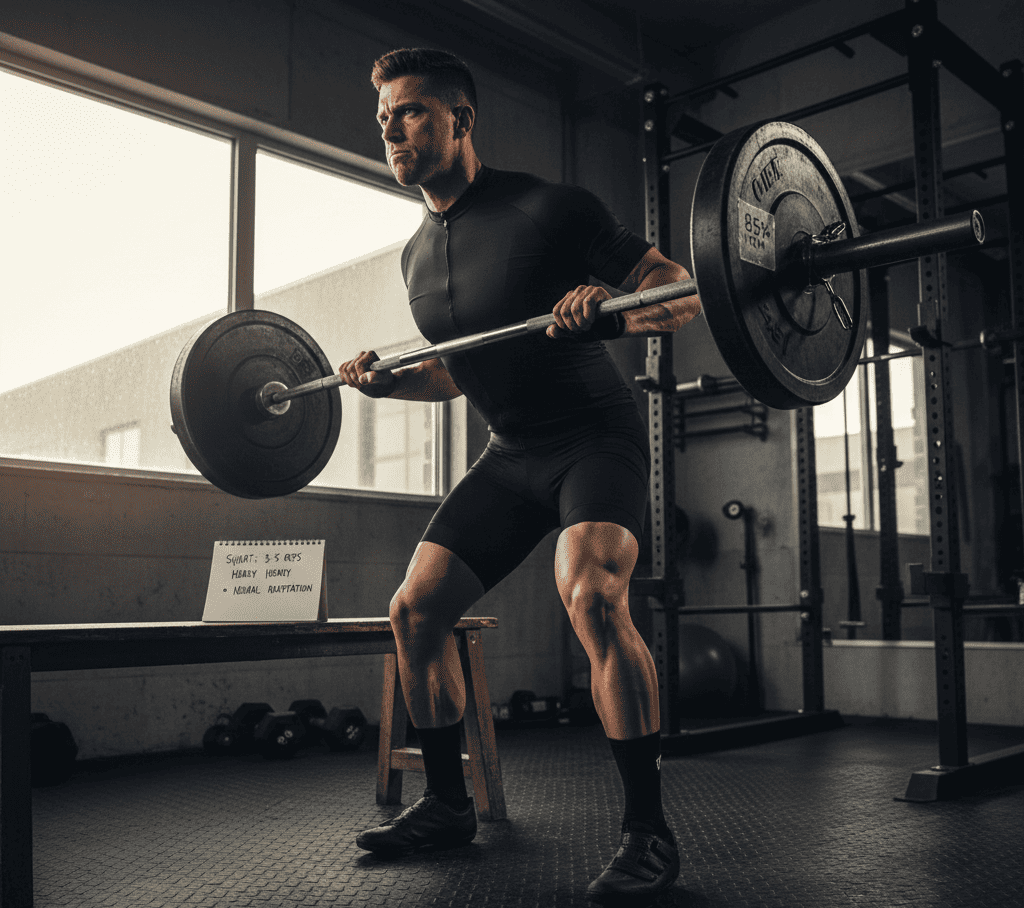
Okay so this one’s huge—and I mean HUGE. You cannot lift the same way in October that you’re lifting in June. Your body isn’t a machine that can peak everywhere simultaneously (though wouldn’t that be nice?). It has to choose: gym strength or bike power. The secret is getting it to do both… just not at the same time.
Off-Season (October-December)
You’re hitting the weights 3 times per week here. This is your window—the narrow window where you can actually build real, substantial strength without compromising riding performance because, let’s be honest, your rides are pretty chill right now anyway. Low intensity zone 2 stuff mostly. Give yourself 72-hour recovery between sessions, don’t rush this.
Base Phase (January-February)
Drop down to 2 times per week. Riding volume is climbing now, you’re spending more hours in the saddle, so something’s gotta give. But you’re maintaining those hard-earned strength gains while piling on bike volume. Schedule your lifts 48 hours after your hardest ride—never, and I mean never, the day before intervals.
Build Phase (March-April)
Now we’re down to 1 maintenance session weekly. Just enough stimulus (barely enough, really) to keep strength from evaporating while you’re hammering high-intensity intervals. Single-leg exercises become your best friend here. 15-20 minutes total gym time—that’s it.
Race Season (May-September)
1 session every 10-14 days or just eliminate it completely during your A-races. You’re protecting against strength loss, nothing more ambitious than that.
Real-world application—and this one stuck with me: Amateur racer Jonas (great guy, met him at a crit last spring) implemented this exact protocol after years of doing it wrong. “I used to lift 3 days weekly year-round,” he told me over post-ride coffee, still shaking his head at his old approach, “and constantly felt heavy on climbs during race season. My legs just wouldn’t snap. Switching to periodized frequency gave me 12% more peak power in April testing while—get this—cutting gym time in half during my race calendar.”
This strategy eliminates the catastrophic mistake of treating strength training as this constant background hum. Your lifting frequency has to pulse with your cycling demands. Period.
The 48-Hour Rule (Recovery Acceleration)
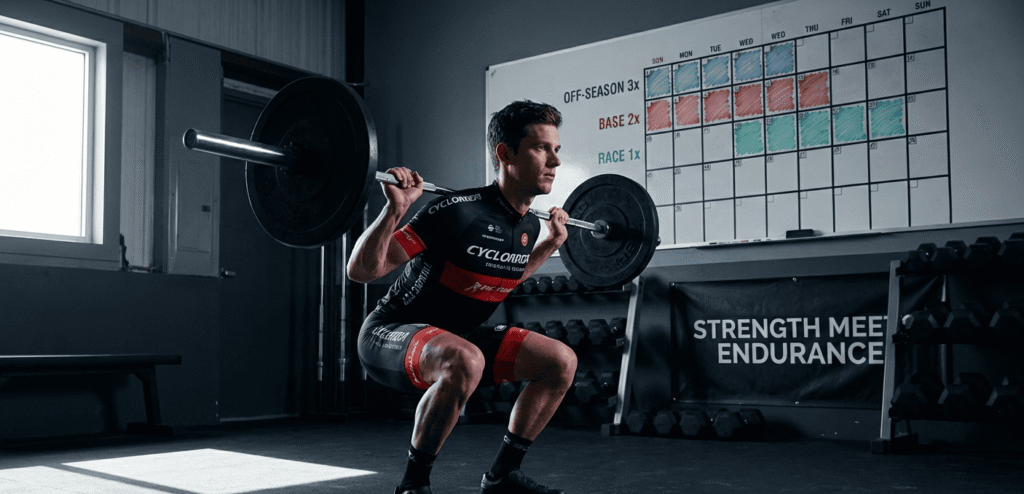
Here’s what absolutely murders progress: lifting too close to hard rides. And I see this everywhere. Minimum 48 hours must separate your last lift and your next high-intensity cycling session—this isn’t a suggestion or optimization hack, it’s physiological law.
When you squat heavy (really heavy, like struggling on that last rep heavy), muscle protein synthesis peaks around 24-36 hours post-workout. Your muscles are literally rebuilding themselves. If you decide to hammer intervals at hour 18? You’re training on damaged tissue. The result is predictably terrible: subpar intervals AND compromised strength adaptation. You get the worst of both worlds.
The fast-forward application:
- Lift Monday and Thursday if you’re doing intervals Tuesday and Saturday
- Lift Tuesday and Friday if your hard rides fall on Wednesday and Sunday
- Always—whenever humanly possible—place lifts immediately after (same day as) your easy recovery rides because this maximizes the separation from your next hard effort
Track this obsessively for 4 weeks. I’m talking spreadsheet level tracking. You’ll see interval power outputs jump 8-15 watts simply from optimizing timing alone, with zero additional training stress added to your program.
Session Duration Inversion (Time-Efficiency Breakthrough)
Long gym sessions are absolutely killing your cycling gains and nobody talks about this enough. The optimal lifting session for weight lifting for cyclists isn’t 90 minutes of grinding through endless sets—it’s 35-45 minutes maximum during off-season and 15-25 minutes in-season.
Why? Because (and this is critical) cyclists need neural adaptation and structural strength, not bodybuilding volume. You’re not trying to look good on the beach—you’re trying to push bigger watts. Every minute past 45 increases systemic fatigue without giving you proportional strength benefit. Diminishing returns kick in hard.
The protocol:
- 4-6 exercises maximum per session (yes, that’s all)
- 3-4 sets per exercise
- Rest periods: 3-4 minutes between heavy compound movements—don’t rush this, I know it feels lazy but it’s not
- Total working sets: 12-16 across the entire session
Focus on these movements: back squats, Romanian deadlifts, Bulgarian split squats, single-leg press, Nordic curls, and hip thrusts. These 6 movements deliver roughly 90% of cycling-specific strength gains. Everything else is just… noise, honestly.
Real-world efficiency: Cut your gym time from 75 minutes to 40 minutes and watch your Functional Threshold Power (FTP) actually improve—seems counterintuitive right?—because you’re fresher for bike workouts. Most cyclists overtrain in the gym. This strategy eliminates that trap entirely.
Load Over Volume (The Intensity Accelerator)
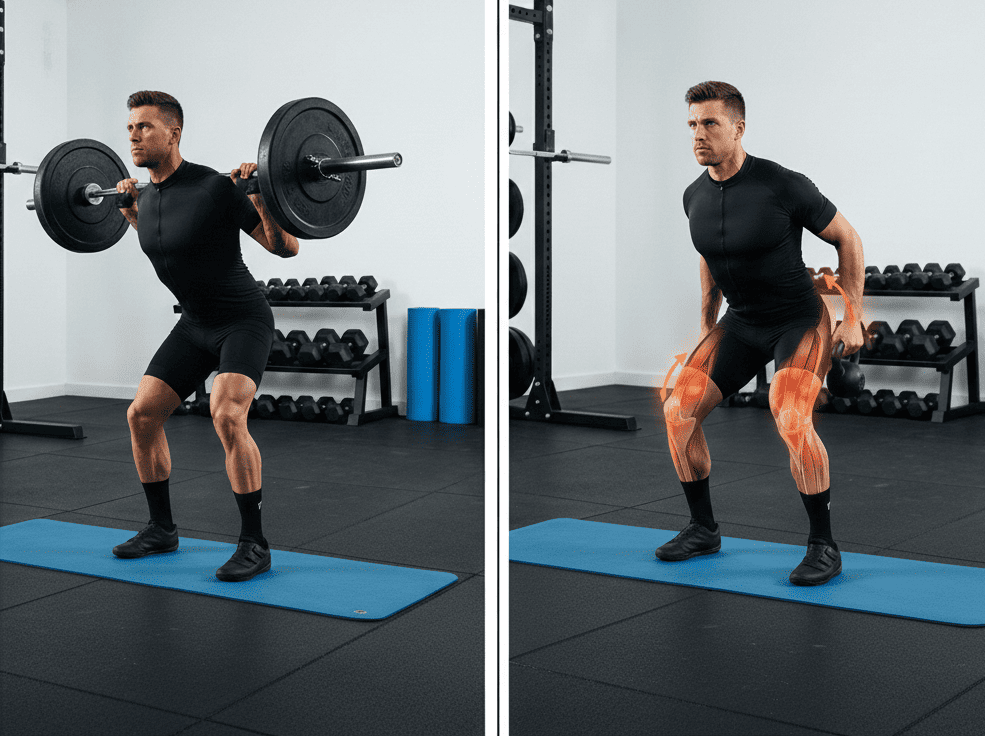
Stop doing 3 sets of 15 reps. Just stop. That’s endurance work—you already do that on the bike for 10-15 hours weekly. Why would you replicate it in the gym?
The fast-forward approach: Heavy loads, low reps, high rest. For cyclists, true strength means 3-5 reps at 85-90% of your one-rep max, not burning out with light weights until your muscles scream. That burning sensation? That’s not making you faster on the bike.
Exact prescription:
- Off-season: 4 sets of 4-6 reps at 80-85% max
- Base phase: 3 sets of 5-7 reps at 75-82% max
- Build/race: 2-3 sets of 6-8 reps at 70-78% max
This approach triggers neuromuscular adaptation—teaching your muscles to fire harder and faster (like flipping a light switch vs slowly turning a dimmer)—without the crushing muscle damage and fatigue that comes from high-volume training. You get stronger without getting bigger or slower. Actually, you get faster because power-to-weight improves.
Application: If your current squat is 100kg for 10 reps, switch to 120kg for 5 reps. Same total training stimulus, 40% less time, massively superior power transfer to pedaling. The math just works better.
Single-Leg Dominance (The Specificity Hack)
Bilateral exercises (both legs simultaneously) build general strength—the kind that looks good on paper. Unilateral exercises (one leg at a time) build cycling-specific power, the kind that shows up in your Strava times.
After your first 6-8 weeks of bilateral foundation building (you need this base first, don’t skip it), shift 60-70% of your lifting volume to single-leg work:
- Bulgarian split squats: 3 sets of 6-8 per leg
- Single-leg Romanian deadlifts: 3 sets of 6-8 per leg
- Single-leg press: 3 sets of 8-10 per leg
- Step-ups with load: 2 sets of 8 per leg
Why this accelerates results dramatically: Cycling is a unilateral sport disguised as bilateral. Each leg pushes independently through the pedal stroke—your right leg has no idea what your left is doing. Single-leg training eliminates the sneaky compensation patterns where your stronger leg dominates (we all have one), forcing balanced development.
Expect 5-8% power improvement in your weaker leg within 6 weeks, which directly translates to smoother pedaling and higher sustainable wattage. I’ve seen it happen over and over.
Implementation Blueprint
Combine all five strategies into your program starting today—not Monday, not next week, today:
Week 1-8 (Off-season): Lift 3x weekly, 40-45 minutes, bilateral movements dominate, 4×5 reps at 82-85%, minimum 48 hours before hard rides.
Week 9-16 (Base): Lift 2x weekly, 35-40 minutes, shift to 60% unilateral, 3×6 reps at 78-82%.
Week 17-24 (Build): Lift 1x weekly, 20-25 minutes, 70% unilateral, 3×8 reps at 72-75%.
Race season: Lift every 10-14 days, 15-20 minutes, unilateral maintenance only—protect those gains.
You now have the exact blueprint that elite cyclists use to build strength without sacrificing speed. No more conflicting advice from internet forums. No more wasted gym sessions where you leave feeling accomplished but your next ride suffers. And no more wondering if you’re lifting too much (probably) or too little (unlikely).
Take action now: Audit your current lifting frequency against these five strategies. Make the adjustments this week—literally schedule them in your calendar right now. Track your on-bike power metrics for the next 30 days and watch the numbers climb. They will.
Stay tuned for our next ebook: The Complete Gym Workout for Cyclists—where we break down every single exercise, rep scheme, and progression protocol you need to maximize strength gains while minimizing interference with your riding. It’s coming soon. And you can find our e-Books Here
Check out our Full Cycling Training Guide for more tips and info !