
The Best Fluffy Pancakes recipe you will fall in love with. Full of tips and tricks to help you make the best pancakes.


Look—you’re buried under a mountain of HIIT cycling advice that contradicts itself every other paragraph. One article screams at you to sprint for 20 seconds, then the next one’s like “nah, actually do 4-minute intervals” and you’re just sitting there thinking… what? Some fitness guru swears by 5 sessions weekly (which sounds absolutely insane, by the way), while another “expert” warns you’ll literally destroy your body if you do more than one.
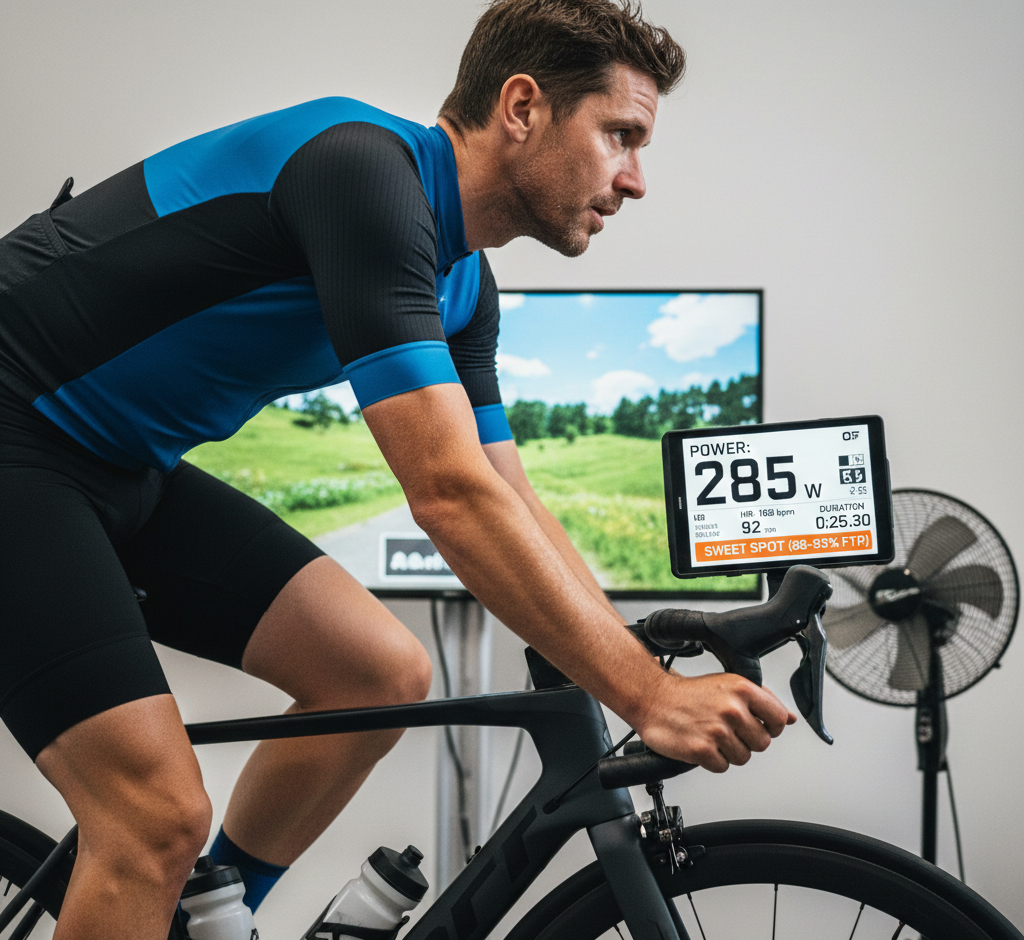
You just want results. Not a PhD in exercise science.
We get it—honestly, at Pedalynx we’ve been there too. So here’s 4 actionable steps to actually start HIIT cycling this week. No more overthinking, no more analysis paralysis.
1. Pick ONE HIIT Cycling Format and Just… Stick With It
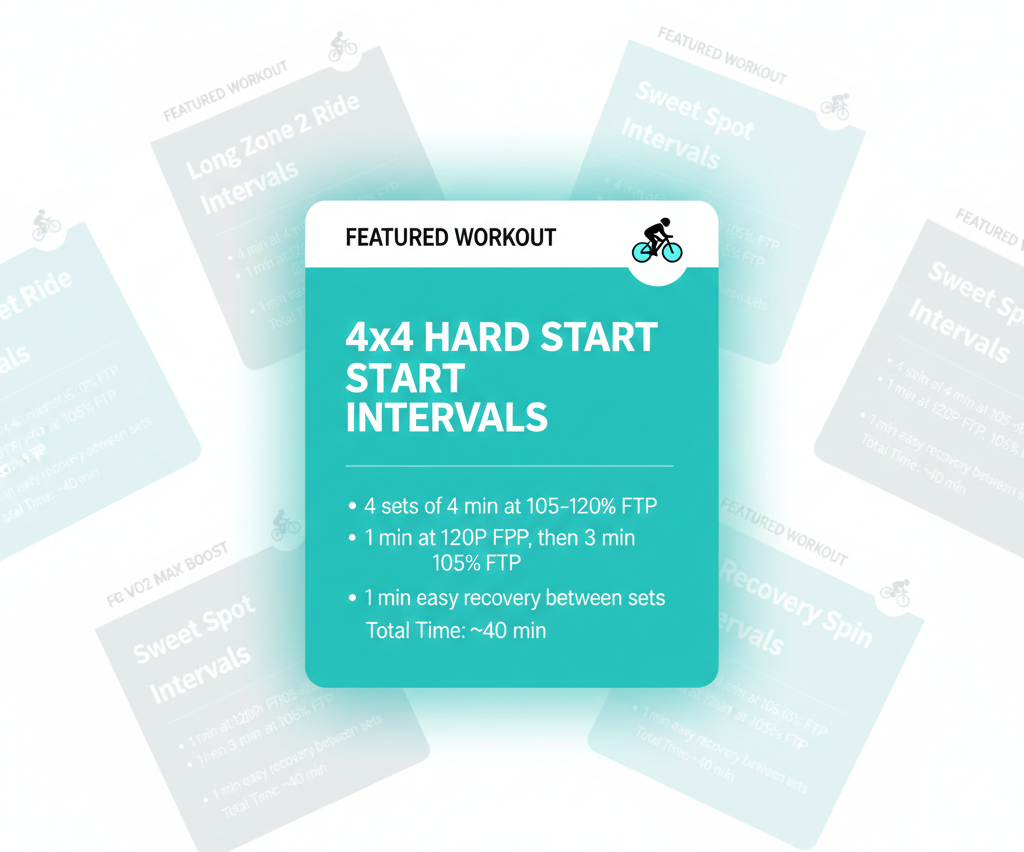
The Problem: In our previous post we broke down four proven HIIT formats: there was the 30/30 intervals (that’s 30 seconds hard, 30 seconds easy at 120-130% FTP—pretty brutal), then 40/20 lactate clearance intervals, Tabata sprints (20/10) which are genuinely terrible in the best way, and the 4×4 minute Norwegian method. Beginners see all these options and basically… freeze. Like a deer in headlights but on a bike.
Your Solution: Start with 4×4 minute intervals. That’s it—period, end of story.
Why this specific format:
- It’s got actual science backing it up for VO₂ max development (not just bro-science)
- The intensity sits at 90-95% max heart rate which is hard but not “I’m-gonna-die” hard
- Way lower injury risk compared to those all-out sprints that make your legs feel like jelly
- Simple enough that you won’t forget what you’re supposed to be doing mid-workout
How to actually do it:
- Warm up: 15 minutes of easy spinning (seriously don’t skip this—I learned that one the hard way)
- Work: 4 minutes at a hard pace where you’re breathing heavily, can only speak 3-5 words at a time
- Rest: 4 minutes easy spinning (you’ll need it)
- Repeat: 4 total work intervals
- Cool down: 10 minutes easy
Done. Master this for 6 weeks before you even think about exploring other formats—trust the process here.
2. Train HIIT Cycling 1-2 Times Per Week Maximum (Seriously, That’s Enough)
The Problem: You’ve probably read everything from “once weekly” to “daily HIIT sessions” which is frankly ridiculous. You’re terrified of overtraining but also scared you’re not doing enough—it’s like being stuck between a rock and a hard place, except both the rock and the hard place are making your legs hurt.
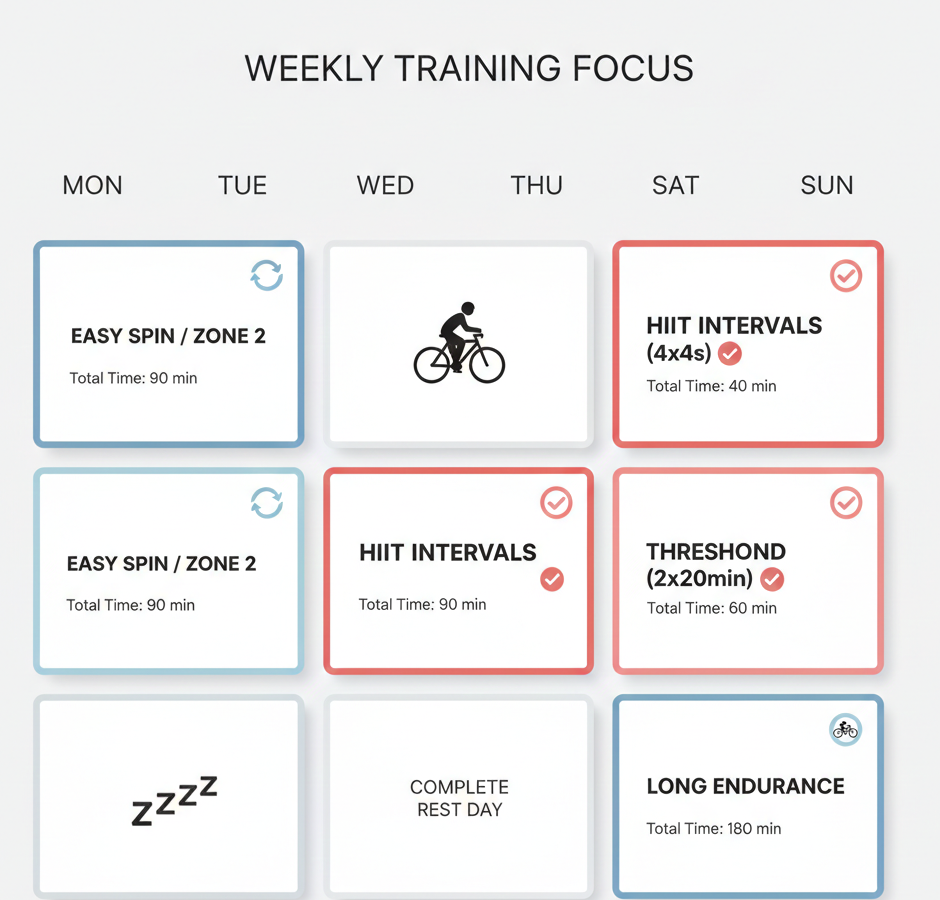
Your Solution: 1-2 HIIT sessions per week. Full stop. Remember from our previous post? HIIT should only be 10-20% of your total training volume—the rest needs to be easier stuff or you’ll burn out faster than a cheap candle, if you are really on a busy schedule , here is how you can do HIIT Cycling especially for Busy Cyclists.
Your weekly schedule looks like:
Weeks 1-4:
- 1 HIIT session (Tuesday or Wednesday usually works best—you’re fresh from the weekend)
- 2-3 easy Zone 2 rides (that’s 45-60 minutes where you can hold an actual conversation)
- 2 rest days (yes, rest days COUNT as training)
Weeks 5 and beyond:
- 2 HIIT sessions if—and only if—you’re recovering well
- Keep 48-72 hours between HIIT workouts (your muscles need time to rebuild)
- Still do 2-3 easy Zone 2 rides
- 1-2 rest days minimum
Critical rule nobody talks about: If you’re genuinely sore, mentally exhausted, or straight-up dreading the workout—take another rest day. Your body’s smarter than any training plan.
3. Use the Talk Test for HIIT Cycling Intensity (Forget All That FTP and Heart Rate Nonsense… Sort Of)
The Problem: Every article throws around FTP, power meters, heart rate zones like everyone’s got a spare $1,000 lying around for equipment. You don’t own fancy gear and honestly? You don’t even know what your numbers are supposed to be.
Your Solution: The talk test is completely free and surprisingly accurate—like, science has actually validated this approach.
During those 4-minute work intervals:
- You should only be able to speak 3-5 words at a time
- Something like “This is… pretty hard… right now…”
- If you’re chatting in full sentences, push harder
- If you literally cannot speak at all—ease off a bit (you’re going too hard)
During 4-minute recovery periods:
- You should be able to speak full sentences within 2-3 minutes
- Like “I’m starting to feel better now, that was tough”
Bonus tip if you’ve got a heart rate monitor: Aim for 90-95% max heart rate during work intervals. Don’t know your max? Just subtract your age from 220—it’s not perfect but it’s close enough for government work.
First session approach (this matters): Start conservative. Pick an intensity where you think you could actually last 6-7 minutes if you had to. Since you’re only doing 4 minutes, you’ve got buffer room built in. Then adjust your next session based on how you felt—it’s more art than science at first.
4. Start With What You Already Have (Equipment Literally Doesn’t Matter Yet)
The Problem: Social media’s got you convinced you need a $3,000 smart trainer, a power meter, subscription software, maybe a personal coach, possibly a sports scientist on retainer… before you can even START HIIT cycling. It’s overwhelming and honestly—kind of gatekeepy? Certainly with the fast rise of AI Tech and Smart Trainers.
Your Solution: You need exactly 3 things and I mean exactly:
- A bike (literally any bike—road bike, mountain bike, that stationary one gathering dust in your garage)
- A timer (your phone already does this perfectly fine)
- A safe place to ride (quiet road, bike path, or even a basic trainer)
That’s the whole list.
Progressive equipment path if you’re curious:
Start right here, right now:
- Any functioning bike that doesn’t fall apart
- Smartphone timer app (free!)
- Flat route with minimal traffic stops
Add these later if you want (not if you need):
- Heart rate monitor costs $30-60 tops
- Basic bike computer for tracking cadence
- Indoor trainer runs $200-500 if you hate weather
Optional advanced stuff for way down the road:
- Smart trainer with all the bells and whistles
- Power meter (genuinely helpful but expensive)
- Training apps like Zwift or TrainerRoad
Here’s the thing—we’ve personally seen riders make absolutely massive fitness gains with nothing but a bike and a stopwatch. Don’t let equipment become your excuse for not starting. (I know someone who got ridiculously fit using a beach cruiser and a $10 digital watch, so…)
Your First HIIT Cycling Session (Literally Just Copy This)
Total time: 60 minutes
- Minutes 0-15: Warm up easy, gradually ramp up the intensity (don’t start cold)
- Minutes 15-19: First 4-minute interval—hard effort, only 3-5 word sentences possible
- Minutes 19-23: Recovery spin at easy conversation pace
- Minutes 23-27: Second 4-minute interval (probably feels harder than the first)
- Minutes 27-31: Recovery spin
- Minutes 31-35: Third 4-minute interval
- Minutes 35-39: Recovery spin (hang in there)
- Minutes 39-43: Fourth 4-minute interval—or skip it if you’re absolutely cooked
- Minutes 43-53: Cool down nice and easy
- Minutes 53-60: Stretch it out (quads, hamstrings, hip flexors especially)
Week 1 modification because you’re new: Only complete 3 of the 4 intervals. Build up to all 4 by week 3. There’s zero shame in this—everyone starts somewhere.
As the days pass by , and you begin to master a little bit this Plan, you can now implement HIIT Cycling for Weight Loss.
Real Results: Axel’s Experience (This Guy Gets It)
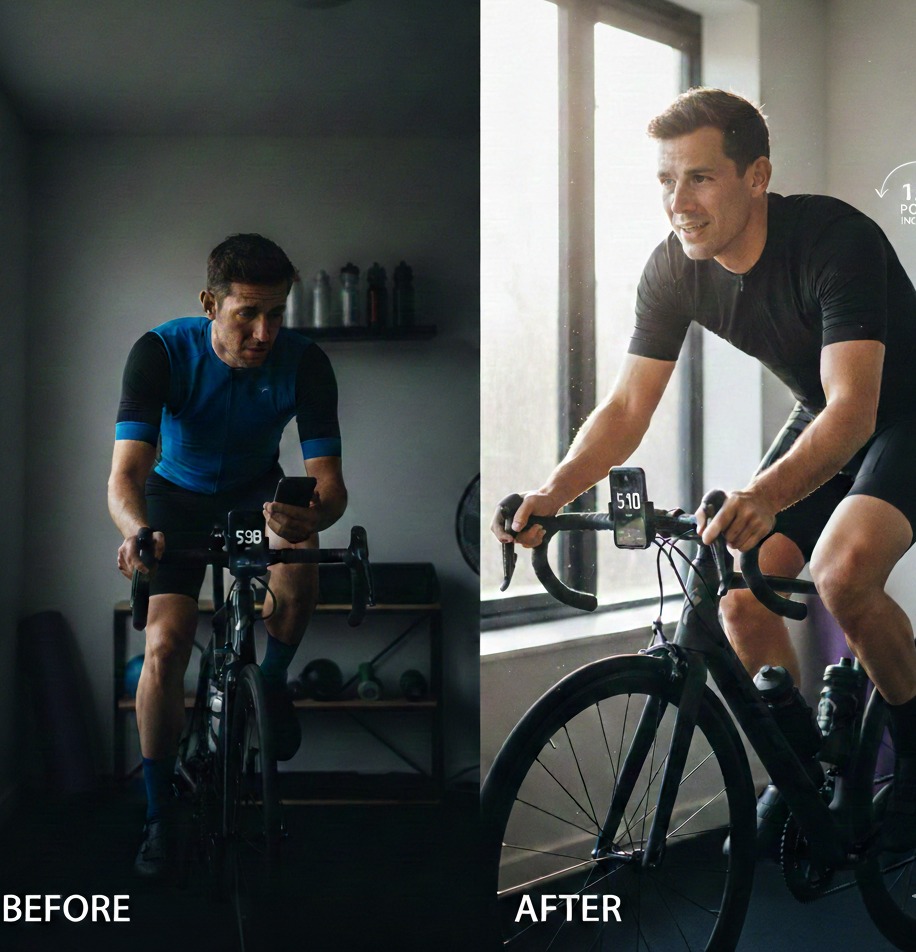
“I literally wasted three months just… reading about HIIT cycling before Pedalynx’s plan finally gave me the clarity I needed. Started with those 4×4 intervals once per week—couldn’t even finish all four intervals the first time, felt pretty defeated honestly. But six weeks later? I’m crushing all the intervals consistently and just set a PR on my local climb. The simplicity of the plan removed every single excuse I’d been making.”
Stop Researching Already, Just Start Riding
HIIT cycling for beginners isn’t some complicated puzzle—it really isn’t:
- One format: Those 4×4 intervals we talked about
- Clear frequency: 1-2 sessions weekly (not 5, not 7)
- Simple intensity check: That talk test thing
- Minimal gear needed: Bike plus timer equals you’re ready
The confusion ends right now—like, literally right now. Open your calendar and put one session in for this week. Use the exact structure we just gave you above. Then adjust as you start learning what your body can handle. and Avoid These HIIT Cycling Mistakes that we talked about on one of our recent posts.
Every single elite cyclist you’ve ever heard of started exactly where you are right now—uncertain, maybe a little scared, but willing to begin anyway.
The breakthrough happens the moment you stop researching endlessly and actually start pedaling.
Summary: Your HIIT Cycling Quick Reference (Screenshot This)
The 4-Step Plan:
- Format: Stick to 4×4 minute intervals at 90-95% max heart rate (use that talk test: 3-5 words only during hard parts)
- Frequency: 1-2 HIIT sessions per week with 48-72 hours minimum between sessions
- Intensity: Talk test is your friend here—short choppy sentences during work intervals, full sentences during recovery
- Equipment: Bike plus timer plus safe route equals literally all you need to start today
Weekly Structure that actually works:
- 1-2 HIIT sessions (Tuesday and/or Wednesday typically work well for most people)
- 2-3 easy Zone 2 rides at 45-60 minutes where you can talk normally
- 15-minute warm-up and 10-minute cool-down for every single HIIT session—non-negotiable
- Rest days are absolutely non-negotiable for actual adaptation to happen
Progressive Approach (be patient with yourself):
- Week 1-2: Just complete 3 intervals
- Week 3-4: Build up to 4 intervals
- Week 5+: Maybe add that second weekly session if you’re recovering well
For those advanced formats we mentioned earlier—like 30/30 VO₂ max intervals at 120-130% FTP, the 40/20 lactate clearance work at 110-120% FTP, and those brutal Tabata sprints—check our previous post on effective HIIT workouts for cyclists.
Ready for the complete periodization breakdown? Visit Pedalynx’s Cycling Training guide for comprehensive plans and recovery strategies that’ll take you to the next level.







[…] the truth nobody wants to hear: HIIT cycling for weight loss absolutely works—like, it’s genuinely one of the best tools out there—but […]
[…] The fitness industry doesn’t help matters. HIIT sells. “Ride easy for 3 hours” doesn’t exactly make for viral Instagram content, does it? Social media rewards suffering faces and dramatic post-ride collapse photos—not science. Here is how you can actually start HIIT Cycling. […]