The Best Fluffy Pancakes recipe you will fall in love with. Full of tips and tricks to help you make the best pancakes.


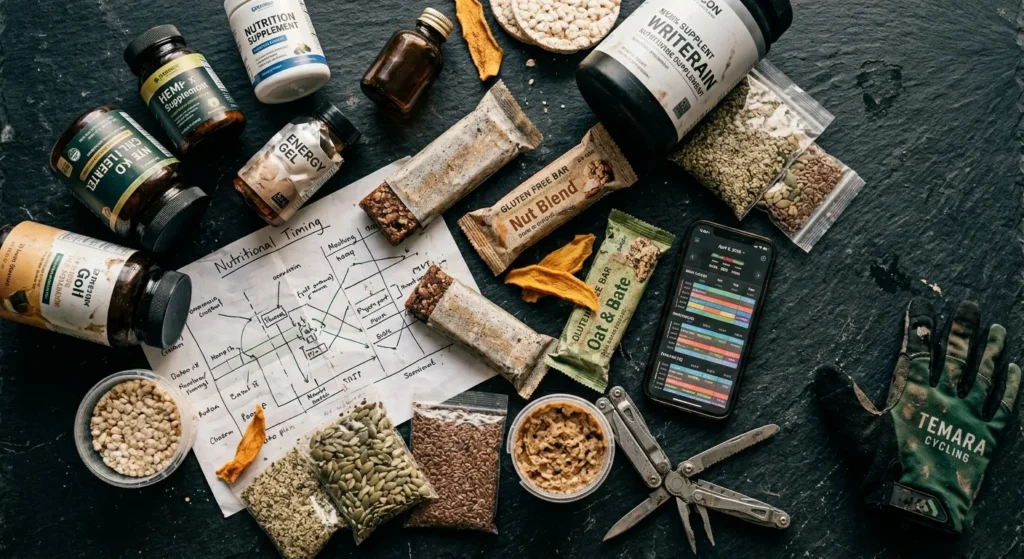
Picture this. It’s not even 6am yet — the sky outside is doing that weird purple-grey thing it does before it decides to commit to morning — and you’re standing in your kitchen, fully kitted up, cleats clicking on the tile floor every time you shift your weight. In front of you: a cutting board, four different certified gluten-free products, a tub of something called “performance seed blend,” and approximately zero mental clarity.
You were supposed to leave 20 minutes ago.
I’ve been there. A lot of gluten-free cyclists have, actually — this specific flavor of overwhelm that feels almost embarrassing because you’re supposed to have it figured out by now. The thing is, the nutrition industry — God bless it — has a vested interest in making gluten-free eating feel complicated. More complexity means more products. More products means more revenue. And you’re standing in your kitchen at 5:58am paying the price for someone else’s business model.
Here’s what I wish someone had told me earlier: the cyclists performing best on gluten-free diets aren’t doing more. They’re doing dramatically, almost aggressively, less.
That’s the minimalist’s edge. Sit with that for a second.
Why Overcomplicating Gluten Free Cycling Is Wrecking Your Rides
There’s a concept in behavioral psychology — decision fatigue — that doesn’t get nearly enough airtime in cycling nutrition circles. The research is pretty unambiguous: after roughly 20 to 35 meaningful decisions in a single morning, the quality of subsequent choices deteriorates. Not slightly. Significantly.
So if you’re burning cognitive fuel on elaborate pre-ride rituals, cross-contamination checklists, and rotating ingredient combinations before you’ve even touched your bike — you’re arriving at every ride already running at a deficit. Mentally. Which bleeds into physically faster than most people realize.
Minimalism isn’t the lazy option, I want to be clear about that. It’s actually the harder discipline — because subtraction requires more confidence than addition. Anyone can add another supplement, another “optimized” food, another protocol. Stripping back to only what works? That takes nerve.
The gluten-free cyclists who thrive across full seasons — not just peak for one race and collapse — share this one quiet, almost boring habit. They’ve cut everything that doesn’t directly move performance forward. No experimentation for its own sake. No complexity theater. Just a small, verified, repeatable set of foods executed with precision.
Simple systems, done perfectly, beat complicated ones done adequately. Always.
3 Minimalist Gluten Free Cycling Principles That Simplify Everything
Principle 1: Limit Your Gluten Free Cycling Foods to 3 Per Fuel Window
The gluten-free cycling recipes post — which honestly should be bookmarked on every gluten-sensitive rider’s phone — breaks fueling into four distinct windows. Most people read it and immediately try to rotate fifteen different options across each one.
That’s the trap. Pick 3 foods per window. Maximum. Know them cold. Trust them completely.
Your pre-ride window — and we’re talking 60 to 90 minutes before you clip in, not five minutes before like some kind of chaos agent — needs only this:
- 1 medium sweet potato (~27g carbs, naturally gluten-free, zero label anxiety, requires basically no thought)
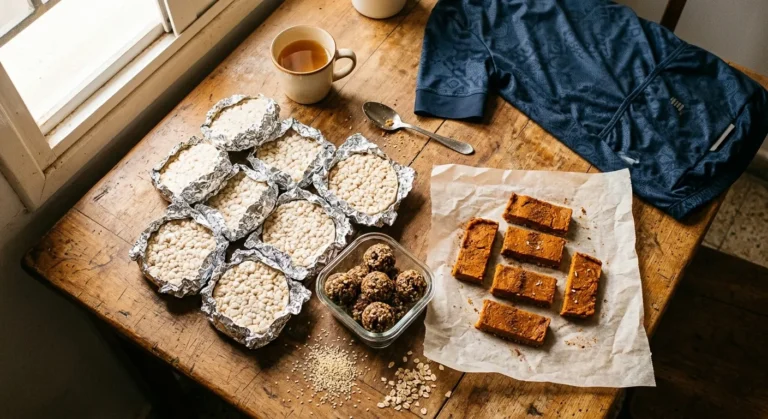
- 2 rice cakes with jam (~30g carbs — there’s a genuinely fascinating reason rice dominates pro cycling fuel and it goes deeper than you’d expect)
- 1 banana (~25g carbs, costs less than a gel, needs no preparation, your grandmother could pack this)
Three items. That’s your entire pre-ride menu — not a rotating seasonal selection, not a mood-dependent matrix. Three. You wake up, you execute, you leave on time for once.
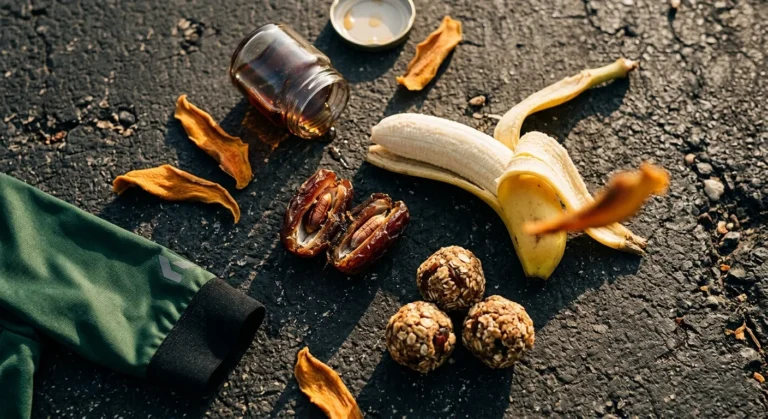
On the bike? The 3-window snack system covers the timing mechanics better than I can in a paragraph — apply the same minimalist filter to it. 2 Medjool dates every 45 minutes (~36g carbs per pair). Done. That’s it. Not exciting. Incredibly effective.
Principle 2: Only Eat Gluten Free Cycling Foods You Can Verify Instantly
Here’s a rule that sounds almost too simple — and that’s exactly why it works.
If a food has more than 5 ingredients listed on its packaging, it has no place in your riding nutrition. Not because every multi-ingredient product contains gluten (though cross-contamination risk climbs sharply with complexity). But because stability — gut stability, specifically — comes from simplicity. A product with 14 ingredients is 14 potential variables behaving differently depending on heat, hydration, and effort level.
One-ingredient foods don’t have that problem:
- Sweet potato — 1 ingredient
- Banana — 1 ingredient
- Medjool dates — 1 ingredient
- White rice — 1 ingredient
- Quinoa — 1 ingredient
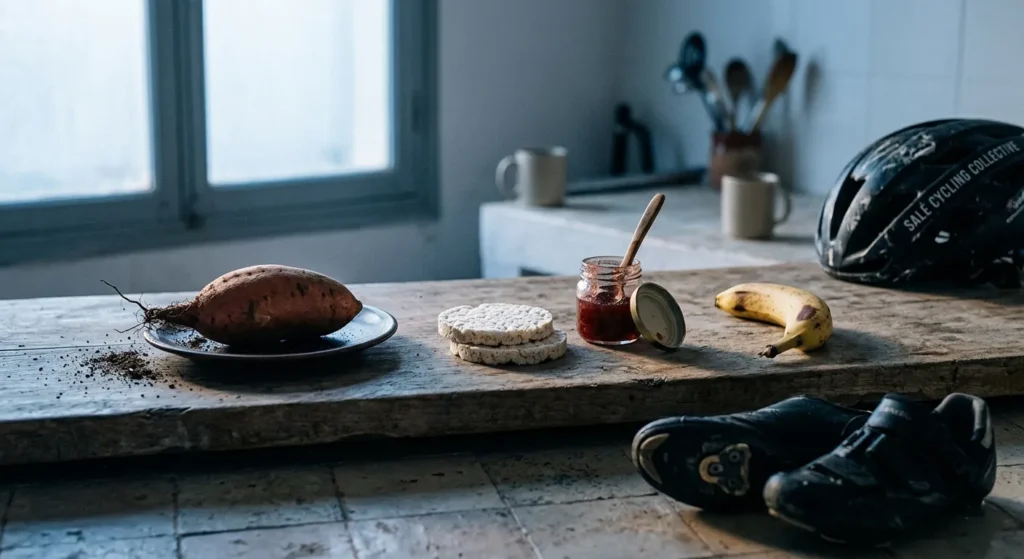
These are your anchors — everything else is a guest that needs to justify its presence. This one filter alone eliminates the vast majority of cross-contamination risk. It also — and this part matters — eliminates the ambient anxiety that follows gluten-sensitive athletes through every meal. Building real cycling stamina across a season demands consistency. Consistency demands simplicity you can actually sustain when life gets messy.
Which it does. Constantly.
Principle 3: Gut Training Is a Gluten Free Cycling Strategy Too
This one doesn’t get talked about enough. Almost never, actually — and I think that’s a genuine gap in most gluten free cycling tips you’ll find online.
Your gut adapts. It’s not static, it’s not fixed — it’s a system that responds to training just like your cardiovascular system does, just on a longer timeline and with less obvious feedback. Cyclists who eat chaotically — rotating foods, constantly experimenting, pivoting to whatever new “optimized” thing appeared in their feed this week — develop chaotic gut responses. That’s not a coincidence. That’s cause and effect.
Riders who commit to the same small set of verified gluten-free foods, timed the same way, for extended periods? Their digestion becomes almost boringly predictable. No cramping at kilometer 70. No mysterious bonk triggered by something that “should have been fine.”
Think of Zone 2 training — low intensity, high repetition, adaptations that build quietly over months and then suddenly feel enormous. Gut training is identical in principle. Low variability. High repetition. 8 to 12 weeks minimum before you assess. Let your digestive system catch up to your ambition before you change the variables again.
Real Gluten Free Cyclists Who Prove Minimalism Works
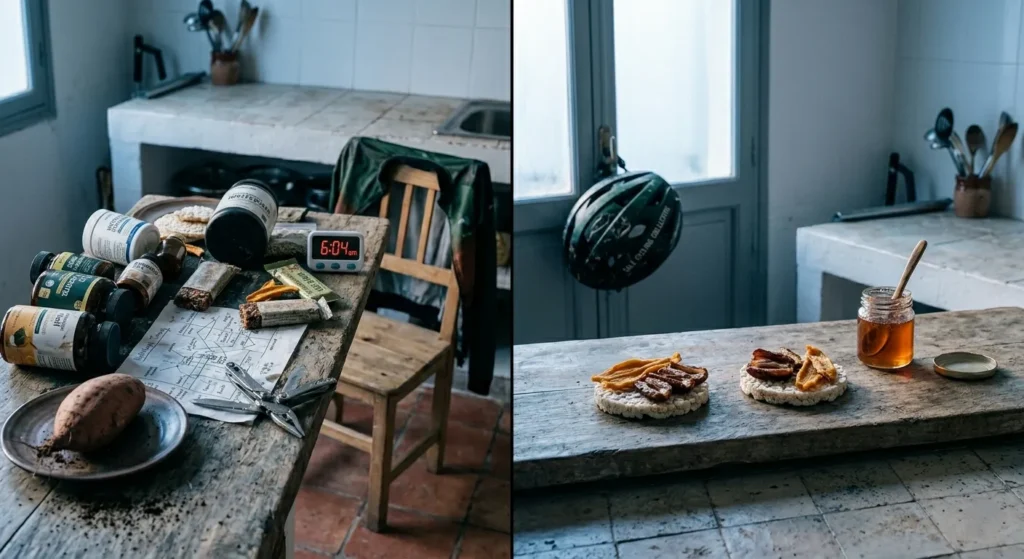
Two riders. Same sensitivity. Very different approaches — and honestly, the contrast is almost uncomfortable to look at directly.
Rider A rotates through 11 different gluten-free pre-ride combinations depending on what’s in the fridge, what mood they’re in, what recipe just popped up on Instagram. Performance swings wildly. Gut flares happen without obvious cause. They spend significant mental energy troubleshooting after every difficult ride — was it the new bar? The sauce on the rice? The stress? Who knows.
Rider B eats the same 3-item pre-ride combination for 10 consecutive weeks. Sweet potato. Rice cakes. Banana. Religiously, almost tediously consistent. Within 3 weeks — gut adapted, zero bloating, zero mid-ride distress. By week 8 — average ride duration extended by 22 minutes without any additional training volume added.
The only variable that changed was the elimination of variables. That’s worth sitting with.
Your Gluten Free Cycling Audit: The Challenge That Starts Today
Not this weekend. Not after your next race. Today — this requires maybe 15 minutes and zero new purchases.
Open your kitchen, your nutrition notes, your memory — whatever you’ve got:
- List every food you’ve consumed pre-ride in the last 30 days
- Flag anything with more than 5 ingredients on the label, no exceptions
- Identify your 3 best-performing pre-ride combinations — the days your legs felt genuinely, inexplicably good
- Cut everything else for the next 8 weeks and don’t negotiate with yourself about it
That’s the audit. No spreadsheet, no app, no new protocol to learn. Just ruthless subtraction applied to what’s already there.
Gluten-free cycling doesn’t have to feel like a second job. It has to feel like second nature — and the only path from one to the other runs straight through simplicity.
Audit your plate. Cut the noise. Ride like you mean it.