The Best Fluffy Pancakes recipe you will fall in love with. Full of tips and tricks to help you make the best pancakes.


Let’s be honest for a second. Most cycling nutrition advice is either blindingly obvious or buried under so much jargon that by the time you’ve parsed it, you’ve already missed your fueling window and you’re ten kilometers into a slow, quiet bonk. Nobody talks about that part — the slow creep of it, the way your legs start feeling like wet concrete before your brain even registers something’s wrong.
Fruit for a bike ride fixes a surprising amount of this. Not all of it. But more than people give it credit for.
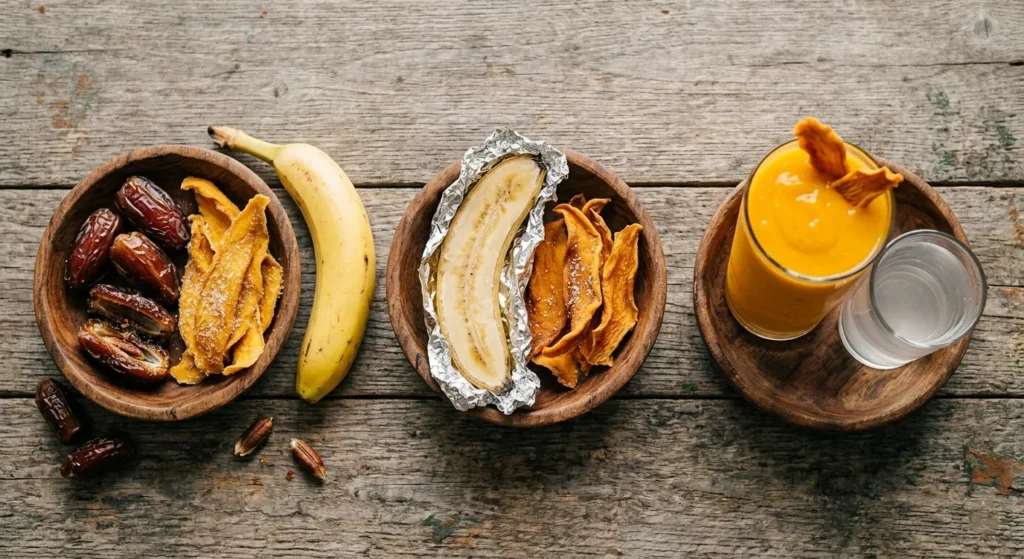
The reason we keep coming back to it — and we’ve tested a lot of things across this site — is that fruit is one of the only foods that fits neatly into every phase of a long ride without demanding much from your gut or your brain. And that second part matters more than most riders think. Decision fatigue is real. Cognitive overhead before a 4-hour ride is a tax you pay with your legs, not your head.
Here are 5 strategies that cut the noise and make fruit work harder for you. No fluff. Let’s go.
Gut Check Diagnostic
Gut Check Diagnostic
3 questions. We’ll diagnose your nutrition flaw and give you the exact strategy to fix it.
Question 01 of 03
Where do you usually crash on a long ride?
Option A
Within the first 60–90 minutes.
Option B
Deep into the ride — the last hour.
Option C
My legs just explode suddenly without warning.
Please select an answer.
Question 02 of 03
What does your current jersey pocket look like?
Option A
Packed with energy bars and gels — lots of ingredients.
Option B
Whole foods like bananas or dried fruit.
Option C
Usually empty — I forget to eat.
Please select an answer.
Question 03 of 03
How is your stomach during high-intensity efforts?
Option A
Bloated, gurgling, or I get “gut rot.”
Option B
Totally fine — no issues at all.
Option C
I feel nauseous if I eat too much sugar.
Please select an answer.
Please answer all three questions first.
Pedalynx · Nutrition Report
Gut Check Result
—
Your Nutrition Persona
—
The Diagnosis
—
Your Exact Strategy
—
✓ Link Copied!
Take a screenshot and share it on your Instagram story!
Follow us @pedalynx.cycling
Pedalynx Gut Check · For educational purposes only
Strategy 1: Stop Treating Fruit Like One Big Category — It Isn’t
This is probably the mistake we see most. Rider grabs a banana. Eats it whenever. Wonders why they’re still bonking at kilometer 80. The fruit isn’t the problem. The timing is.
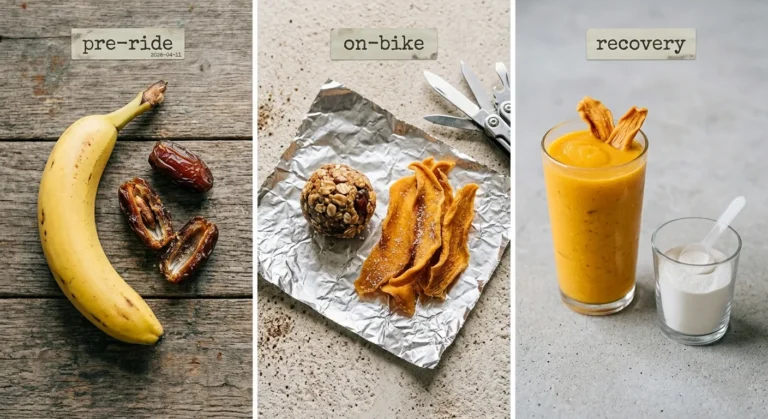
There are 3 completely distinct windows on any ride over 75 minutes, and we mapped them out in detail in our best vegan cycling snacks guide. Each one has a different job. Each one needs a different kind of fuel.
Here’s how fruit maps across them:
- Pre-ride (60–90 minutes before you clip in): 1 banana (~25g carbs) or 2 Medjool dates (~36g carbs). Soft, fast-digesting, low fiber — your gut barely knows it happened.
- On the bike (every 45 minutes, no exceptions): Dried mango strips (~35g carbs per 40g), half a banana in foil, date-oat balls (~25g each). Simple enough to eat one-handed at pace.
- Recovery (within 30 minutes of stopping — yes, really): 1 cup frozen mango, coconut water, and a scoop of plant protein. Hits the 3:1 carb-to-protein ratio your muscles are screaming for.
Window-match your fruit and you’ve already leapfrogged maybe 70% of riders on your next group ride. It’s that straightforward — and that underused.
Strategy 2: The Glucose-Fructose Thing Is Not Marketing — It’s Actually Real
Okay so this one surprised us too, if we’re being completely honest.
Dates and bananas — eaten together, or in close rotation — deliver both glucose AND fructose at the same time. Two different intestinal transport systems activate simultaneously. The result? Your gut can process up to 90 grams of carbohydrates per hour, versus just 60g from single-sugar sources. That gap — 30 extra grams per hour — compounds fast on long efforts.
Above 65% VO2 max (which is basically all of your real training, let’s be real) your body is burning carbohydrate almost exclusively. Fat metabolism is too slow — it’s like trying to charge your phone off a solar panel the size of a postage stamp during a cloudy Tuesday. Theoretically possible. Practically useless when you need watts now.
Practical take: 2 Medjool dates and half a banana in your jersey pocket. ~61g carbs, dual-transport delivery, and nothing to unwrap while you’re trying not to get dropped. That’s the play.
Strategy 3: The 5-Ingredient Rule — Apply It Without Mercy
We first laid this out in our gluten-free cycling tips post, and it’s one of those principles that sounds almost too simple until you actually audit your snack drawer and realize half of what’s in there has 14 ingredients and an optimistic label about “clean energy.”
If it has more than 5 ingredients, it doesn’t go in the jersey pocket. Full stop.
Real fruit doesn’t have this problem:
- Banana — 1 ingredient. ~25g carbs. Peel and go.
- Medjool dates — 1 ingredient. ~18g carbs each. Ancient fuel, genuinely.
- Dried mango (unsweetened) — 1 ingredient. ~35g carbs per 40g serving.
- Raisins — 1 ingredient. ~22g carbs per 30g. Underrated. Seriously.
Multi-ingredient “fruit products” — the bars, the gel-hybrids, the blends with added oat syrup and sunflower lecithin — introduce variables your gut doesn’t need when it’s already under load. Every extra ingredient is a new unknown. Heat, dehydration, effort level — all of them change how those ingredients behave. Simplicity isn’t settling. Simplicity is the strategy.
Strategy 4: Your Pre-Ride Window Should Cost You Zero Mental Energy
Here’s something nobody frames this way but should: the decisions you make before a ride are not free. They cost something. Cognitive resources — whatever you want to call them — deplete across the morning, and after roughly 20–35 meaningful choices, the quality of everything that follows drops. Not a little. Measurably.
So if you’re standing in your kitchen at 6am cross-referencing three different fruit options while your kit is on and your cleats are clicking on the tile — you’re already losing.
We cover the full pre-ride nutrition breakdown in our what to eat before a long bike ride guide, but the short version for fruit specifically is this:
Pick one. Eat it. Leave.
Our standing recommendation — 1 banana, 60–90 minutes before you ride. If you want a backup option: 2 dates. If you want a third, rice cakes with jam (not a fruit but it’s in the same spirit — dead simple, absurdly effective). That’s the list. Not a rotating seasonal menu. Those three things, executed consistently, until your gut has adapted so well that fueling feels automatic.
“Honestly I thought my whole diet was the issue — I’d gone plant-based and just assumed that was why I kept struggling past the 2-hour mark. Took me embarrassingly long to realize it was the timing, not the food. Locked in the banana before, dates every 45 minutes on the bike, mango smoothie straight after — and within about three weeks my rides just felt… different. Less desperate, I guess. More in control.” — Linda, Pedalynx Community
Strategy 5: Gut Training Is a Real Strategy and You’re Probably Ignoring It
This is the one that doesn’t show up in most fruit-for-cycling content. Which is wild, because it might be the most high-leverage of the lot.
Your digestive system adapts. It’s not a fixed system — it’s trainable, the same way your cardiovascular system is, just slower and with less obvious feedback. Cyclists who rotate randomly through different fruits and snacks each week keep their gut in a state of constant recalibration. Cyclists who lock in 3 consistent fruit-based options, timed the same way, for 8–12 weeks straight? Their digestion becomes almost boring in how reliable it is. No cramping at kilometer 70. No mystery bonk from something that “should’ve been fine.”
It’s the Zone 2 principle applied to your stomach — low variability, high repetition, adaptations that compound. Our gluten-free cycling recipes are a good starting point for finding repeatable combinations worth locking in.
The protocol is simple — almost aggressively so:
- Choose 3 fruit options across your windows. Done, that’s the menu.
- Run them for 8 weeks without deviation. Not 3 rides. Eight weeks.
- Assess only after that window — not after one weird Tuesday where everything felt off anyway.
Boring? Maybe. Effective? Almost embarrassingly so.
The Quick-Reference Numbers
| Window | What to Use | Carbs | When |
|---|---|---|---|
| Pre-ride | 1 banana or 2 dates | ~25–36g | 60–90 min out |
| On-bike | Dates + dried mango | ~50–60g/hr | Every 45 min |
| Recovery | Mango smoothie + protein | ~40g | Within 30 min |
This Ride. Not Next Month.
Here’s the thing about fruit for a bike ride — it doesn’t require a shopping haul, a new protocol, or a spreadsheet. It requires a decision. One ride, three windows, executed cleanly. Pre-load 60–90 minutes out. Fuel every 45 minutes on the bike, timer if you have to. Hit recovery before you even think about the shower.
The riders making real jumps in performance aren’t discovering exotic superfoods. They built a system. They respected the windows. And mostly, they stopped treating nutrition like a vague intention and started treating it like the third pillar of training it actually is.
The fruit’s already there.
Lock in the windows. Trust the system. Go ride.