
The Best Fluffy Pancakes recipe you will fall in love with. Full of tips and tricks to help you make the best pancakes.


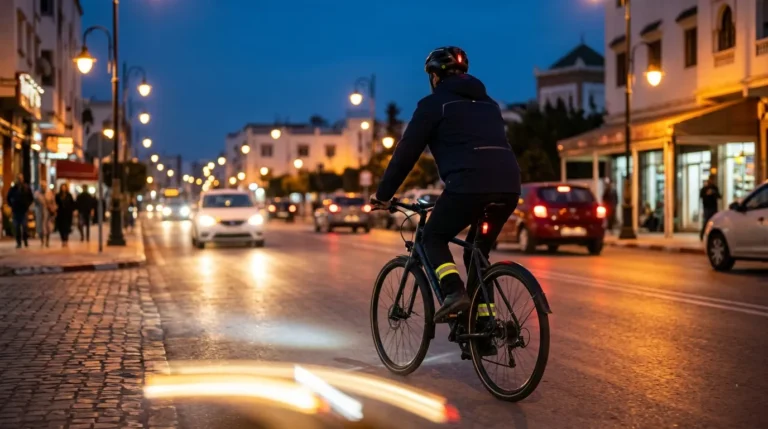
Most cyclists get night safety completely wrong. They buy a cheap blinky light, slap it on the back of their bike, and call it done. Then they wonder why drivers still don’t notice them, why close calls keep happening, and why riding after dark feels like a calculated risk rather than a normal part of their commute.
Here’s the thing: visibility is not a light problem. It’s a system problem. And until you treat it like one, you’re plugging a hole in a sinking boat with one finger.
We’ve covered how to switch from car to bike commuting and what apps will optimize your route and predict your conditions — but none of that matters if you don’t make it home safely after dark. So let’s talk about what actually works, why most cyclists never figure it out, and how you can implement it tonight.
The Secret: Systematic Visibility, Not Just Equipment
Safe cycling at night isn’t about having lights. It’s about being seen from every angle, at every moment, by every road user — including pedestrians stepping off curbs and drivers pulling out of side streets. That’s the secret most cycling guides skip over. It requires a layered approach across 4 key areas, and missing even one of them creates a dangerous gap.
1. The Front Light Trap — And Why Output Actually Matters
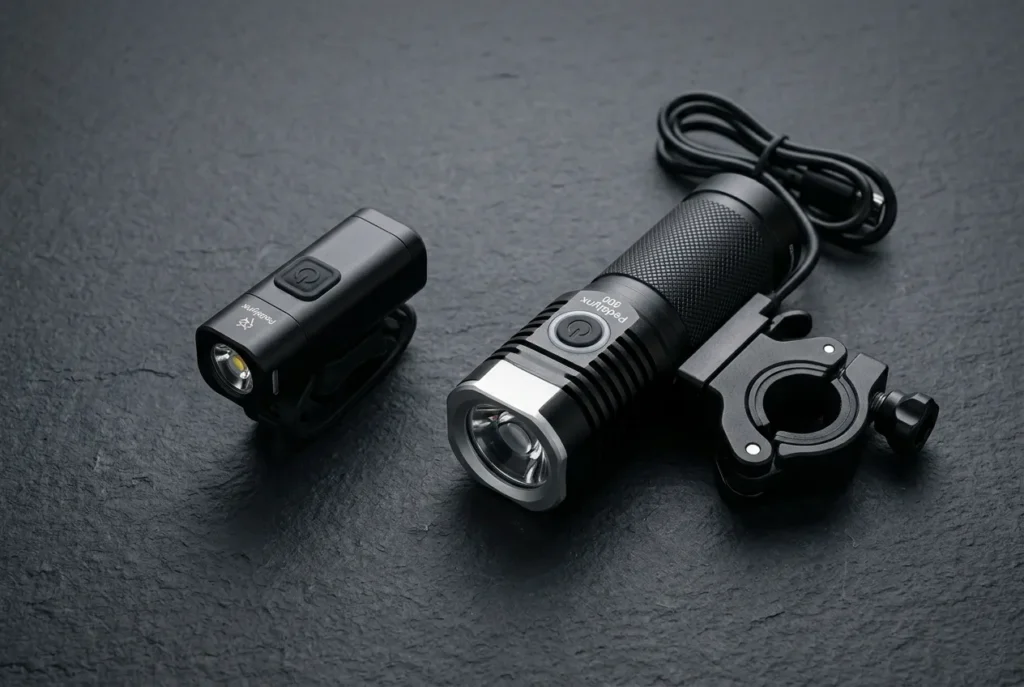
Ask most cyclists what lumen count their front light runs and they’ll shrug. That’s the problem.
A 200-lumen light is invisible in urban environments with street lighting. It registers as background noise to a driver’s brain. You need at minimum 400–600 lumens for urban riding, and 800+ lumens if your route includes any unlit stretches. This isn’t marketing — it’s how human contrast detection works under ambient light conditions.
The other overlooked factor: flash mode vs. steady beam. Flash gets attention at distance. Steady beam lets drivers judge your speed and trajectory as they approach. Use both simultaneously if your light supports it — or run two separate front lights.
What to look for:
- Runtime of at least 3 hours on your preferred mode (check this, not the max-brightness runtime)
- A wide beam angle — narrow spotlights miss peripheral vision entirely
- USB-C charging so you’re not carrying proprietary cables in your commuter backpack
2. The Rear Light Mistake Almost Everyone Makes
Your rear light is not decoration. It is your primary defense against the most dangerous threat in urban night cycling: being rear-ended.
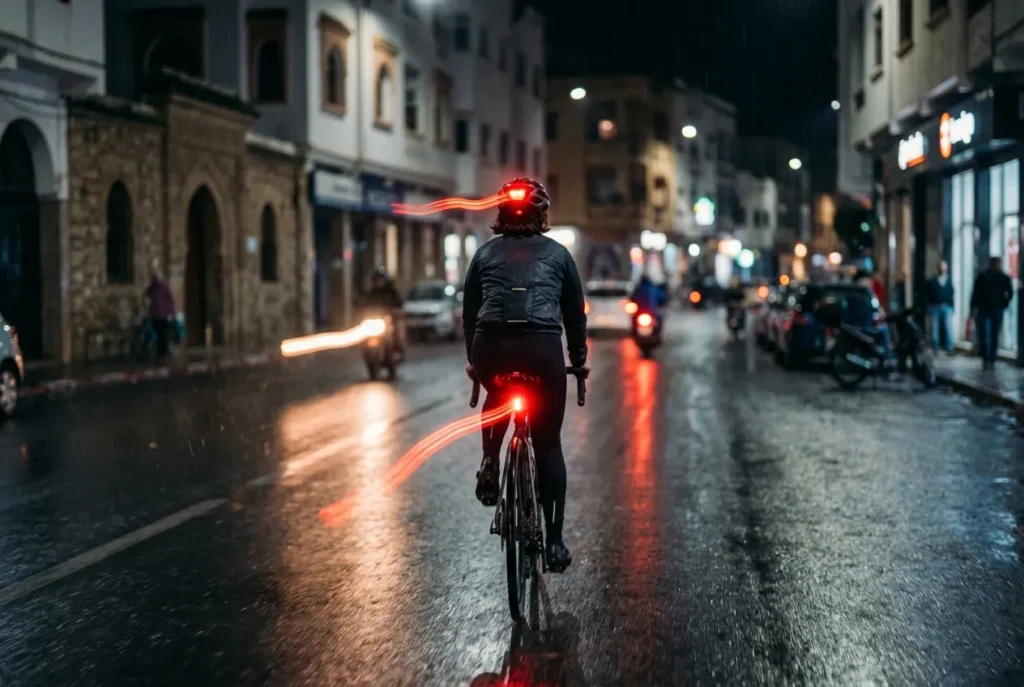
The mistake? Mounting it on the seatpost only. At low seatpost height, your light gets blocked by cargo, bags, or even your own body position when leaning forward. The fix is a helmet-mounted rear light in addition to your seatpost unit. Studies have consistently shown that moving lights — i.e., lights that move with your body — are registered significantly faster by drivers than static ones.
Run at minimum 2 rear lights:
- 1 on the seatpost — minimum 50 lumens in flash mode
- 1 on your helmet — even a small 30-lumen unit here makes a disproportionate difference
3. Clothing and Reflectivity — The Part Nobody Talks About
Lights tell people you’re there. Reflectivity tells people exactly where you are and how fast you’re moving.
Reflective material works by bouncing car headlights directly back to the driver — it’s bright at the exact angle that matters most. But here’s what’s overlooked: the position of reflective material matters more than the quantity. Reflectors on moving joints — ankles, knees, wrists — create a biological motion signature that the human brain recognizes instantly as a person on a bike. Static reflectors on a bag or jacket don’t create that effect.
We covered how a smart capsule wardrobe for commuting keeps your daily decisions minimal. Apply the same logic here: choose 2–3 base pieces with built-in reflectivity rather than constantly adding and removing accessories.
Specifically:
- Reflective ankle bands — non-negotiable, costs under €10, works on any trousers
- A jacket with reflective piping on the arms and shoulders — not just a back strip
- A reflective backpack cover — your waterproof commuter backpack likely has a slot for one
4. Route Intelligence After Dark — Your Apps Are Not Equal
This is where the system thinking really pays off.
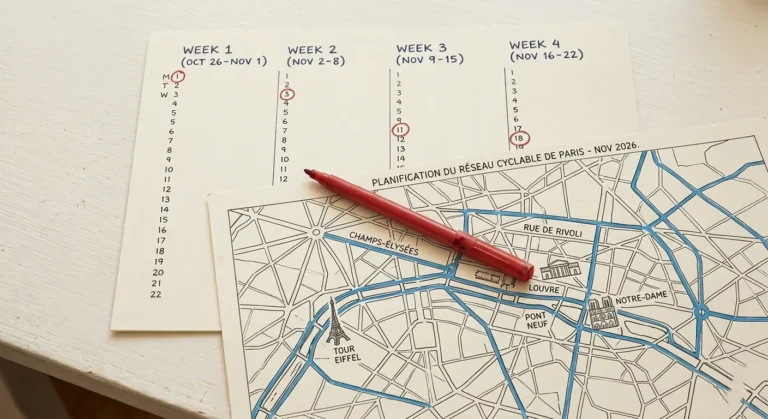
Your daytime commute route and your nighttime commute route should not be the same. Roads that are perfectly manageable at 8am — with full visibility, active bike lanes, and predictable traffic — become genuinely dangerous at 9pm when drivers are less attentive and side streets have zero ambient light.
Komoot lets you pre-plan routes with surface type and traffic exposure built in. Use it specifically to build a dedicated night route — prioritizing lit roads, protected infrastructure, and minimal crossing points. Do this once. Save it. Switch to it automatically when riding after 7pm.
Also: wind conditions affect your reaction time and bike handling. VeloVane gives you route-specific wind prediction so you know when crosswinds are going to push you toward traffic — a risk that’s exponentially higher at night when drivers have less time to react to unexpected lateral movement.
5. The Behavioral Layer — What Gear Can’t Fix
“I had all the lights. I had the jacket. I still got clipped by a car pulling out of a side street. It wasn’t until I changed how I position myself on the road that the close calls stopped.” — Oxlade, daily urban commuter
Oxlade’s experience is common, and it points to something no piece of equipment solves: lane positioning. At night, ride further from parked cars than you would in daytime — not because dooring is more likely, but because your lateral position gives drivers more time to compute your trajectory. A 30–40cm shift toward the center of the lane sounds aggressive. It’s not. It’s the single fastest behavioral change you can make for safe cycling at night.
Also:
- Reduce your speed by 15–20% on unfamiliar routes after dark — your reaction distance is the same, but hazard visibility is halved
- Make eye contact at every junction before proceeding — don’t assume being seen
- Announce your presence on shared paths with a bell at least 5 meters before approaching pedestrians
Put It Together — Before Your Next Night Ride
The secret to safe cycling at night isn’t one thing. It’s a system — lights that work together, clothing that creates a motion signature, routes planned for darkness, and positioning that gives drivers the processing time they need.
You don’t need to overhaul everything tonight. But you do need to start somewhere.
Pick one gap from this list and close it today:
- Upgrade your front light to 400+ lumens minimum
- Add a second rear light at helmet height
- Install reflective ankle bands
- Build a dedicated night route in Komoot
- Shift your lane position 30–40cm toward center
The cyclists who own the night aren’t reckless — they’re systematic. They’ve removed the gaps that leave things to chance. Your city doesn’t get safer after dark. But you can.
Start with one change. Make it tonight.
Explore more from our commuter cycling series: Best Apps for Bike Commuting · Commuter Cycling Clothing · Best Waterproof Commuter Backpacks · Switch from Car to Bike



[…] went deep on this in our night cycling safety guide, and the conclusion is uncomfortable for anyone who thought they’d already sorted this: most […]