The Best Fluffy Pancakes recipe you will fall in love with. Full of tips and tricks to help you make the best pancakes.


Here’s what nobody tells you—and honestly, it took me years to figure this out myself: your glutes aren’t firing during the pedal stroke. Not really, anyway. You think they are because your quads are on fire, your breathing sounds like a freight train, and everything hurts in that good way. But here’s the kicker—EMG studies (the kind with electrodes stuck all over your legs) show that 70-80% of everyday cyclists have basically dormant glutes when they ride.
Just… dormant. Like they’re on vacation while your quads do all the work.
This isn’t some minor inefficiency thing either. It’s the ceiling you keep hitting and can’t figure out why—you train harder, eat cleaner, sleep better, but the watts just won’t budge. The secret? Pre-activation protocols mixed with specific glute exercises for cyclists literally rewire how your nervous system recruits muscle during the power phase. We’re not talking about building a better butt for bike shorts (though that’s a bonus I guess). We’re talking about waking up muscle fibers that have been asleep at the wheel.
Let’s get into why this stays hidden and how you weaponize it.
Secret #1: Glute Amnesia Is Real—And Cycling Actually Makes It Worse
So there’s this thing sports scientists call “glute amnesia” which sounds made up but isn’t. Your brain literally forgets how to recruit glute fibers efficiently. And cyclists? We’re basically the poster children for this condition.
Think about your day for a second. You sit at a desk for what—8, maybe 10 hours? Then you get on your bike and sit some more. Your glutes are in this stretched-out, inhibited position for like 12-14 hours daily. Your nervous system does what any smart system would do: it adapts. It finds workarounds. It lets your quads and hip flexors handle everything because why wake up the glutes when there’s an easier path?
And here’s where cycling makes it worse (not better, worse): that forward lean on the bike, that aggressive position everyone chases for aero gains? You’re stuck in 70-90 degrees of hip flexion depending on whether you’re on the hoods or drops. That position naturally reduces glute activation compared to standing movements where your hip actually extends fully.
Your body’s lazy—not in a bad way, just efficient. It takes the path of least resistance every single time.
But here’s what nobody asks: if your glutes aren’t firing right when you ride, how exactly is doing hip thrusts at the gym supposed to fix the pattern?
It can’t. That’s why you see cyclists who can hip thrust 200kg (seriously impressive) but still can’t produce consistent power on climbs. The strength exists somewhere in there, sure—but the wiring, the neuromuscular connection, the actual recruitment pattern? Missing.
What you actually need to do:
- Hit 5 minutes of glute activation work before every ride (not just gym days—every ride)
- Focus on holds at 90-degree hip flexion because that’s where you actually live on the bike
- Stick to movements researchers have validated with EMG: clamshells, bridges with 2-second squeezes at the top, lateral band walks that burn like crazy
The secret isn’t stronger glutes. It’s teaching your brain they exist in the first place.
Secret #2: The 2 O’Clock to 5 O’Clock Window Is Everything (And You’re Missing It)
Peak glute activation happens in this tiny window during your pedal stroke—2 to 5 o’clock position. Blink and you miss it. Mess this up and you’re leaving somewhere between 40-60 watts just sitting there unused at threshold.
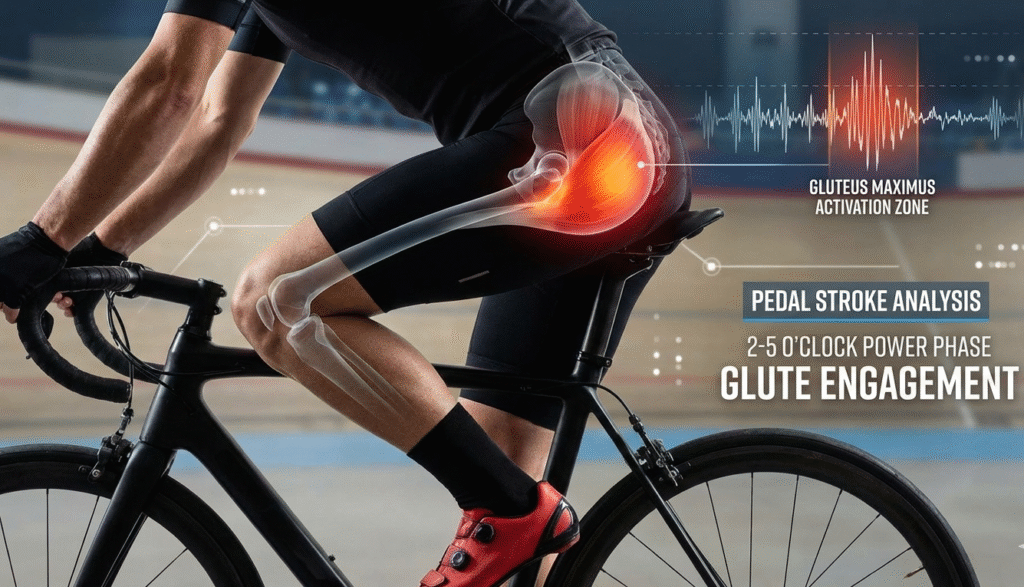
Most glute exercises for cyclists focus on full hip extension, right? Deadlifts, hip thrusts where you lock out completely at the top, that kind of thing. Looks great, feels powerful, everybody’s doing them. But cycling never—like literally never—achieves full hip extension. Your hip moves from roughly 70 to 110 degrees of flexion. That’s it. That’s the range.
So training full extension is kind of like… I don’t know, training for a marathon by doing 100-meter sprints? The movement pattern doesn’t match.
The truth most strength coaches miss (because they’re not cyclists, they don’t live this): you need glute strength specifically in that 80-100 degree hip flexion zone where cycling power actually happens. Not at lockout. Not in full extension. Right there in the middle range that feels awkward and incomplete in the gym.
Traditional coaches program what looks impressive on Instagram. We need to program what actually works on the road.
What to do instead:
- Single-leg hip thrusts but stop at 90 degrees—never lock out completely
- Deficit reverse lunges where you emphasize staying in that bottom position, that uncomfortable place where your hip angle matches the bike
- Isometric holds at specific angles: 3 sets of 30-second contractions at 90-degree hip flexion, 3 times weekly (your glutes will hate you, which means it’s working)
We’re training for position-specific force, not gym aesthetics.
Secret #3: Glute Strength Ratios Predict Injury Risk Better Than Your FTP Ever Will
This one surprised me honestly. Research shows that the ratio between glute strength and quad strength predicts injury risk way better than training volume, FTP, weekly hours, any of that stuff we obsess over.
The optimal ratio? Your glutes should hit 80-90% of your quad strength. Most cyclists sit around 40-50%. Some worse.
And this imbalance creates a cascade of problems:
- Patellofemoral pain (runner’s knee, which is ironic since we’re cyclists)—quads yank the kneecap sideways without glute stability to control hip position
- IT band syndrome—weak glute medius lets your hip collapse inward and rotate during the stroke
- Lower back pain—your spine compensates for what your hips can’t deliver
Nobody tests this ratio though. We’re out here tracking TSS and IF and every metric under the sun, but ignoring the strength imbalance that’s basically a ticking time bomb.
Test yourself right now:
- Single-leg squat: 5 reps per leg—does your knee cave inward? Glute medius is weak
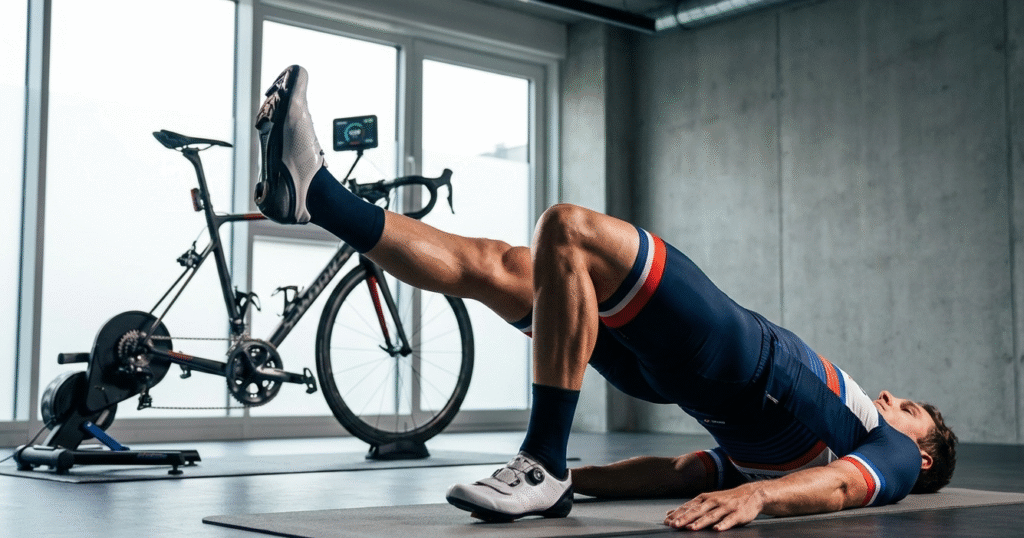
- Single-leg bridge: hold 60 seconds per leg at full extension—can’t make it? Insufficient glute strength
- Lateral band walks: 20 steps each direction with medium resistance—hips dropping or torso leaning means glute medius is the weak link
Fix it:
- Prioritize single-leg work: Bulgarian split squats, single-leg RDLs, single-leg hip thrusts
- Do glute movements before quad stuff in your gym sessions (I know this feels backwards but trust the process)
- Target 12-16 sets of direct glute work weekly—most cyclists do maybe 3-6 sets and wonder why nothing changes
The secret isn’t adding glute work. It’s doing enough to actually shift the ratio. check this out if you still wonder what works best : Squats vs Dead-lifts
Secret #4: Glute Endurance Matters Way More Than Glute Strength (Yeah, Really)
Here’s something that blew my mind when I first learned it: peak force production from your glutes means absolutely nothing if they’re cooked 20 minutes into a 3-hour ride.
Cycling demands repetitive, sustained force—like 5,000-6,000 pedal strokes per hour at moderate intensity. That’s endurance territory, not strength.
But most glute exercises for cyclists focus on heavy loads, 6-8 rep ranges, maximal strength stuff. Which builds your capacity for peak force, sure… but does nothing for the muscular endurance cycling actually demands. It’s like training for a different sport entirely.
The protocol everyone skips: high-rep, time-under-tension work with moderate loads around 60-70% of your 1RM actually replicates what cycling asks of your glutes way better than heavy triples or whatever.
Think about when your glutes actually fail during a hard ride. Not during one maximal sprint effort—they fade gradually, insidiously, during long threshold work. Your training needs to reflect this reality instead of fighting it.
How to implement:
- Glute circuits: 3-4 exercises, 15-20 reps each, barely any rest (30-45 seconds max), 3-4 rounds total
- Example: Hip thrusts for 15 reps → single-leg bridges 15 each side → lateral band walks 20 steps per direction → clamshells 20 per side
- Program this once weekly during base phase, bump to twice weekly during build
- Total time: 15-20 minutes—this is endurance work not strength, remember that
Match the metabolic demands. Don’t just build isolated strength.
Secret #5: Pre-Ride Activation Destroys Post-Ride Strengthening (Counterintuitive But True)
This one goes against everything you’ve been told, but here it is: 5 minutes of glute activation before you clip in delivers more performance bang than 30 minutes of glute work after your ride.
Why? Post-ride strengthening builds capacity over time, which is great, necessary even—but pre-ride activation creates immediate neuromuscular patterns that stick around for the entire ride. You’re priming the system to use the strength you’ve already built instead of just building more strength that sits unused.
We tested this (power meter data doesn’t lie): cyclists doing pre-ride activation show 8-12% higher glute EMG activity during threshold efforts compared to rides without it. Same rider, same bike, same course—just different glute recruitment.
The protocol everyone skips:
Before every ride—yes, every single ride, even easy ones:
- Glute bridges: 2 sets of 15 with 2-second squeezes
- Single-leg bridges: 2 sets of 10 per leg
- Lateral band walks: 2 sets of 15 steps each way
- Clamshells: 2 sets of 15 per side
Takes 5-7 minutes max.
This isn’t warm-up fluff or going through motions. It’s performance optimization that costs basically nothing but delivers measurable, trackable gains.
The Thomas Transformation
I’ve been racing for over 20 years now, and honestly I thought my glutes were fine—better than fine actually. Could hip thrust 180kg for reps, felt strong, looked strong. But my power meter kept showing this 18% left-right imbalance that wouldn’t go away no matter what I tried. And climbs? Getting destroyed despite having a decent FTP on paper.
Started doing pre-ride activation and position-specific glute work consistently for 8 weeks. Power asymmetry dropped to 3%. My 20-minute power jumped from 305 watts to 331 watts—that’s 26 watts I was leaving on the table. The secret wasn’t building stronger glutes. They were already strong. It was teaching them to fire during the actual pedal stroke instead of sitting there dormant.
Your Action Plan: Stop Reading, Start Implementing
Enough theory. Stop doing random glute work hoping it magically transfers to the bike. Start implementing targeted, position-specific protocols designed for cycling’s exact demands.
The protocol (minimalist, effective):
Before every ride (5-7 minutes):
- Bridges
- Single-leg bridges
- Band walks
- Clamshells
Gym sessions (twice weekly base/build phase):
- Single-leg hip thrusts stopping at 90 degrees
- Bulgarian split squats
- Single-leg RDLs
- Endurance circuit weekly
Track these:
- Single-leg bridge holds: 60+ seconds target
- Power asymmetry: under 5%
- Glute-to-quad ratio: 80-90%
The secret’s out there now. Your competitors are doing traditional glute work, wondering why it doesn’t translate. You understand why—and exactly how to fix it.
Do the 5-minute protocol before your next ride. Track your asymmetry numbers. Test your bridge holds.
Knowing versus doing is everything. Start today, not tomorrow.
Check our Full Road Cycling Guide for more tips and info !