The Best Fluffy Pancakes recipe you will fall in love with. Full of tips and tricks to help you make the best pancakes.


Here’s what kills me—and I mean really drives me crazy about cycling culture: everyone pretends your FTP is some universal constant, like gravity or the speed of light. Indoor, outdoor, Tuesday morning, Saturday afternoon… doesn’t matter, right? Your power is your power.
Except it’s not. And this myth? It’s absolutely destroying your training.
Listen—research from the Journal of Science and Cycling shows something wild: indoor cycling generates 5-10% lower power output at what feels like the same effort compared to riding outside. Not because you’re weak or lazy (though some days, sure, maybe a little lazy). But because heat, muscle recruitment, even the way your brain processes suffering—all of it shifts depending on whether you’re staring at your garage wall or chasing someone up a real climb.
Yet here we are, 90% of training plans just copy-pasting the same workouts for both environments like it doesn’t matter where your wheels are spinning.
The game-changer—and I’m talking legitimately life-altering for your training—is this: acknowledging that your body is basically a different engine indoors versus outdoors, and programming accordingly. Stop pretending otherwise. Start getting faster.
The Heat Problem
Why everyone ignores this: Because we’re obsessed with data we can see. Watts? Check. Heart rate? Got it. The fact that you’re slowly cooking yourself like a rotisserie chicken in your pain cave? Eh, whatever.
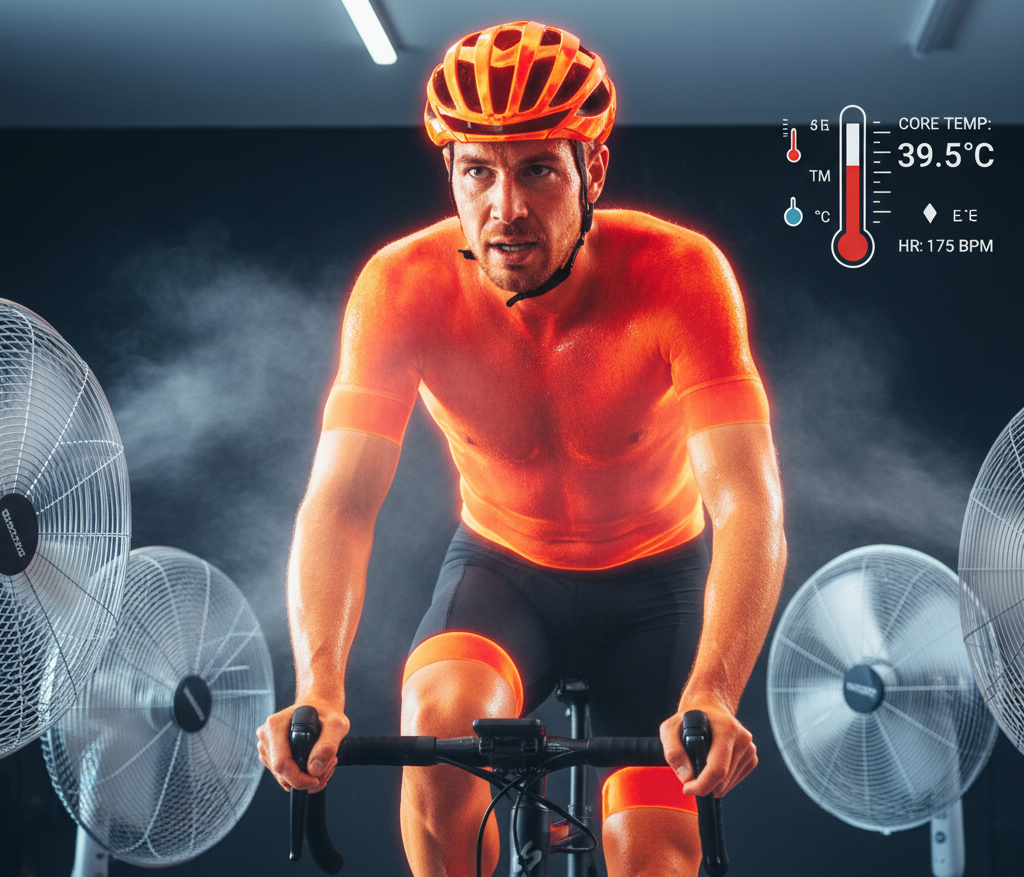
The International Journal of Sports Physiology and Performance—actual scientists with actual thermometers—found that your core temperature climbs 0.5-0.7°C higher during indoor sessions at identical workloads versus outdoor rides. Even with fans blasting (and yes, I know you bought the expensive fan that sounds like a jet engine), the airflow at 20 mph indoors is nothing—NOTHING—like actual 20 mph wind when you’re moving through space outside.
Your body panics. Redirects blood to your skin for cooling instead of your quads for power. It’s doing triage, basically… and your FTP is the casualty.
The fix: Just accept it—drop your indoor FTP targets by 5-8%. Your 300-watt outdoor threshold? That’s 276-285 watts indoors, and it should feel just as hard. Because physiologically speaking (and this is the part that matters), it is.
What to actually do:
- Multiply outdoor zones by 0.92-0.95 for indoor work—yes, really
- Two fans minimum, positioned for cross-ventilation (one straight-on, one at 45 degrees)
- Keep your room cold. Like, uncomfortably cold before you start. 65-68°F if possible
- Cut interval duration by 10-15% indoors—so those 4-minute efforts become 3:30ish
- Longer recovery valleys, maybe 20% more, because your core temp needs to reset
Think about this: what if your body’s already redlining just trying to thermoregulate before you even get to the “training” part?
Your Muscles Fire Differently
Why it’s overlooked: The bike looks the same in both places, so obviously the pedaling motion is identical… right?
Wrong. So wrong.
European Journal of Applied Physiology used EMG sensors—these electrode things that measure muscle activation—and discovered glute and hamstring engagement drops 12-18% indoors compared to outside at matched power. Twelve to eighteen percent! That’s massive.
Here’s why: outdoors you’re constantly (and I mean constantly—every single second) making micro-adjustments. A gust of wind. Road camber. Avoiding a pothole. That slight grade change. Your stabilizers are firing, your posterior chain is engaged, your neuromuscular system is doing this complex dance.
Indoors? You’re locked in. Grinding. It becomes this quad-dominant, monotonous, almost robotic movement pattern that—honestly—is nothing like real cycling.
The adaptation: Indoor training is incredible for isolated muscular endurance, don’t get me wrong. But it’s terrible (like, objectively bad) at neuromuscular completeness. Outdoor training builds full-chain power and real-world handling. They’re not competing—they’re complementary tools.
And look—if you’re serious about actually maximizing what indoor training can do for you, “Indoor Gains: The Ultimate Home Cycling Plan“ breaks down exactly how to periodize around this. It exploits indoor training’s strengths (controlled intervals, precise power, muscular endurance work) while programming outdoor sessions to cover what the trainer can’t touch (neuromuscular variety, psychological freshness, the eccentric loading from actual terrain).
What to implement:
- Indoors: cadence variation drills—30-second surges from 70 to 110 RPM, feels awful, works amazingly
- Alternate seated/standing every 2-3 minutes during threshold efforts (even when you don’t want to)
- Single-leg drills monthly, 1 minute each leg, to expose imbalances you didn’t know existed
- Save your VO2max and anaerobic work for outdoors where full neuromuscular recruitment happens naturally
- Use the trainer for sweet-spot and threshold—controlled suffering that builds mitochondrial density
Are you training the muscles you actually use when you race? Or just the ones the trainer happens to activate?
Your Brain Quits Before Your Legs (The Mental Fatigue Nobody Talks About)
Why it’s overlooked: Because you can’t upload “mental exhaustion” to Strava. It’s not quantifiable, so coaches ignore it.
But here’s the thing—central governor theory (which is legit science, not pseudoscience) proves your brain gives up before your body actually has to. And indoors? Your brain is screaming at you to stop way earlier.
Frontiers in Psychology found that perceived exertion during indoor cycling averages 1.5-2.0 points higher than outdoor riding at identical heart rates, identical power, identical everything measurable. Why? Because there’s no environmental stimulation. No forward momentum sensation (which is surprisingly important to your sense of accomplishment). No goal-proximity markers—that hill crest getting closer, the town sign you’re chasing, the coffee shop that’s 2k away.
Just a timer counting down. Just suffering for suffering’s sake.
Your brain interprets this as more threatening because there’s no external reward signal. Journal of Applied Sport Psychology shows focus degrades 40% faster in monotonous environments—after about 45-50 minutes indoors, most athletes’ attention just… falls apart. Quality plummets.
The adaptation: Match workout duration to psychological capacity, not just what your legs can handle. A 90-minute endurance ride outside and a 90-minute trainer session? Not the same stimulus. Not even close.
What works:
- Cap focused indoor intervals at 60-75 minutes max—save the 90+ minute stuff for outdoors
- Use 60-second microbreaks (soft pedal at 100W) every 12-15 minutes during indoor endurance (it’s not cheating, it’s strategic)
- Indoor interval sessions: 3-4 work bouts maximum. Outdoor sessions can handle 5-6 because your brain isn’t dying
- Mix erg mode and resistance mode every 3-4 minutes to maintain engagement—monotony is the enemy
- Reserve mentally demanding workouts (negative splits, progressive builds, anything requiring concentration) for outdoor sessions
What if your “bad” indoor workout wasn’t physical weakness at all—what if it was just your brain hitting its limit?
The Truth Nobody Wants to Hear
The secret isn’t that indoor or outdoor is “better”—that’s not the point, and honestly that debate is exhausting and pointless.
The secret is they’re fundamentally different stimuli requiring different prescriptions. Period.
Training plans that pretend environment doesn’t matter are like… I don’t know, nutritionists who don’t adjust calories based on whether you’re sitting at a desk or running marathons. Technically following principles, sure, but missing the entire practical application that actually matters.
Your outdoor 20-minute FTP test and your indoor 20-minute FTP test should give you different numbers. Your heart rate zones shift based on thermoregulation demands—that’s not failure, that’s data. And your mental endurance varies with environmental engagement. These are features, not bugs.
What You Do Next (Starting This Week, Not “Eventually”)
Stop pretending your garage and the road are interchangeable. They’re not, you know they’re not, now act like it.
Retest your indoor FTP separately. Use that number—not your outdoor number—for all trainer workouts. Watch your consistency explode when targets actually match reality instead of some fantasy version of fitness.
Audit your last month. How many indoor sessions went over 75 minutes of focused work? How many left you mentally destroyed rather than physically tired? Adjust. Adapt. Stop repeating what doesn’t work.
Assign workouts strategically based on environment. Indoor gets: threshold, sweet-spot, neuromuscular power (those 30-second sprint things). Outdoor gets: VO2max, endurance, tempo, group rides, anything requiring sustained focus or neuromuscular variety.
The cyclists getting stronger—really, genuinely stronger, not just accumulating meaningless TSS—aren’t training harder. They’re training smarter by acknowledging that where you ride fundamentally changes how you should ride.
Your body already knows indoor and outdoor cycling are different experiences. It’s been trying to tell you this the whole time.
Maybe it’s time your training plan actually listened.
You can also check our free Full Indoor Cycling Guide for more tips!