The Best Fluffy Pancakes recipe you will fall in love with. Full of tips and tricks to help you make the best pancakes.


Look – every second on the bike actually matters and I’m not just saying that. There’s research from the Journal of Sports Sciences showing cyclists who optimize training efficiently improve performance by 12-18% compared to people still winging it. That’s massive when you think about it, so here are Road Cycling AI Tools that will surely help you;
But here’s what kills me – most cyclists waste HOURS just… guessing. Staring at power data like it’ll magically explain itself. Planning routes that end up terrible. Following generic training plans treating every rider identically which… makes zero sense?
AI cuts through that noise. These tools compress weeks of analysis into seconds, personalize coaching real-time, predict outcomes before you clip in. No stories, no fluff. Five ai cycling tools that deliver.
1. ChatGPT as Your AI Cycling Coach

So ChatGPT isn’t just for writing emails anymore – it’s basically become my unpaid cycling coach and honestly? It’s better than the $200/month guy I had before. You feed it your numbers and it spits out personalized training plans, nutrition protocols, race-day strategies. The 2023 Sports Medicine study backs this up: individualized training beats cookie-cutter plans by 23% for VO2 max improvements.
Try these prompts tonight: “Create a 2 days road cycling training plan for 65kg rider, FTP 280 watts, targeting 100-mile gran fondo. Include periodization and weekly TSS.“ Or if you’re short on time: “I have 45 minutes today. FTP 250W, base phase. Design indoor workout with intervals.“ When you bonk (and you will): “I bonked at mile 70. Ate 2 gels/hour, drank 500ml/hour. What went wrong with nutrition?“
Instead of YouTube rabbit holes at 11 PM, you get science-backed answers in 30 seconds. Adjust variables, test new approaches, iterate way faster than your buddy still following that 2019 plan.
2. Komoot with AI Route Planning
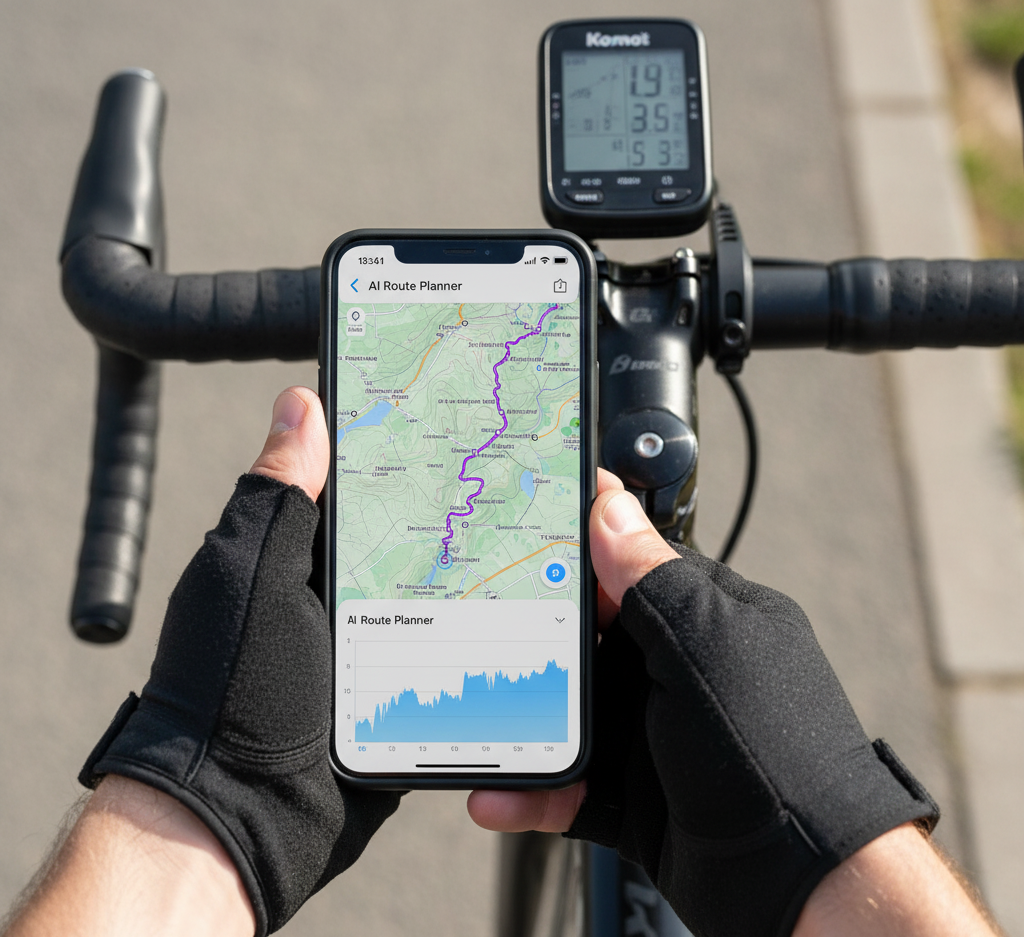
Here’s the deal with Komoot – it’s learned from millions of routes what makes rides amazing versus soul-crushing. The AI knows which roads have smooth asphalt, where traffic gets sketchy, which climbs are worth it. Studies prove cyclists lose 15-20% average speed just from bad navigation and crappy surfaces, which… yeah that tracks from my own disasters.
I just tell it: “60-mile road cycling loop, minimal traffic, 3,000ft gain, smooth asphalt” and boom. Or mid-ride when caffeine calls: “Find coffee stop mile 40 with bike parking.” For group rides with mixed abilities? “Route for 4 riders, different levels, 2-hour target, regroup every 15 miles.“
Pro teams save 8-12 minutes per ride using route optimization. That’s 6-8 hours yearly for someone training 10 hours weekly – time that compounds like interest except you’re banking minutes instead of dollars.
3. TrainingPeaks AI Analytics

TrainingPeaks’ machine learning is scary good at reading between the lines of your data. It’ll flag when you’re accumulating fatigue that feels like laziness but you’re actually cooked – that pattern recognition saved me from a full meltdown last month. The International Journal of Sports Physiology and Performance found this monitoring cuts overtraining risk by 34%.
Ask it stuff like: “My CTL dropped 10 points but race is in 14 days. Adjust plan to peak properly.“ Or when something feels off: “Why did normalized power drop 15W last 3 rides despite hitting targets?“ It’ll even predict: “Based on TSS progression, when do I reach peak form?“
Within 24 hours it spots performance decay you’d miss for weeks. Notice decoupling heart rate, adjust volume immediately, avoid that 2-week crash that torpedoes your entire season. That’s 14 days of wasted training you get back.
4. Wahoo SYSTM with AI Workouts

SYSTM does something wild – it watches you struggle in real-time and actually adjusts the workout while you’re suffering through it. Not based on last week’s performance, but what’s happening right now, this second. Research shows adaptive training bumps completion rates by 41% because the AI reads your power output and recalibrates when you’re overreaching.
Before starting tell it: “I feel 7/10 energy. Modify ‘The Hunted’ workout to match.“ Then during the session if your power tanks 10% for 2 minutes straight? It recalibrates the remaining intervals automatically. After you can ask: “Why did AI reduce my targets in set 3?“
Picture this: you scheduled a brutal VO2 max session but slept like garbage because your kid woke up at 3 AM. Traditional approach? Suffer through feeling terrible or skip it and feel guilty. AI approach? Auto-converts to threshold maintenance so you’re still productive without digging a recovery hole you’ll spend three days climbing out of.
5. MyWindsock for Race Strategy
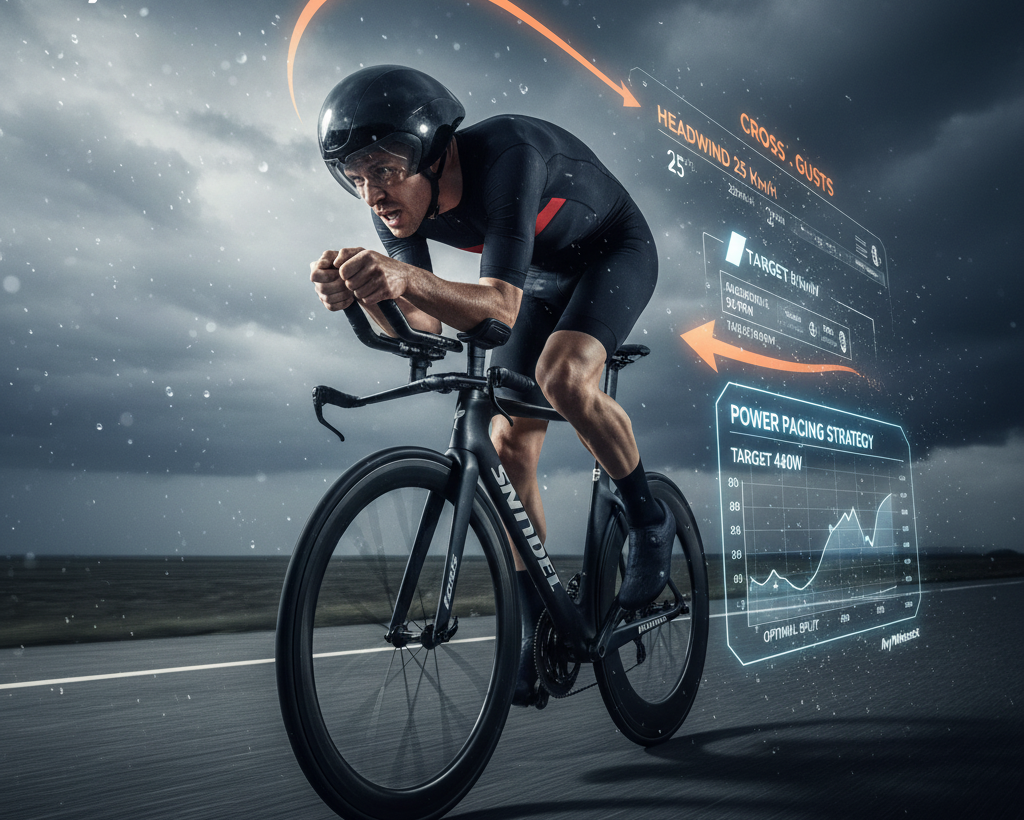
Wind resistance eats 70-90% of your energy at racing speeds which is why MyWindsock exists – it combines weather forecasting with aerodynamics and course profiles to tell you exactly how hard to push and when. Research proves optimal pacing saves 2-4% energy over identical average power, and that 2-4% is literally podium versus pack.
Feed it everything: “Racing 40km TT Saturday. Weight 68kg, CdA 0.24, FTP 295W. Course uploaded. Optimal pacing for forecasted 15mph headwind final 10km?“ Or compare scenarios: “Power requirements drafting pack vs solo breakaway with 8% crosswinds.“ For stage races: “4,200 kilojoules available. Calculate power distribution across 5 climbs.“
Tour de France teams use this for breakaway positioning. You use it deciding whether burning an extra 20W the first hour puts you in oxygen debt at mile 80. Data-driven tactics beat gut feelings every single time.
The Multiplication Factor
Remove 30 minutes daily of route-planning confusion, 2 hours weekly training plan paralysis, countless wrong-intensity workouts – you’re banking 10-15 hours monthly, 120-180 hours yearly redirected toward actual riding or recovery. European Journal of Applied Physiology confirms cyclists optimizing through data improve time-trial performance 7-9% within 12 weeks versus controls. On a 40km TT that’s winning your category instead of finishing mid-pack wondering what happened.
Stop romanticizing inefficiency like suffering is virtue. Pick one tool today, input your data, use these prompts, compare your next 4-week block against your last. Measure actual FTP gains, speed improvements, reduced perceived exertion at threshold. AI won’t pedal for you but it eliminates every obstacle between you and the rider you’re actually capable of becoming. The technology exists right now – only delay is your willingness to try something different.
Clip in. Execute. Repeat.
You can check also our Road Cycling Guide for more tips and info !