The Best Fluffy Pancakes recipe you will fall in love with. Full of tips and tricks to help you make the best pancakes.


Here’s something that’ll mess with your head a little. The most effective performance fuel in professional cycling isn’t locked behind a supplement patent or buried in some sports science journal behind a paywall. It’s not a new thing. It’s rice. Just—rice. The stuff your grandmother made without thinking twice, the thing you probably have half a bag of sitting in the back of a cabinet right now, slightly forgotten.
And yet here we are. Most amateur cyclists are out here spending $4 a gel, stacking processed bars, mainlining sugar and wondering why their legs turn to wet cement somewhere around hour two. Meanwhile the peloton—quietly, consistently, for decades—has been running on rice cakes wrapped in foil, handed through car windows at speed.
The secret isn’t the rice itself, exactly. It’s understanding why it works. That’s the part nobody explains properly. Let’s fix that.
Rice Manages Your Glucose Like a Slow-Burn Fire, Not a Bonfire
Ask yourself something honest: do you actually know what happens to your blood sugar during a four-hour ride? Like, mechanically—what’s going on in there?
Most riders don’t. And that gap in understanding is costing them finishes.
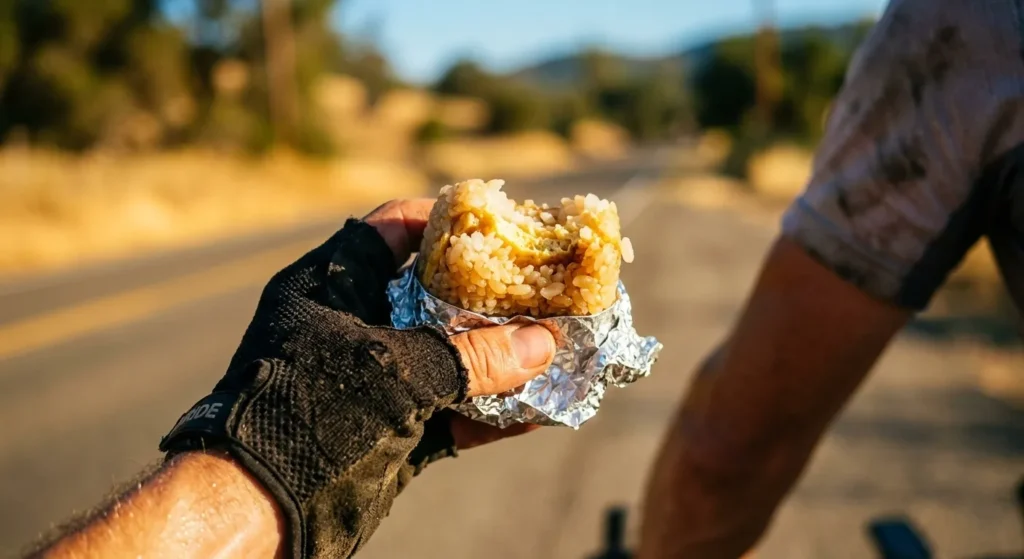
White rice has a glycemic index of around 72—high enough to deliver glucose efficiently, but when it’s eaten as a rice cake (with egg, a little fat, maybe a pinch of salt and nothing else really), that number softens. The fat and protein slow the release. What you get is a glucose curve that looks less like a spike and more like a long, steady climb. Which is—almost poetically—exactly what you want from your legs.
Here’s why the type of carbohydrate matters and not just the raw quantity:
- Your muscles run almost exclusively on glycogen above 65% VO2 max—that’s most of your ride
- Those stores last maybe 90 minutes at race pace before the tank starts reading empty
- Consistent fueling from around minute 45 onward delays the bonk—but only if glucose stays stable
- Processed sugars spike insulin aggressively, which can interrupt fat oxidation mid-ride. Rice doesn’t do this. Not like that.
Team Ineos built rice cakes into their grand tour nutrition protocol and stuck with it—through multiple Tour de France wins, through leadership changes, through all of it. That’s not coincidence. That’s a conclusion.
To actually use this:
- Basic rice cake formula: 250g cooked white rice, 2 eggs, salt, compressed and cut into squares
- Eat roughly one cake every 45 minutes on rides longer than 90 minutes
- Add a thin layer of cream cheese or coconut oil to soften the glucose curve further
Your Gut Is Basically Offline During Hard Efforts—Rice Is One of the Few Foods That Doesn’t Care
This one—honestly this one changed how I think about mid-ride nutrition entirely.
When you’re riding hard, your body reroutes blood away from your digestive system toward your working muscles. By as much as 80%. Eighty. That means the gut you’re asking to process a dense, fiber-heavy bar or a complex gel cocktail is operating on a fraction of its normal capacity. It’s like trying to run a dishwasher on a camping generator. Something’s not going to get clean.
GI distress in endurance sports is so common it’s almost treated as normal. It isn’t. It’s a fueling error.
Rice sidesteps this almost entirely:
- Virtually no fiber in white rice—which sounds like a negative until you realize fiber is exactly what slows digestion when you can’t afford that
- Low fat in plain preparation, meaning gastric emptying happens fast
- Gluten-free, hypoallergenic—no inflammatory response, no bloating, no cramping from common allergens
- Absorbs fluid rather than pulling it from surrounding tissue (a quiet problem with some sugar alcohols hiding in popular gels)
It digests like it was designed for this. Maybe it was, in a way—humans have been fueling physical labor with rice across cultures for thousands of years. There’s something almost obvious about it in retrospect.
Practical application:
- 48 hours out from a long ride or event, shift to white rice as your dominant carb. Pull back on whole grains—less gut load going in means less gut drama on the road
- Skip the heavy sauces and high-fiber additions on pre-ride rice meals
- And please—test this in training first. Never debut a nutrition strategy on race day. That’s a cardinal rule that somehow keeps getting broken.
The Recovery Window Is Real, and Rice Hits It Better Than Almost Anything
Nobody talks about this part. Which is wild because it might be the most important part.
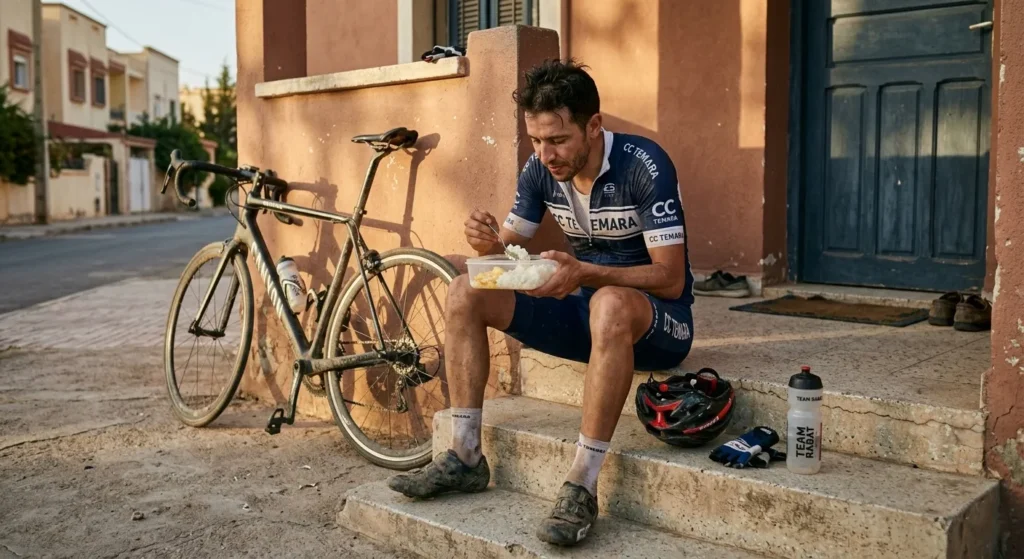
After a brutal ride—legs cooked, glycogen gone, that specific kind of exhaustion that feels almost peaceful—your body opens what sports scientists call the “glycogen resynthesis window.” Roughly 30 minutes post-exercise where high-glycemic carbohydrates trigger an insulin response that rebuilds muscle glycogen at an accelerated rate.
White rice is nearly perfect for this window. Fast-digesting. High-glycemic when you need it to be. No friction.
Compare it to the alternatives:
- Brown rice: More nutritious in a vacuum, slower to digest—wrong tool for the immediate post-ride window
- Pasta: Solid, but heavier, slower to break down, not ideal when you’re racing again tomorrow
- Commercial recovery drinks: Effective but expensive, and a lot of them come with bloating you didn’t ask for
- White rice + protein: Hits glycogen resynthesis and kicks off muscle repair at the same time. Two birds.
Riders competing across 21 stages in 23 days at the Tour aren’t eating rice at every meal because the chef ran out of ideas. They’re eating it because recovery speed at that level is everything—the difference between performing on stage 17 and simply surviving it.
How to apply this:
- Within 30 minutes of finishing, eat 1 to 1.5 cups cooked white rice with 20–25g of protein
- Salt it. Seriously. Sodium replacement after a long sweaty effort matters more than most people realize.
- During multi-day blocks, target 6–10g of carbohydrate per kilogram of bodyweight daily—rice as the foundation, everything else built around it
So. Why Do Cyclists Eat Rice?
Because it works at every single stage—before, during, after. It’s stable where gels are chaotic. It’s gentle where bars are demanding. It rebuilds what hard riding breaks down, faster than most of what’s marketed to you at three times the price.
The peloton didn’t stumble onto this. They kept returning to it because nothing else—nothing—has consistently outperformed it across the full arc of a race day.
Make the rice cakes this week. Eat them on your next long ride. Pay attention to what doesn’t happen.
The bonk that never came. That’s the secret, right there.
Check our Full Cycling Nutrition Guide for more tips and info !