The Best Fluffy Pancakes recipe you will fall in love with. Full of tips and tricks to help you make the best pancakes.


The Myth That’s Literally Holding Everyone Back (Including Maybe You)
Okay so there’s this idea—and I hear it constantly at trailheads, buried in Reddit threads, whispered between riders at coffee stops—that if you want to use AI and smart technology for mountain biking you need to be some kind of data scientist or tech genius. Like you need a computer science degree just to understand what your bike computer’s telling you.
It’s complete nonsense, honestly. But it’s the kind of nonsense that keeps people stuck.
Here’s what nobody talks about enough: beginners actually have this weird advantage when it comes to adopting AI-powered training tech. And I mean a real advantage, not just some motivational poster garbage.
Think about it—experienced riders? They’ve got years of habits baked in. They’re suspicious of new methods (I get it, I used to be that person), they’ve got their “proven” training approaches, and there’s this whole psychological investment in continuing what’s always worked. Or what they think has worked. Meanwhile someone who’s brand new to the sport walks in with zero baggage, no preconceived notions about how training “should” look, and they just… absorb the new stuff. Like a sponge.
Plus—and this is crucial—today’s AI tools aren’t designed for engineers. They’re designed for regular people who just want to ride faster and not feel destroyed afterward. The complicated stuff, all those algorithms and machine learning models crunching numbers in the background? You never see it. What you get is simple, visual, ridiculously intuitive interfaces that are honestly easier than trying to manually track your training in some Excel spreadsheet from 2015.
Why Smart Tech Actually Levels Everything Out
The whole democratization thing happening with AI in mountain biking right now… it’s kind of revolutionary when you step back and look at it. Like, ten years ago—maybe even five—only elite athletes had access to this level of personalized training data. You needed a coach, maybe a sports scientist, definitely a substantial budget.
Now? Your phone has more analytical power than what guided professional cycling teams in 2015. That’s wild.
And here’s the beautiful part that beginners especially should understand: AI doesn’t care about your resume. It doesn’t care if you’ve been riding since childhood or if you bought your first mountain bike last month. The algorithms look at YOUR data—your heart rate, your power output, your recovery patterns, your specific physiology—and optimize recommendations for you. Not for some hypothetical average rider who doesn’t exist, but for you specifically.
5 Strategies That Actually Work
1. Just Start with Ride Analytics Apps—Seriously, They Do the Thinking
Apps like Strava, TrainingPeaks, TrailForks… they’ve all got AI built in now that automatically analyzes your rides. You don’t need to understand anything about exercise physiology (though it’s interesting if you want to dive in later).
You just record your ride. That’s it.
Then the app tells you stuff like: “Your effort was heavily anaerobic today” or “You’re ready for intervals tomorrow” or “Take it easy—your training load is elevated.” And I remember when I first started using this tech properly—probably 2023, maybe early 2024—I was shocked at how much I’d been overtraining without realizing it. The app just… knew. Before my body fully felt it.
The advantage for beginners is massive here because you haven’t developed that “feel” yet that experienced riders rely on (and often misinterpret anyway). The app speaks in plain language. No jargon unless you want to dig deeper into the metrics.
If you want to go deeper into how ride metrics actually translate into speed gains, check out our guide on How Mountain Bikers Are Using Analytics to Get Faster.
2. Smart Trainers Are Like Having a Coach Who Never Gets Tired of You
Indoor training used to be soul-crushing. Just pedaling to nowhere, watching the wall, counting minutes.
Smart trainers changed everything—platforms like Zwift, Wahoo SYSTM, they use AI to automatically adjust resistance based on how you’re performing right now. Not how you performed last week. Not how the workout was originally designed. How you’re doing in this exact moment.
For beginners this is huge because it removes the dangerous guesswork. You know what kills new riders? Overtraining because they don’t know what “too hard” feels like yet. Or undertraining because they’re being too cautious. The AI finds that sweet spot automatically, ensuring progressive overload happens systematically (that’s the fancy term for “getting stronger without breaking yourself”).
You just pedal. The technology handles the complex periodization stuff that would normally require expertise you haven’t developed yet.
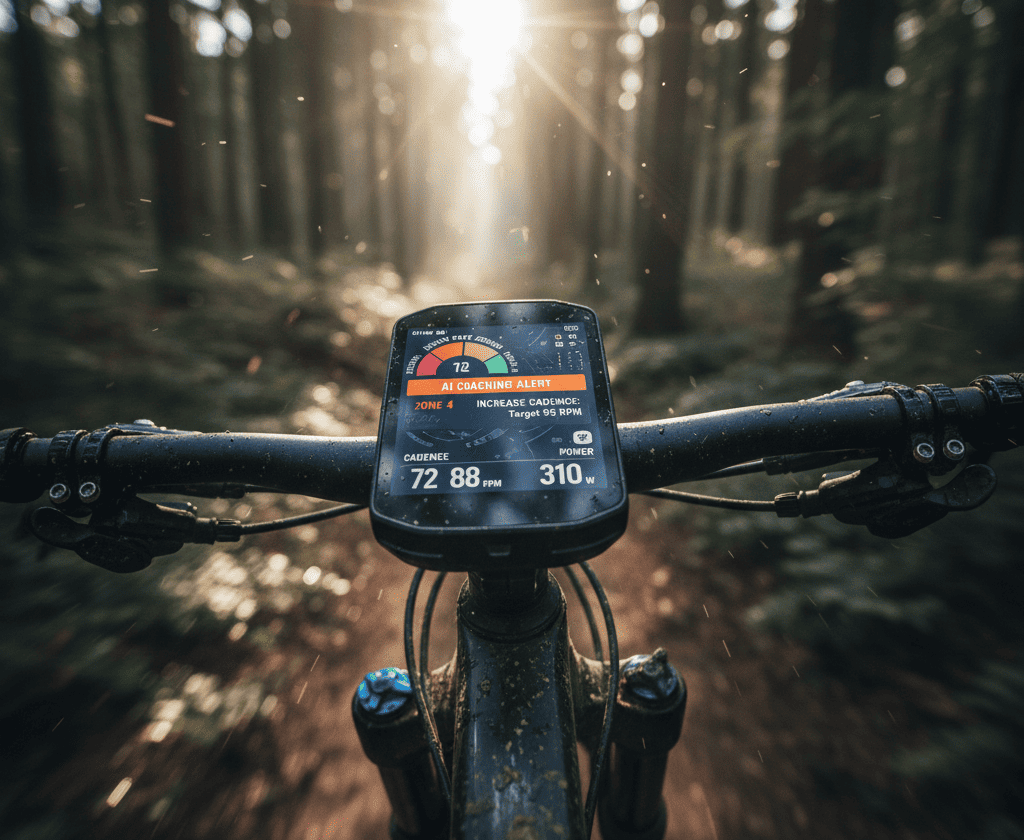
3. AI-Powered Bike Computers Give You Real-Time Coaching Out on the Trail
Modern bike computers—Garmin Edge series, Wahoo ELEMNT, Hammerhead Karoo—they’re not just fancy speedometers anymore. They actively guide your training while you ride.
Picture this: you’re climbing some technical singletrack, breathing hard, legs burning… and your bike computer buzzes. “Heart rate too elevated for sustainable aerobic development. Reduce pace 12%.”
That’s real-time coaching that used to cost hundreds of dollars per month from a human coach, now happening automatically on a $400 device. And the AI considers everything—your recent training load, how you slept last night (if you’ve got a wearable synced), accumulated fatigue from the week. It’s like having someone whispering strategic advice in your ear before you make mistakes.
Though sometimes I ignore it because, you know, pride. (Don’t be like me—listen to the computer more often than not.) Not sure which riding style benefits most from smart tech? Our comparison in From Cross-Country to Enduro: Which MTB Discipline Fits You? clears that up.
4. Predictive Recovery Analytics (This One’s Underrated)
Okay this might be the most important one and nobody talks about it enough.
Wearables like Whoop, Garmin watches, Oura Ring… they use machine learning to analyze your heart rate variability—that’s the variation in time between heartbeats, which sounds technical but basically tells you how stressed your nervous system is—plus your sleep quality, resting heart rate, all this stuff. Then they predict your recovery state before you even wake up.
For beginners who lack the body awareness that comes with years of training (and honestly, lots of experienced riders lack it too), this is invaluable. Instead of guessing whether you’re recovered or risking that accumulated fatigue that leads to injury or burnout, you get clear guidance: “Recovery score: 68%. Optimal workout today: moderate trail ride, 60-75 minutes, avoid high-intensity.”
I ignored this advice for a month straight once—thought I knew better—and ended up overtrained by mid-summer 2024. Took three weeks to recover properly. Don’t be stubborn like I was.
5. Training Plans That Actually Adapt to Your Life
Static training plans are basically dead at this point, or they should be. They’re relics from before we had adaptive AI.
Modern platforms—TrainerRoad’s adaptive training, Wahoo’s AI features—they continuously recalibrate your entire training plan based on how your body responds. Crushed that interval session? AI automatically increases the intensity for next time. Struggled to finish? It scales back, prevents overtraining, adjusts your timeline without making you feel guilty.
This adaptability is transformative when you’re new because beginners experience rapid fitness changes (newbie gains are real) and usually have unpredictable schedules. Unlike rigid plans that completely fall apart when you miss a workout or have a bad week, AI-powered programs just… reorganize around real life.
The Confidence Thing (Which Matters More Than People Admit)
Beginners struggle with confidence—that’s just reality. You’re constantly questioning whether you’re training right, improving fast enough, making good decisions. That doubt is exhausting.
Smart technology replaces uncertainty with objective feedback. When you see quantifiable evidence that your climbing power increased 12% over eight weeks… or that your recovery time shortened from 48 hours to 36 hours… doubt evaporates. Data-driven confidence feels different than ego-driven confidence. It’s grounded in verifiable progress, which creates sustainable motivation that survives the inevitable setbacks.
Your Move: Technology Meets Structured Training
Understanding that AI and smart tech are accessible? That’s step one. But you need a structured system that strategically integrates these tools into actual training.
That’s what I built in “Mountain Gains: The Ultimate MTB Training System.“
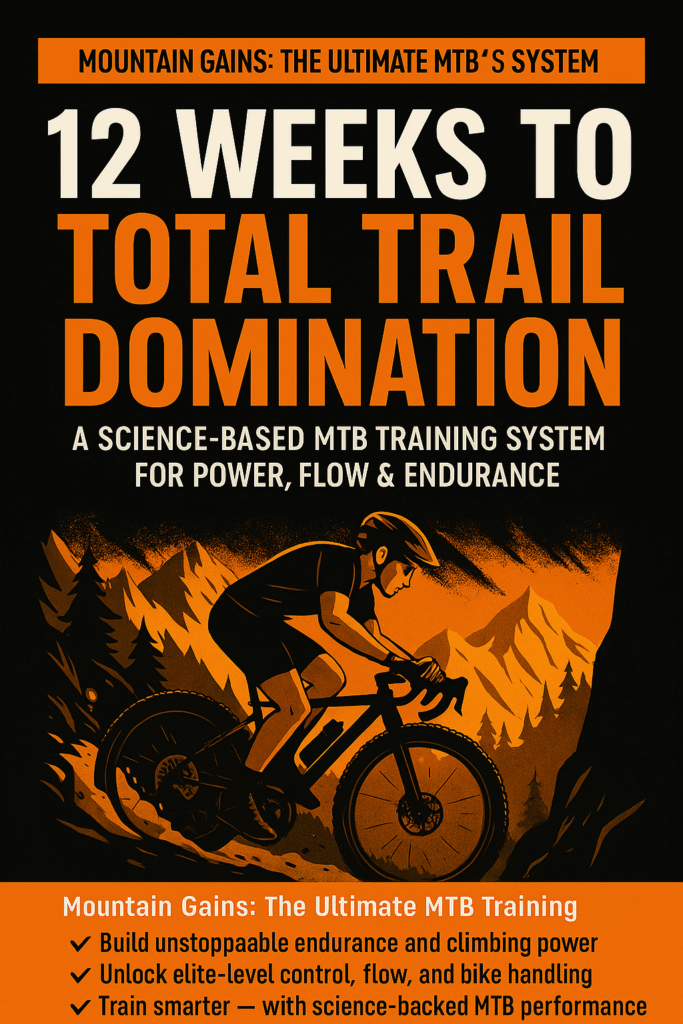
This eBook provides complete, progressive training plans that seamlessly weave together AI-powered ride analytics, smart recovery protocols, data-driven workout progressions… all explained in language that doesn’t assume you have a sports science background. You’ll discover exactly which technologies to adopt, how to interpret their insights without getting overwhelmed, and how to structure training for maximum gains.
The revolution isn’t coming—it’s already here. The tools exist. They’re accessible. They work.
Stop letting the expertise myth hold you back. Grab “Mountain Gains” today and discover how AI and smart technology can accelerate your progression faster than you think possible. Your strongest, fastest, most confident riding is waiting on the other side of this decision.
The trails won’t wait around. Neither should you.
Check our Mountain Biking Guide Here for more tips and info !