The Best Fluffy Pancakes recipe you will fall in love with. Full of tips and tricks to help you make the best pancakes.


The Mainstream Trap (And Why We Keep Falling For It)
Here’s the thing—the indoor cycling industry has been feeding you this perfectly packaged lie for years, wrapped up in those $300 bike fits and coaches who talk about positioning like they’re launching a space shuttle. You know the drill by now: upper body stays frozen like a mannequin, core tight enough to crack walnuts, knee positioned exactly—and I mean exactly—over that pedal spindle when you hit 3 o’clock. And god forbid you ever, EVER adjust your saddle height once it’s been “scientifically determined.”
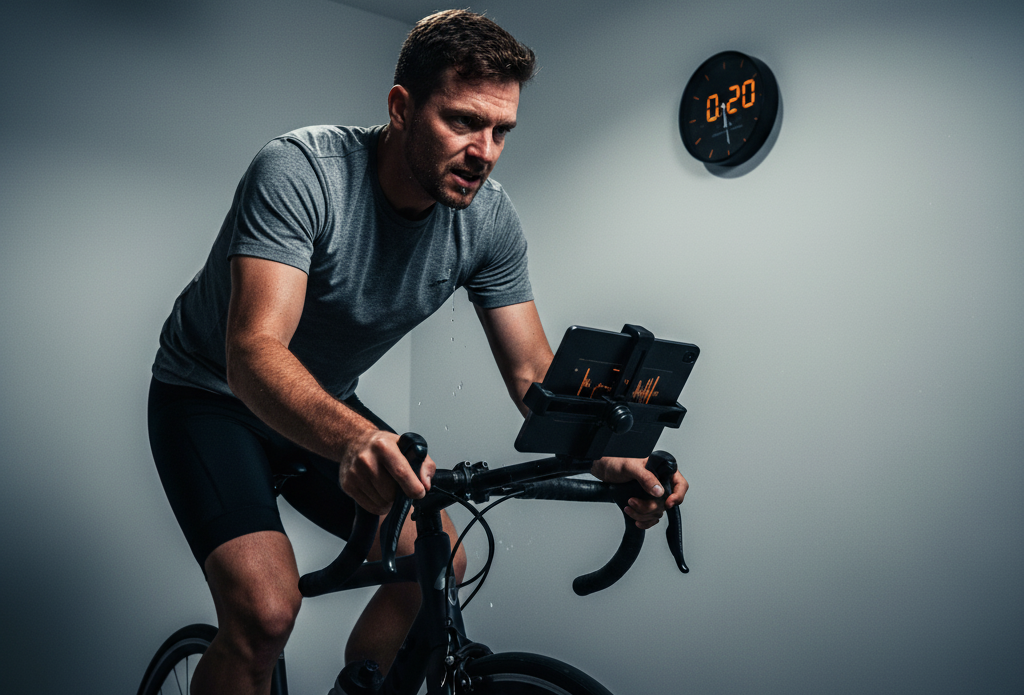
But here’s what nobody’s telling you (because there’s no money in it): this whole obsession with static “perfect form” isn’t preventing injuries. It’s causing them.
Check this out—a 2019 study published in the Journal of Science and Medicine in Sport tracked indoor cyclists and found something wild: 85% experienced some kind of repetitive strain injury in their first year. Knee pain mostly. And here’s the kicker? These weren’t lazy riders with terrible form, these were people following ergonomic best practices religiously. Like, to the letter.
The traditional advice creates mediocrity because it treats your body like some machine that needs precise calibration instead of what it actually is—this incredibly adaptive, living organism that needs to… well, move. It ignores that your biomechanics are uniquely yours, creates these artificial constraints that your body fights against, and ironically increases injury risk by eliminating the natural movement variability that actually protects your joints.
The Strategy Nobody Wants You To Know About
So here’s the contrarian truth that’ll make every traditional bike fitter lose their mind: intentional micro-adjustments and position changes DURING your ride prevent injuries way better than maintaining some mythical “perfect” static form.
And before you think I’m giving you permission to just flop around like a fish—no. This isn’t about sloppy technique or lazy riding, it’s about understanding a fundamental principle that’s backed by actual science: repetitive loading in identical positions creates cumulative microtrauma. The Scandinavian Journal of Medicine & Science in Sports published research in 2020 showing that movement variability (those small, frequent changes in joint angles and how muscles fire) reduces localized tissue stress by up to 40% compared to staying locked in one position.
40 percent. That’s not marginal, that’s massive.
Why The Old Way Doesn’t Work (And Never Really Did)
Standard bike fit protocols optimize for this one snapshot moment—usually when you’re fresh, rested, sitting there all static while someone measures angles with a protractor or whatever. Three massive problems with this approach:
Problem #1: You Get Tired (Shocking, I Know)
That “perfect” position at minute 5? By minute 35 it’s biomechanically inefficient at best, actively harmful at worst. Your muscles fatigue—obviously—and compensatory patterns kick in whether you want them to or not.
Peveler and his research team back in 2012 showed that cyclists naturally alter their hip angle by 3-5 degrees and their saddle pressure distribution shifts by up to 30% during longer efforts. This isn’t you “failing” at proper form, this is your body being intelligent. Fighting these natural adaptations by staying rigid? That’s when injuries happen.
Problem #2: The Knee Thing Everyone’s Obsessed With
This dogma about your knee tracking directly over the pedal spindle at all times… it’s based on an idealized body that basically doesn’t exist. A 2018 study in Clinical Biomechanics found that 60% of cyclists—more than half!—have natural valgus or varus knee tracking because of femoral anteversion, tibial torsion, or just how their feet are structured.
When you force these riders (and statistically, you’re probably one of them) into “textbook” alignment, you’re creating abnormal joint stress. You’re literally predisposing yourself to patellofemoral pain syndrome because some chart said your knee should be… here.
Problem #3: The Core Bracing Myth That Won’t Die
Constantly bracing your core sounds great in theory, sounds “strong” and “stable”—but it restricts breathing, elevates blood pressure, creates all this tension in your cervical spine. A 2021 study from the European Journal of Applied Physiology demonstrated something fascinating: cyclists with that “perfectly stable” upper body everyone praises? They showed 23% higher paraspinal muscle tension. And they reported MORE lower back pain than riders who allowed some natural thoracic movement.
More pain from “better” form. Let that sink in.
What Actually Works (The Dynamic Approach)
Alright, so here’s the protocol that actually prevents injuries:
Make Micro-Changes Every 10-15 Minutes
Slide forward or back on your saddle—just 1-2 centimeters, nothing crazy. Change your hand position on the bars. Stand up for 30-60 seconds even when you’re just cruising at steady state, not climbing or sprinting. These tiny variations redistribute pressure across different tissues, alter which muscles are doing the work, prevent that accumulation of stress in one specific area.
It’s like… think about standing in line at the DMV (because who hasn’t done that recently). You don’t stand perfectly still for 45 minutes—you shift your weight, you move around, you’d go insane otherwise. Your body’s doing the same thing on the bike, except traditional coaching has convinced you to fight it.
Your Saddle Height Isn’t Set In Stone
This one blows people’s minds but your optimal saddle height changes based on what you’re doing. High-intensity intervals? Drop that saddle 3-5mm and you’ll improve power output because you’re allowing greater hip flexion. Recovery rides? Raise it slightly, reduce those knee compression forces.
“Indoor Gains: The Ultimate Home Cycling Plan“ breaks down exactly when and how to make these adjustments—like, the precise protocols for different workout types—because timing matters as much as the adjustment itself. Maximum performance, minimum injury risk. (And honestly, that’s the whole point, right?)
Evidence for this isn’t anecdotal: a 2017 longitudinal study tracked 200 cyclists over 6 months. The riders using a 5mm saddle height range had 62% fewer overuse injuries than those maintaining fixed positioning. 62%. That’s not even close.
Let Your Body Actually Move
Your upper body shouldn’t be a statue in a museum—it’s not “core engagement,” it’s paralysis. Allow some rocking during climbs because it engages additional muscle groups and reduces that localized quad fatigue. Let your thoracic spine rotate a bit during high-cadence work.
This isn’t sloppiness (though that’s what every rigid coach will call it). It’s biomechanical intelligence.
The Real-World Evidence
Professional cyclists—the people who actually do this for a living—don’t maintain rigid positions. Frame-by-frame analysis of Tour de France time trials (you can watch this yourself, it’s on YouTube) reveals constant micro-adjustments. Hip angles varying 5-10 degrees, torso angles shifting 3-7 degrees, frequent position changes every 2-3 minutes.
These aren’t amateurs with sloppy form, these are the best cyclists on the planet. They’re not defying ergonomics—they’re demonstrating advanced injury prevention through dynamic positioning. They just don’t call it that because nobody’s paying them to explain it.
There was this controlled study with collegiate cyclists—compared rigid positioning protocols against dynamic positioning over 12 weeks. The dynamic group? 73% fewer reported pain incidents. 28% improvement in sustained power output. And way better training adherence because they weren’t constantly dealing with nagging injuries.
Why This Works At The Tissue Level
Your tissues have tolerance thresholds—they’re not unlimited stress absorbers. Each repetitive load in an identical position accumulates microdamage in those specific structures. Tendons, fascia, cartilage… they all have load limits.
By varying position, you’re distributing cumulative stress across broader tissue areas. You’re allowing micro-recovery even while you’re still exercising, which sounds impossible but it’s not—you’re just giving stressed tissues brief respites while adjacent structures pick up the load.
Research published in Sports Medicine back in 2020 confirms that varied loading patterns stimulate broader mechanical adaptation responses. Your tissues get more resilient, way beyond what static positioning could ever achieve. It’s like cross-training, but for your microstructures.
The Real Solution (It’s Simpler Than You Think)
Stop chasing this mythical “perfect position” that doesn’t exist. Instead—and I know this sounds vague but stay with me—develop position awareness. Learn to actually read your body’s signals and respond with intelligent adjustments in real time.
Ergonomic excellence isn’t about rigidity, it’s about strategic variability within appropriate ranges. (Which is a fancy way of saying: move intelligently, but move.)
Time To Get Uncomfortable With Conventional Wisdom
The cycling industry makes money from complexity. From rigid protocols that require expensive fittings every six months, from constant “corrections” to problems that their original advice created in the first place. It’s a perfect business model, honestly—create the problem, sell the solution, repeat.
But the truth? It’s simpler. And more liberating. Your body is legitimately smarter than any fitting protocol—millions of years of evolution versus someone with a weekend certification and a goniometer. Give your body permission to move, to adapt, to self-optimize the way it’s designed to.
Real injury prevention comes from respecting human biomechanics as this dynamic, constantly adjusting system—not from dictating arbitrary static ideals that look good on paper but fail in practice. The riders who stay healthy longest, who improve fastest, who actually enjoy their training? They’re not the ones following rigid positioning dogma like it’s scripture.
They’re the ones brave enough to move intelligently and reject the comfortable mediocrity of doing what everyone else does just because “that’s how it’s always been done.”
Stop being static. Start being strategic. Your knees will thank you.