The Best Fluffy Pancakes recipe you will fall in love with. Full of tips and tricks to help you make the best pancakes.


You’re not slow—your smart trainer is actually making you weaker.
Look, let’s just say it: the indoor cycling industry has dumped billions (literally billions) into convincing you that more technology = better performance. Except it doesn’t. The data’s there but nobody wants to look at it because, well… there’s way too much money on the line.
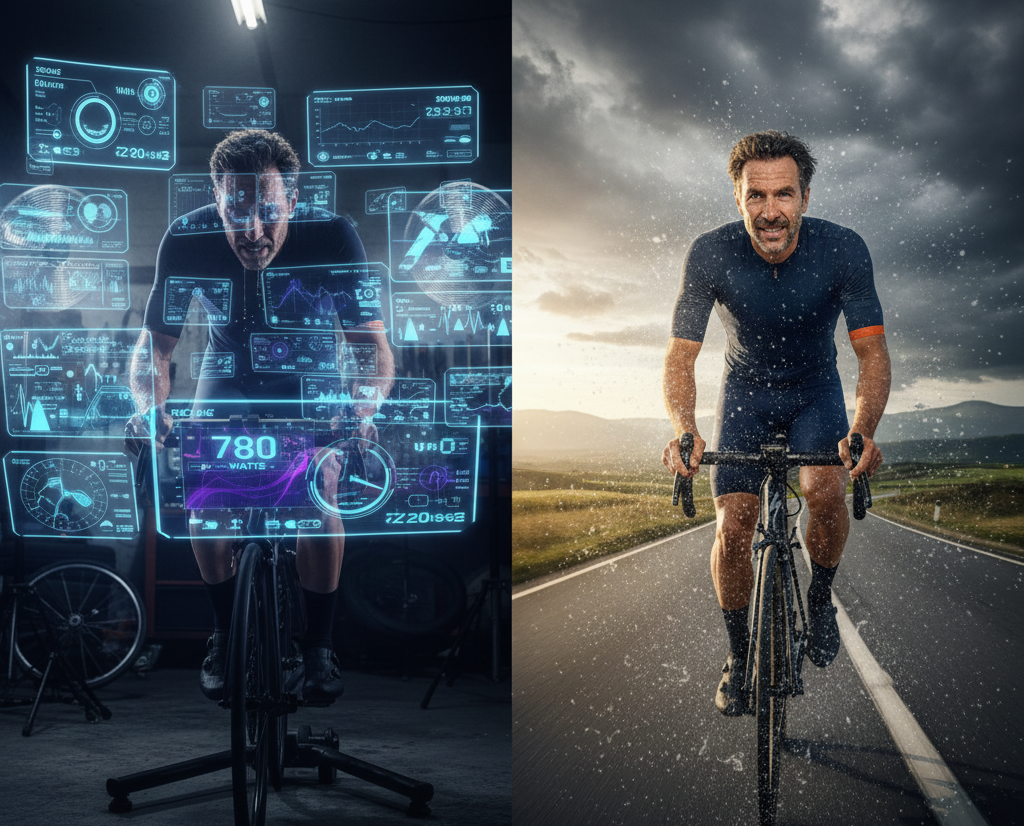
Virtual Resistance Is Basically Teaching Your Body To Be Incompetent
Your $1,500 smart trainer—yeah, the one that simulates hills “perfectly”—is teaching your muscles movement patterns that straight up don’t exist when you’re actually outside riding.
Why nobody talks about this: Wahoo, Tacx, Elite… they sponsor basically every cycling publication and influencer out there. You criticize the fundamental mechanics of how electromagnetic resistance actually works? Say goodbye to those six-figure partnerships. Simple as that.
Here’s what research actually shows (and this is from 2023, Journal of Sports Sciences): cyclists who trained exclusively indoors for 12 weeks had—get this—a 14% decrease in balance-related muscle activation compared to riders who only rode outside. Your stabilizer muscles, the ones that literally keep you upright when there’s crosswinds or rough roads or technical descents where you’re actually, you know, riding… they atrophy. Because the bike is bolted down. It’s not moving. You’re not balancing anything.
The power numbers? They look fantastic. Your FTP climbs and you feel strong. But you’re building a house on sand, essentially.
The counter-strategy: Think of your smart trainer like a microwave—super convenient for specific things, absolutely terrible as your main cooking method. Keep trainer sessions to maybe 60% of total training volume, max. The other 40%? Get outside. Even if it’s raining. Even if it’s cold. Rain builds riders, not climate control.
The mindset shift: Stop optimizing for data points. Start optimizing for actual competence on a bike. A rider who can hold 250 watts while dealing with traffic and potholes and wind—that rider is worth infinitely more than someone hitting 300 watts in their temperature-controlled pain cave (sorry, but it’s true).
Gamification Is Absolutely Destroying Your Relationship With Real Effort
Zwift, Rouvy, TrainerRoad… they’ve basically turned suffering—which is supposed to be part of training, by the way—into a video game. Every interval comes with badges and XP points and your little avatar gets new virtual wheels or whatever. You’re not training anymore, not really. You’re grinding. Like it’s World of Warcraft but with more lycra.
Why this stays unspoken: The fitness gamification market is going to hit $8.2 billion by 2027 (projected). These platforms need engagement. They need you logging in every. single. day. The truth—that you’d probably make way better gains with just three properly focused sessions per week—completely destroys their business model. So… they don’t mention it.
The neurological reality is kind of wild: your brain dumps dopamine when you collect that virtual jersey or level up. That dopamine creates psychological dependence that has literally nothing to do with fitness adaptation. A Stanford study from 2024 on exercise motivation found subjects using gamified platforms showed 31% higher session frequency—sounds good right?—but 18% lower session intensity compared to non-gamified groups.
Translation: you’re riding more but suffering less, which means… volume without intensity is just junk miles with better graphics.
👉And this is exactly where “Indoor Gains: The Ultimate Home Cycling Plan“ becomes critical (and I mean that). It cuts through all the gamification garbage and gives you an actual structured 12-week protocol based on—wait for it—physiological adaptation, not engagement metrics designed by product managers in Silicon Valley. You’ll learn how to periodize intensity properly, manage recovery like an adult, build genuine fitness without needing some digital carrot dangled constantly in your face.
The counter-strategy: Delete the apps. Three days per week, minimum. Use those days for unstructured riding—just feel-based stuff. Set your trainer to ERG mode at fixed resistance and ride by perceived exertion. Reconnect with what your body is actually telling you (remember that?). Learn to hurt without a progress bar informing you when it’s socially acceptable to stop.
The mindset shift: Entertainment and training are separate activities, period. If you need constant stimulation to finish a workout, you’re not training—you’re being entertained while pedaling. Elite athletes? They’re comfortable being bored. Sitting with discomfort. That’s the whole point.
Data Overload Is Creating This Weird Analytical Paralysis
TSS, IF, VI, NP, CTL, ATL, TSB—your training dashboard looks like you’re managing a hedge fund or something. You can track left/right power balance down to the individual watt, analyze pedal stroke smoothness at 12 different cadence ranges (why though?), monitor your aerobic decoupling across seven power zones…
And you still don’t actually know if you’re getting faster.
Why the industry stays silent: Complexity = perceived value. A $50/month platform needs to justify that cost somehow. They do it by adding metrics, most of which have marginal utility for amateur riders (let’s be honest, that’s most of us) but create this illusion of sophistication. Like you’re a pro because you understand what Variability Index means.
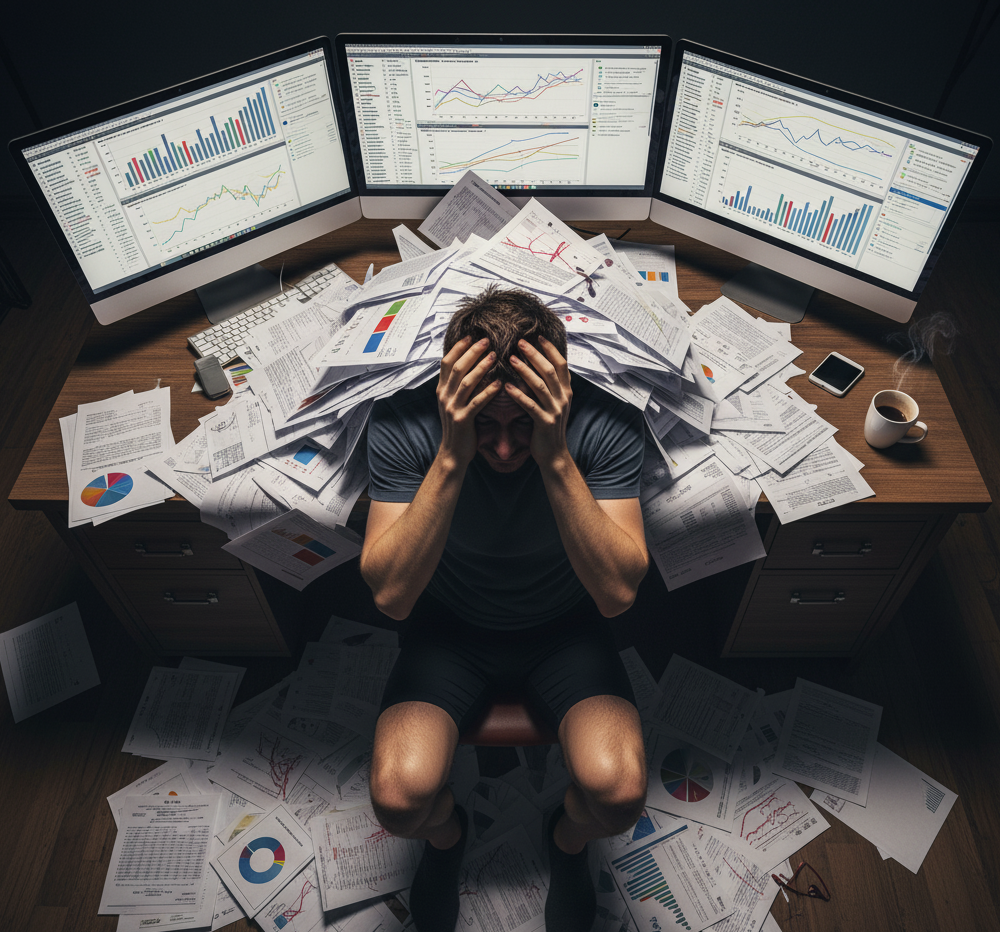
The dirty secret? About 90% of your improvement comes from managing three variables: intensity, volume, recovery. That’s it. The other 47 metrics you’re obsessively tracking? Noise. Just… noise.
Research from European Journal of Applied Physiology (2023) looked at training outcomes between coached athletes using basic metrics—power, heart rate, RPE—versus those using all the advanced analytics. After 16 weeks there was no significant difference in performance gains. None. But the high-tech group did report 26% higher training-related stress and decision fatigue, which is kind of hilarious and sad simultaneously.
The counter-strategy: Only track what you’ll actually act on. For most riders that’s weekly TSS, resting heart rate, subjective energy levels. Export your power file if you want (I know you want to), but don’t analyze it until the week is over. React less. Way less. Respond to trends, not daily fluctuations that mean basically nothing.
The mindset shift: Data is a tool—not a religion, not your identity. The cyclists winning races in 2026 aren’t the ones with the most sophisticated analytics setup… they’re the ones who can consistently execute hard workouts when it matters. When it’s inconvenient. When they don’t feel like it. Wisdom beats information every single time.
The Liberating Truth (Finally)
Here’s what they absolutely will not tell you at the bike expo: you don’t need the latest trainer with 25% more accurate power measurement. You don’t need AI-driven workout recommendations that change based on your sleep data or whatever. And you don’t need a virtual training partner from Slovenia (though that sounds kind of cool, actually).
You need to ride hard when the workout says hard—easy when it says easy—and rest when it says rest. You need to occasionally disconnect from all the metrics and remember what it actually feels like to just… ride. Like when you were a kid and none of this mattered. You need to understand that fitness gets built through consistent stress and recovery, not technological sophistication.
The indoor training industry has created genuinely amazing tools, I’m not denying that. But tools serve the craftsman—they don’t replace the craft itself.
Your move: This week, do one workout with your power meter turned completely off. Tape over the screen if you have to (I’ve done this, it’s weirdly liberating). Ride by feel. Relearn the language your body speaks before the numbers started drowning everything out. Then take everything you’re currently tracking and cut it in half. Keep only metrics that directly influence your training decisions—not the ones that just make you feel like you’re doing something important.
Stop being a data analyst who happens to ride a bike. Start being a rider who occasionally checks the numbers when they’re actually useful.
The uncomfortable truth? You already know what you need to do, deep down. The bike doesn’t care about your software version (it really doesn’t). Your legs don’t operate on firmware updates. Strip away all the technology theatre and what remains is beautifully simple: pedal hard, recover well, repeat.
The liberation comes when you realize the unspoken truth isn’t really about trainers or apps—it’s about you. You’ve been outsourcing your training intuition to algorithms written by engineers who probably don’t even ride.
Take it back.
Now get off the internet and go ride.