The Best Fluffy Pancakes recipe you will fall in love with. Full of tips and tricks to help you make the best pancakes.


Nobody wants to admit this but indoor cycling is fundamentally boring—and pretending otherwise? That’s what’s actually killing your indoor cycling motivation.
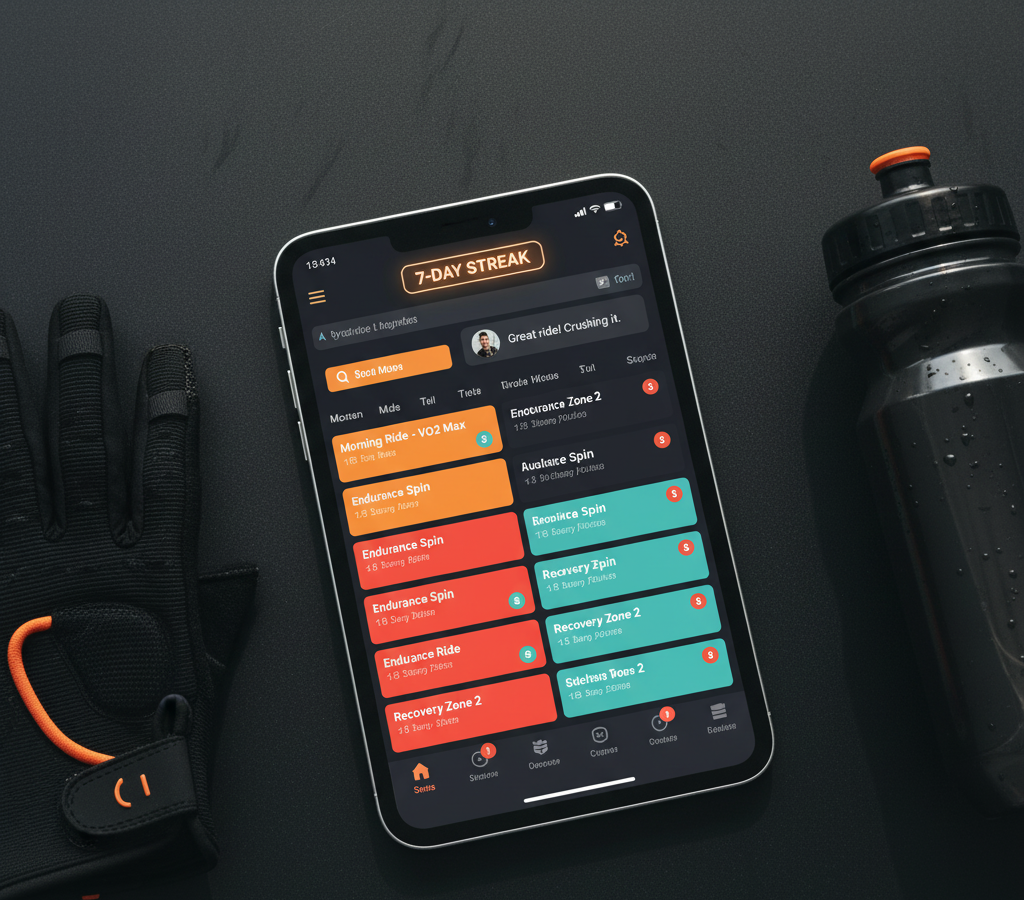
We’ve all scrolled through the glossy marketing. Indoor training is “just as effective” as outdoor riding (sure), virtual platforms make it “feel real” (do they though?), and motivation is simply about “finding your why.” Complete. Utter. Bullshit. The truth is that indoor cycling strips away literally everything that makes cycling psychologically rewarding. The changing scenery, the wind you don’t think about until it’s gone, that random dog that almost takes you out. All of it. Gone.
Until you actually accept this baseline reality, you’ll keep wondering why you can’t stay motivated cycling indoors while everyone else (spoiler: they’re struggling too) seems to have it figured out.
Here are three unspoken truths the cycling industry absolutely will not tell you—and what actually works when you’re training alone, staring at the same wall crack for the 47th time.
Your Brain Is Literally Wired to Hate Repetitive Indoor Training
Why Nobody Talks About It: The indoor cycling industry profits from selling you solutions. Smart trainers ($1,200), subscription apps ($15/month forever), fancy pain caves. If they admitted that your brain’s dopamine system is designed to seek novelty and reward unpredictability—that would undermine their entire business model.
The Science: Research from University College London shows that dopamine neurons respond most powerfully to unexpected rewards, not predictable ones. Indoor cycling is the definition of predictable—same room, same view, same four walls. Your brain’s reward circuitry basically flatlines after 15-20 minutes because there’s zero novelty input. This isn’t a motivation problem. It’s neurobiology.
A 2019 study in Frontiers in Psychology found that monotonous environments significantly decrease intrinsic motivation AND increase perceived effort during exercise. Translation: the same exact workout feels harder indoors because your brain is understimulated. Like, scientifically, measurably harder.
The Mindset Shift: Stop trying to love indoor training. You don’t have to love it (I sure as hell don’t most days). Frame it as strategic suffering—a tool, not an experience. Outdoor rides are for joy. Indoor sessions? Those are for targeted physiological adaptation. Period.
The Counter-Strategy:
- Chaos intervals: Randomize your workout structure completely. Instead of predictable 5×5-minute intervals, use a random number generator for interval length (2-8 minutes) and rest periods (1-3 minutes). Unpredictability reactivates your dopamine response—your brain can’t predict what’s coming so it stays engaged.
- Micro-progression tracking: Forget monthly FTP tests. Track daily micro-wins instead—2 extra watts, 5 extra seconds at threshold, one less time you almost quit. Small, frequent progress hits trigger reward pathways that monotony actively suppresses. I keep a post-it note next to my trainer and just jot down one thing I did better than last time.
- Environmental disruption: Change ONE variable each session. Lighting, temperature, music genre, fan position. Your brain needs something—anything—to break its pattern recognition. Last Tuesday I trained in complete darkness except for a headlamp. Was it necessary? No. Did it make 2x20s slightly less soul-crushing? Oddly, yes.
Social Accountability Is the Only Motivation That Actually Works Long-Term
Why Nobody Talks About It: Because “discipline” and “mental toughness” sell better than “you need other people.” The fitness industry worships rugged individualism. Admitting that cycling consistency tips fundamentally depend on external accountability? That feels like weakness. It’s not, but it feels that way.
The Science: A 2020 meta-analysis in Sports Medicine reviewing 73 separate studies found that social support is the strongest predictor of exercise adherence. Stronger than enjoyment, stronger than perceived health benefits, stronger than personal goals. Researchers at Michigan State University found that working out with a partner increases performance by 200% and workout duration by 180%.
Here’s the uncomfortable part: willpower is finite. Self-motivation depletes like a phone battery. Social accountability doesn’t—it’s an external power source. When you commit to someone else, you activate loss aversion (the fear of letting others down is psychologically twice as powerful as personal disappointment).
The Mindset Shift: Stop viewing accountability as some kind of crutch. It’s not weakness—it’s biology. Elite athletes have coaches and training partners for a reason. Your brain’s prefrontal cortex (responsible for self-discipline) fatigues after prolonged use. External accountability completely bypasses this depletion because the decision is already made.
The Counter-Strategy:
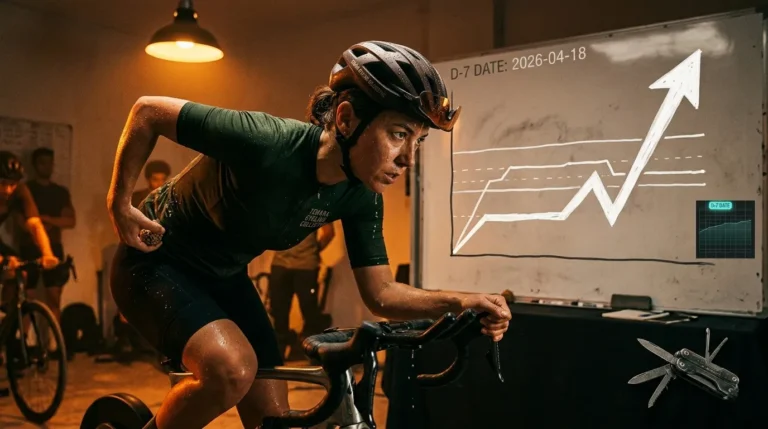
- Public commitment: Post your training schedule on Strava with specific dates and times. Not vague “I’ll train this week” nonsense. Social pressure works because reputation loss is psychologically expensive. Will random internet people actually care if you skip? Probably not. Does your brain think they will? Absolutely.
- Training partner (virtual): Schedule synchronized Zwift/TrainerRoad sessions with someone. Video call optional—just knowing someone else is suffering simultaneously doubles adherence rates. I have a standing Thursday interval session with a guy I’ve never actually met. We barely talk. It works.
- Invest in structure: Programs like “Indoor Gains: The Ultimate Home Cycling Plan“ work because they remove decision fatigue entirely. You’re accountable to a system, not just your fluctuating willpower. Pre-structured workouts eliminate that daily negotiation of “should I train today?” The answer is already decided.
Your Indoor Cycling Setup Is Sabotaging You—and It’s Not About Equipment
Why Nobody Talks About It: The cycling industry desperately wants you obsessed with gear upgrades. Power meters, smart trainers, carbon everything. They don’t want you examining environmental psychology because you can’t buy your way out of that problem.
The Science: A 2018 study in Environment and Behavior found that workout environments significantly impact psychological engagement. Key findings: poor ventilation increases perceived exertion by 12-15%, inadequate lighting reduces motivation by 23%, and confined spaces trigger stress responses that compete with exercise adaptation.
More critical: research from Stanford’s Virtual Human Interaction Lab shows that physical environment directly affects identity formation. If your indoor cycling setup is a cramped corner surrounded by laundry piles, your brain unconsciously categorizes cycling as “something I squeeze in” rather than “something I am.” Identity drives behavior way more powerfully than motivation ever will.
The Mindset Shift: Your indoor cycling setup isn’t about comfort—it’s about psychological priming. Environmental cues shape behavior before you consciously decide anything.
The Counter-Strategy:
- Dedicated space supremacy: Even 6×6 feet matters. Brains respond to spatial boundaries. A dedicated training zone automatically triggers “training mode” before you even clip in.
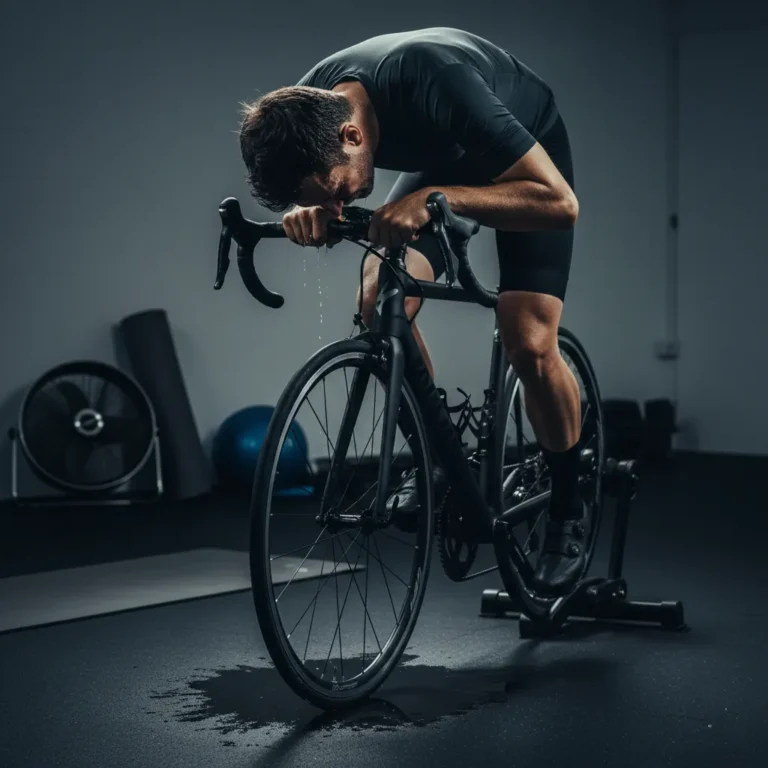
- Airflow non-negotiable: Studies show core temperature rise increases perceived effort exponentially. Two fans minimum (one front, one side). This isn’t comfort, it’s performance science. I learned this after a session where I nearly blacked out and my wife found me lying on the floor. Not my finest moment.
- Visual stimulus control: Face a window or large screen displaying nature scenes. Research shows natural imagery reduces cortisol and extends time-to-exhaustion by 8-12%. Even fake nature helps. Your brain sees green, trees, movement and thinks “outdoor cycling” even though you’re clearly in your basement.
- Friction elimination: Pre-stage everything the night before. Bike ready, bottles filled, workout loaded, gear laid out. Every single decision point is an opportunity to quit. “I need to fill bottles” becomes “maybe I’ll skip today.” Remove. Every. Obstacle.
The Liberating Truth
Here’s what no one says out loud: you don’t need to make indoor cycling fun—you need to make it inevitable.
Stop chasing motivation like it’s some sustainable fuel source. It’s not. Build systems instead that remove the decision entirely. Stack accountability (social pressure works), structure (pre-planned programs eliminate negotiation), and environment (optimized setup reduces friction) until not training actually feels harder than training.
The cyclists who stay motivated cycling indoors aren’t more disciplined—I promise you they’re not. They’ve just eliminated more exit ramps. That’s it. That’s the secret.
Accept the boredom—it’s part of the deal. Weaponize the monotony by using these counter-strategies. Your outdoor season depends entirely on the suffering you’re willing to systematize right now, in November, when it’s dark at 4:30pm and going outside sounds terrible anyway.
Your move: Pick one counter-strategy from each truth. Not all of them (that’s overwhelming). Just one from each. Implement this week—like, actually this week. Stop waiting for motivation to magically appear. It’s not coming. Build the system instead.