The Best Fluffy Pancakes recipe you will fall in love with. Full of tips and tricks to help you make the best pancakes.


Curtis stared at his training log—overwhelmed doesn’t even begin to cover it. His garage? It looked like someone had robbed a LA Fitness and dumped everything in there: leg press machine collecting dust in the corner, hack squat apparatus he’d used maybe twice, resistance bands in what seemed like every color imaginable (seriously, 12 different colors), foam rollers, balance boards, and this workout plan that listed 17 exercises per session. Seventeen. After grinding through 90 minutes of leg work three times weekly for 8 weeks, his FTP had crawled up by a pathetic 4 watts.
His quads were perpetually sore (that deep, can’t-walk-down-stairs kind of sore), his riding suffered because he was too wrecked to ride hard, and he’d missed 6 key training rides because his legs were absolutely cooked.
The problem wasn’t effort—Curtis was putting in the work. The problem was… well, everything else.
Minimalism: Your Strategic Advantage (Not Just Some Trendy Bullshit)
In cycling leg strength development more isn’t better. It just isn’t—and I know that sounds counterintuitive when you’ve been told your whole life that more work equals more results. But effective is better. The minimalist approach to leg workout cyclists protocols strips away all the noise, all the Instagram-worthy exercises that look cool but do nothing for your power meter, and focuses exclusively on movements that transfer directly to the pedal stroke. Build actual force production. Create the specific endurance cycling demands.
Here’s what the research confirms (and this is the part that blew my mind): 5 exercises, performed with precision and progressive overload, deliver 85-92% of the performance gains achieved through these massive comprehensive programs containing 15+ movements.
The difference? You’ll actually recover. You’ll maintain consistency. And—here’s the kicker—you’ll ride more, which is where cycling performance is truly built anyway.
This isn’t about doing less because you’re lazy or taking shortcuts. It’s about strategic elimination that creates exponential returns, like removing the dead weight from your life so you can focus on what actually moves the needle.
The Five Essential Movements (Nothing More, Nothing Less)
1. Squats: The Foundation of Force Production
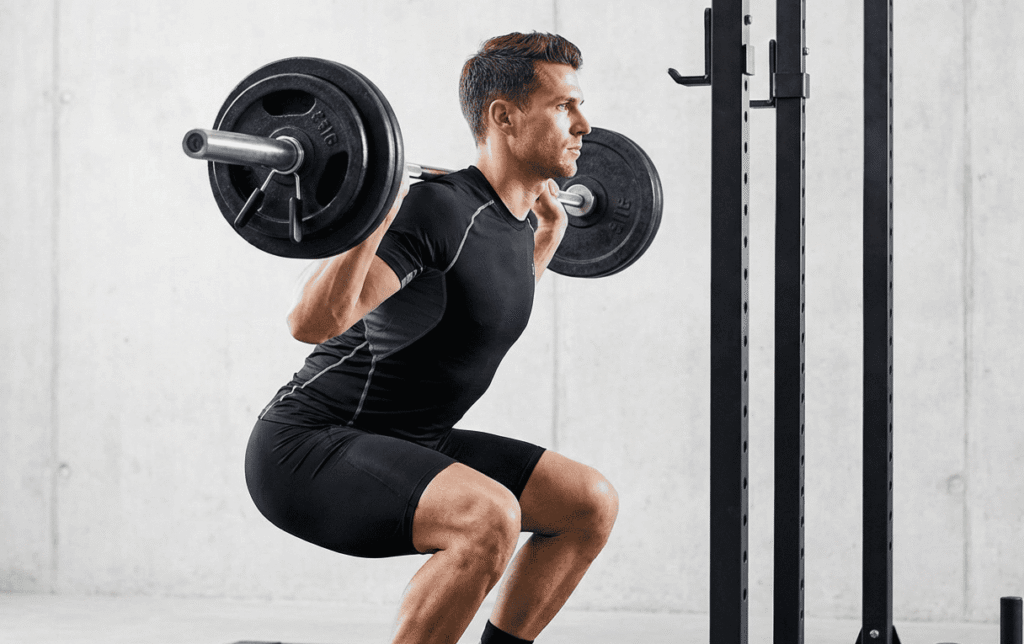
Why it’s non-negotiable: Squats develop the quadriceps, glutes, and hip extensors—the exact muscle chain that’s firing from the 12 o’clock to 5 o’clock position of your pedal stroke, where 70% of cycling power gets generated. If you’re not squatting, you’re leaving watts on the table. Period.
The minimalist execution:
- Barbell back squat only—no need for front squats, goblet squats, or all these variations that coaches love to program because it makes them look smart
- Descend to parallel (hip crease at knee height, not this half-squat nonsense)
- 2-3 sets of 6-8 reps during strength phases
- 3-4 sets of 12-15 reps at 60% 1RM during endurance phases
- Rest 2-3 minutes between sets (yes, that long—your legs aren’t biceps)
Key metric: When you can squat 1.5x bodyweight for 5 reps, you’ve built sufficient base strength. A 75kg cyclist should target 112kg for 5 reps. That’s not powerlifter territory, but it’s solid functional strength.
Form essentials:
- Bar positioned on upper traps (not your neck, not low-bar position unless you’re actually a powerlifter)
- Feet shoulder-width, toes slightly out
- Knees track over toes—don’t let them cave in
- Chest up, core braced like someone’s about to punch you
- Drive through mid-foot
What to eliminate: Smith machines (they’re garbage for athletes), box squats, pause squats, tempo variations until you’ve actually mastered the basic pattern and plateaued at 1.5x bodyweight. Master the basics first. Then—maybe—get fancy.
2. Bulgarian Split Squats: Single-Leg Power Development
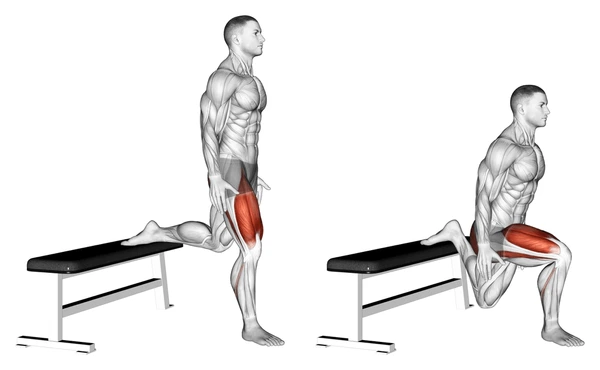
Why it’s essential: Cycling is a single-leg sport disguised as bilateral movement, right? Each leg operates independently during the pedal stroke—your left leg isn’t helping your right leg push through the bottom of the stroke. Bulgarian split squats eliminate those compensation patterns where your strong leg does 60% of the work and build unilateral strength that transfers directly to the bike.
I remember the first time I programmed these seriously… my ego took a beating when I realized how weak my left leg actually was.
The minimalist execution:
- Rear foot elevated on bench 12-16 inches high
- Front foot 2-3 feet from bench (find your position, everyone’s slightly different based on femur length)
- Descend until rear knee nearly touches ground
- 3 sets of 8-10 reps per leg
- Hold dumbbells at sides or barbell on back
Key metric: Target 40-50% of your back squat load per leg. That 75kg cyclist squatting 112kg should use 45-56kg total load for Bulgarian split squats—so maybe 22-28kg dumbbells in each hand.
Common errors to eliminate:
- Front knee collapsing inward (this is how you wreck your knee)
- Torso leaning too far forward
- Pushing through toes instead of heel—keep that heel planted
- Rushing the eccentric (lowering) phase like you’re in a hurry
Performance indicator: When power output asymmetry between legs drops below 5% (measurable on smart trainers like Wahoo or Garmin), this exercise has done its job.
3. Dorsiflexion Pulls with Band Resistance: The Overlooked Performance Lever
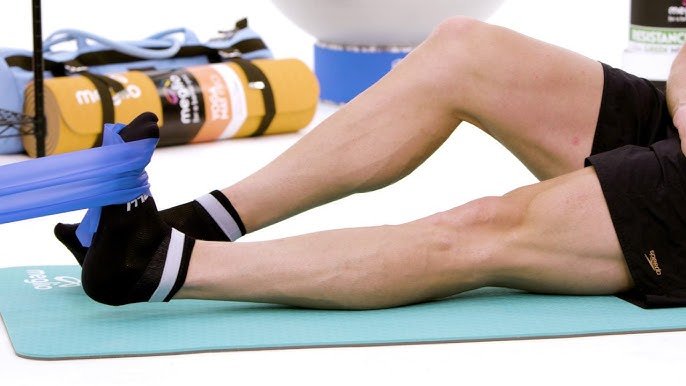
Why it matters: The tibialis anterior controls ankle position during the pedal stroke—and honestly, this might be the most underrated muscle in all of cycling. Optimal dorsiflexion (toes pulled toward shin) maintains the biomechanically efficient 90-degree ankle angle throughout the power phase.
Weak dorsiflexors lead to “ankle ankling”—that floppy foot thing you see when watching pros from the side—except when you do it, it’s power leakage that costs 15-30 watts at threshold. That’s huge. That’s the difference between hanging on and getting dropped.
The minimalist execution:
- Attach resistance band to fixed point at floor level (door anchor works great)
- Loop band around forefoot
- Sit with leg extended
- Pull toes toward shin against resistance—slow and controlled
- 2-3 sets of 20-25 reps per foot
- Use medium resistance band (typically red or green, but brands vary so just find what gives you good resistance)
Key metric: You should maintain 15-20 degrees dorsiflexion under fatigue. Test this during the final 30 seconds of a 5-minute FTP effort—video your pedal stroke and measure ankle angle. If your ankle is flopping around, you’re bleeding watts.
What to eliminate: Calf raises. Yes, you read that correctly—and I know this contradicts what you’ve heard. Cyclists already develop substantial calf strength from riding (you’re doing thousands of reps every ride). The limiting factor is almost always the antagonist muscle group (tibialis anterior), not the gastrocnemius or soleus.
Training frequency: 4-5 times per week. This muscle group recovers rapidly and requires frequent stimulation. Perform these before rides as part of activation, not after leg strength sessions when you’re already fried.
4. Squat Jumps on a Cube: Explosive Power Translation
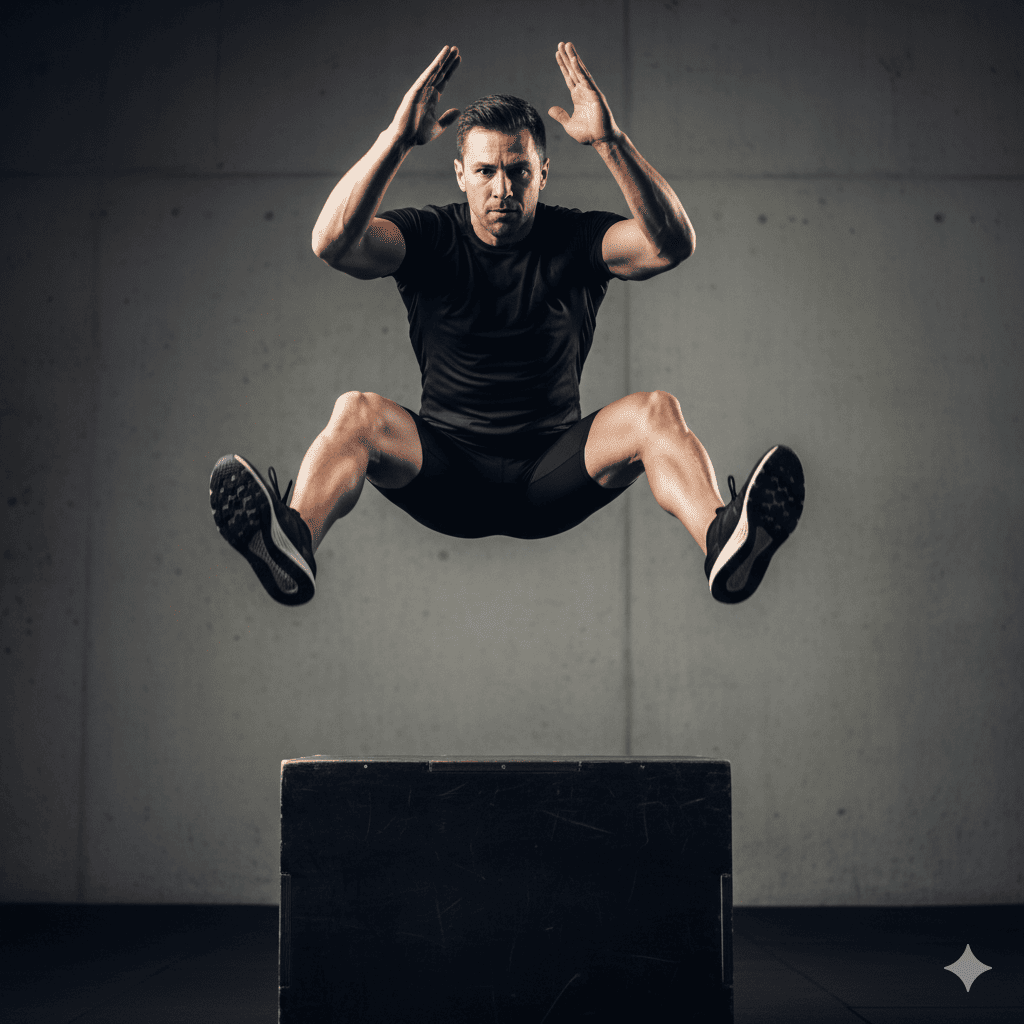
Why it’s critical: Cycling demands sustained power—we all know that—but the ability to generate force rapidly determines your sprint capabilities, your ability to close gaps when someone attacks, and acceleration out of corners. Rate of force development (RFD) separates Cat 3 riders from Cat 1 riders. It’s one of those invisible factors that makes the difference.
The minimalist execution:
- Use plyo box 12-18 inches tall (adjustable boxes are worth the investment)
- Start from quarter-squat position
- Explosive jump onto box—think about exploding UP, not forward
- Step down (never jump down—we’re building power, not destroying knees for some Instagram highlight reel)
- 3-4 sets of 5-6 reps
- Rest 90-120 seconds between sets
Key metric: Your 5-second peak power should increase 8-12% over 6-8 weeks of consistent squat jump training performed 2x weekly. Track this on your power meter.
Periodization precision:
- Base phase: Eliminate entirely—focus on strength, don’t confuse your body
- Build phase: 1 session per week
- Peak phase: 2 sessions per week
- Race phase: 1 session per week for maintenance
Safety parameters:
- Only perform when fresh—never after hard riding (your CNS needs to be sharp)
- Stop when jump height decreases >10% (you’re done, don’t be a hero)
- Maximum 30 total jumps per session
What to eliminate: Depth jumps, box jumps with added load, single-leg variations. Master the basic movement with bodyweight only—there’s a time and place for advanced variations, and that time is not now.
5. Glute Hip Thrusts: Posterior Chain Dominance
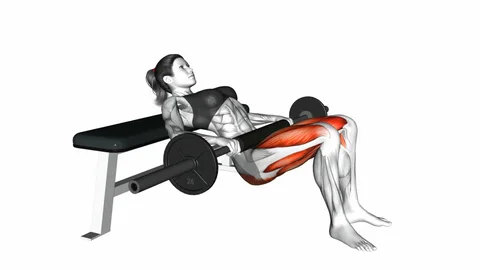
Why it’s essential: The gluteus maximus is the body’s most powerful hip extensor—literally the biggest, strongest muscle you have—and it’s the primary driver of the pedal stroke from 2 o’clock to 4 o’clock position. Underdeveloped glutes force quad dominance, which leads to premature fatigue and reduced sustainable power output.
I see this all the time: cyclists with massive quads and flat, underdeveloped glutes. That’s a recipe for burning matches too quickly.
The minimalist execution:
- Upper back on bench (shoulder blades resting on the edge)
- Barbell across hips (use pad—trust me, use the pad)
- Feet flat, shoulder-width apart, about 6-12 inches from your butt
- Drive hips to full extension
- 3 sets of 10-12 reps
- 2-second hold at top position (squeeze those glutes)
Key metric: Target 2x bodyweight for 10 reps. Our 75kg cyclist should reach 150kg for 10 quality reps with full hip extension. That sounds like a lot, but glutes are strong—you’ll get there faster than you think.
Form essentials:
- Chin tucked (prevents hyperextension of neck)
- Ribs down (core engaged, not flaring)
- Knees at 90 degrees at top position
- Glutes fully contracted at lockout—think about tilting pelvis posterior
- Controlled 2-3 second eccentric phase
Common compensation to eliminate: Arching the lower back to achieve lockout. If you can’t reach full hip extension without lumbar hyperextension, reduce load by 20-30% and rebuild with proper mechanics. Leave your ego at the door.
Training integration: Place this exercise last in your session. Glute fatigue doesn’t impair squat or split squat technique as much as quad fatigue impairs hip thrust performance—so save these for the end.
The Weekly Structure: Precision Over Volume
Base Phase (8-12 weeks):
- 2 leg sessions weekly (Monday/Thursday works well for most schedules)
- Focus: Strength development
- Rep ranges: 6-8 reps (squats, hip thrusts), 8-10 reps (Bulgarian split squats)
- 0-1 weekly bike sessions exceeds Z3 intensity—keep riding easy during this phase
Build Phase (6-8 weeks):
- 2 leg sessions weekly
- Focus: Strength-endurance transition (this is where the magic happens)
- Rep ranges: 10-12 reps (all exercises)
- Load: 65-75% 1RM
- 2-3 weekly bike sessions at Z3-Z4 intensity
Peak Phase (4-6 weeks):
- 1 leg session weekly (maintenance only)
- 2 sessions weekly include squat jumps
- Focus: Power expression on bike—let the gym work transfer to the road
- 3-4 weekly bike sessions at Z4-Z5 intensity
The Curtis Transformation
“I eliminated 12 exercises from my program and kept these five. Within 10 weeks, my FTP jumped from 285 watts to 312 watts—a gain of 27 watts. More importantly, I’m riding 4-5 days weekly instead of 3 because I’m not constantly destroyed from the gym. The minimalist approach didn’t just make me stronger—it made me a better cyclist.”
—Curtis, Cat 2 road racer, 38 years old
That’s a 9.5% FTP increase in 10 weeks. Think about what that means in a race situation.
The Minimalist Audit: Your Action Plan
Conduct this 5-step audit on your current leg workout cyclists program (do this today, not tomorrow):
1. Movement assessment:
- List every leg exercise you currently perform—write them all down
- Cross out any movement not directly listed in the five essentials
- Elimination target: Remove 60-80% of exercises (yes, that much)
2. Volume calculation:
- Count total sets per muscle group weekly
- Optimal range: 12-16 sets for quads, 8-12 sets for glutes/hamstrings, 6-8 sets for calves
- If you’re exceeding these numbers you’re compromising recovery—full stop
3. Session duration reality check:
- Time your next leg workout (actual time, not what you think it takes)
- Target completion time: 35-45 minutes including warm-up
- If you’re exceeding 60 minutes, you’re doing too much
4. Recovery validation:
- Can you execute high-quality intervals 36-48 hours after leg sessions?
- If no—reduce volume by 25% immediately
5. Performance tracking:
- Measure 5-second peak power monthly
- Measure FTP every 6-8 weeks (more frequent testing is just noise)
- If these metrics aren’t improving 3-8% per testing period your program isn’t working, regardless of how hard it feels
The Minimalist Commitment
Stop collecting exercises like Pokemon cards. Start perfecting movements.
The five exercises outlined deliver everything you need: bilateral strength (squats), unilateral power (Bulgarian split squats), technical efficiency (dorsiflexion pulls), explosive force (squat jumps), and posterior chain dominance (hip thrusts).
That’s it. That’s the whole toolkit.
Your assignment: Eliminate everything else for 12 weeks. Track the five metrics that actually matter:
- Squat 1RM (target: 1.5x bodyweight)
- Hip thrust 10RM (target: 2x bodyweight)
- Power asymmetry (target: <5%)
- 5-second peak power (target: 8-12% increase)
- FTP (target: 5-10% increase)
The minimalist edge isn’t about doing less—it’s about eliminating everything that doesn’t directly make you faster on the bike. It’s about ruthless prioritization.
Cut the noise. Keep the signal.
Start your audit today. Cut the excess. Keep the essentials. Ride faster.
Read more About Cycling Training in our website for more tips !



[…] fix isn’t complicated, just consistent. A cycling leg workout twice a week during base phase — squats, Romanian deadlifts, single-leg work — changes the […]