The Best Fluffy Pancakes recipe you will fall in love with. Full of tips and tricks to help you make the best pancakes.


Here’s the thing about time—it’s the one resource you can’t buy back, can’t manufacture, can’t negotiate with. Every single minute you’re dumping into training protocols that don’t work? That’s time you’re stealing from actual results.
In cycling leg workouts (and I mean real, performance-driven leg work, not just casual weekend rides), the gap between someone who’s stuck at the same power output for months and someone who’s crushing PRs every few weeks comes down to this: eliminating the friction. The unnecessary stuff. The steps that look productive but are really just… noise.
Most cyclists—and I’ve seen this happen over and over—waste somewhere around 3-4 weeks sitting on plateaus. Sometimes longer. Why? Bad sequencing, intensity that’s either too much or not enough, recovery that’s completely mismanaged. But here’s what gets me: it’s completely avoidable. The strategies I’m about to break down will compress what normally takes months of fumbling around into something actionable that delivers strength gains you can measure in 21-28 days. Maybe less if you’re dialed in.
Strategy #1: Progressive Overload Through Cadence Manipulation
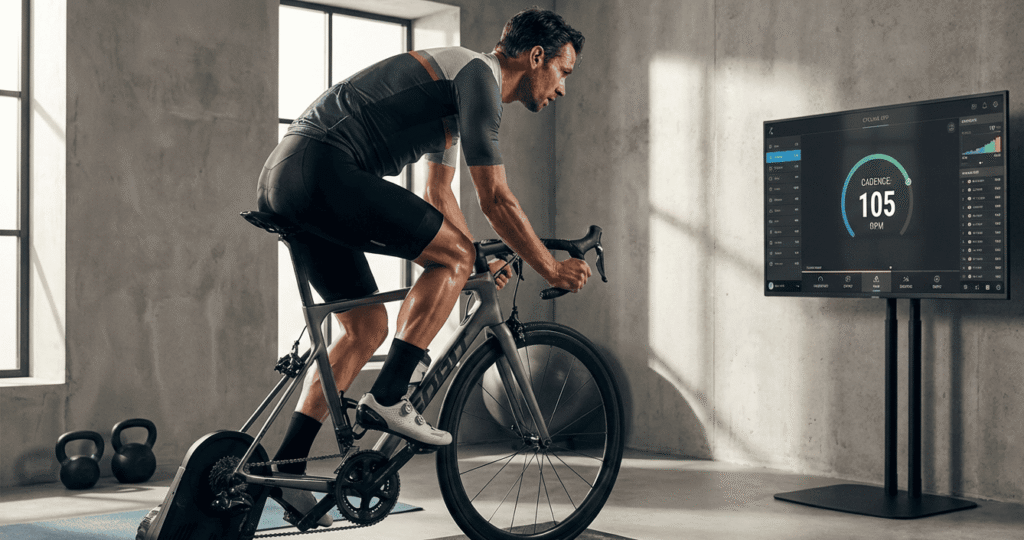
Okay so most people think progressive overload means… what, just ride longer? Add another 30 minutes to your weekly mileage? That’s the standard playbook, and it works—eventually. But it’s slow. Painfully slow.
Fast-forward method: manipulate your cadence zones within the same session.
Execute 4-minute intervals that alternate like this:
- Low cadence (50-60 RPM) at high resistance for 90 seconds (this should feel like you’re grinding through molasses)
- High cadence (100-110 RPM) at moderate resistance for 90 seconds
- Recovery spin at 80 RPM for 60 seconds
What this does—and I remember the first time I tried this, my quads were screaming by interval three—is it forces muscular adaptation without needing dumbbells or barbells or whatever. The low-cadence segments? They’re recruiting those Type II muscle fibers that normally just sit there dormant during your standard Sunday cruise. High-cadence stuff enhances the neuromuscular efficiency, basically teaching your legs to fire faster.
Real-world application: Your indoor trainer sessions become your strength workouts. No gym required (which honestly, who has time for that anyway). Complete 5-6 intervals per session, do this 3 times weekly. Strength gains show up within 2-3 weeks—that’s equivalent to 6-8 weeks of the traditional “just add more miles” approach.
Strategy #2: Hill Repeats With Structured Recovery Ratios
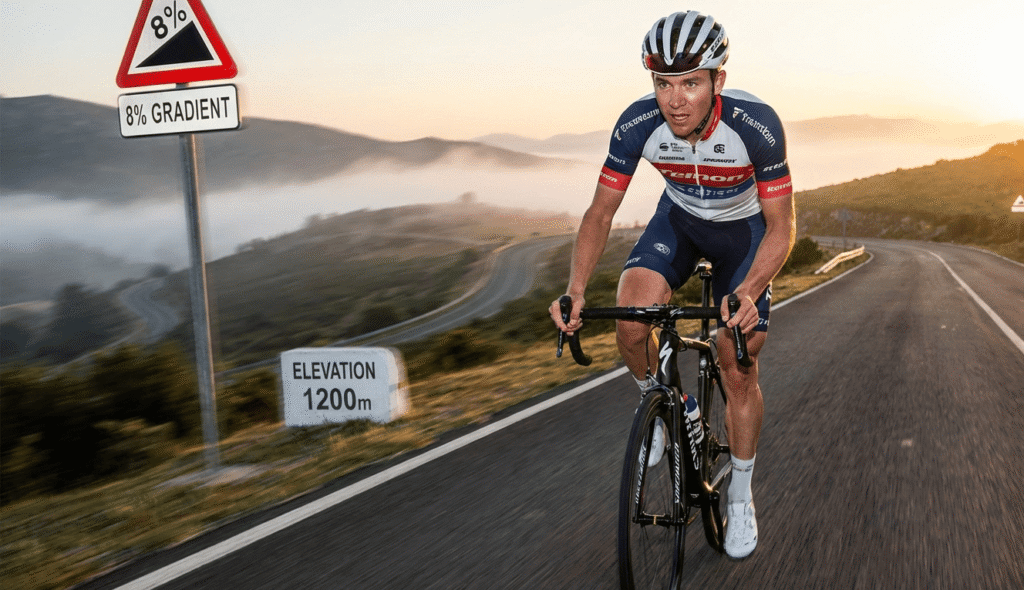
Hills are basically nature’s squat rack. Free resistance training, right there waiting for you. But—and this is critical—the acceleration in results comes from nailing the work-to-rest ratios. Get this wrong and you’re just accumulating fatigue with no adaptation.
Protocol looks like this:
- Select a grade between 6-10% incline (steeper isn’t always better, trust me)
- Work interval: 60-90 seconds at 85-90% maximum effort
- Recovery: 3-4 minutes of active recovery, just easy spinning
- Repeats: 6-8 per session
The critical distinction here (and where most people screw this up): they under-recover between repeats. They think shorter rest = tougher workout = better results. Wrong. What happens is cumulative fatigue that just tanks the quality of each subsequent repeat. That 3-4 minute recovery window? It allows partial ATP-PC system restoration while keeping training density high enough to matter.
Real-world application: Take one of your weekly endurance rides—maybe that Thursday ride you do—and replace it with hill repeats. Jackie, who races amateur competitions in the northeast, told me she switched to this protocol. “Within 4 weeks, my FTP jumped 15 watts and my standing climb power went up 22%.” Those aren’t small numbers.
Track your power output (or heart rate ceiling if you don’t have a power meter yet) on each repeat. When you can hold 95% of your first-repeat power all the way through to the final repeat, that’s when you increase the grade by 1-2% or extend the duration by 15 seconds.
Strategy #3: Single-Leg Drilling for Bilateral Strength Balance
Muscular imbalances are like… they’re like having a leak in your car’s transmission. Everything seems fine until you really need the power, and then you realize you’ve been compensating the whole time. Your dominant leg does the heavy lifting, literally, and masks how weak your non-dominant leg actually is.
Single-leg drills expose this—sometimes uncomfortably—and correct it within 10-14 days.
Here’s how:
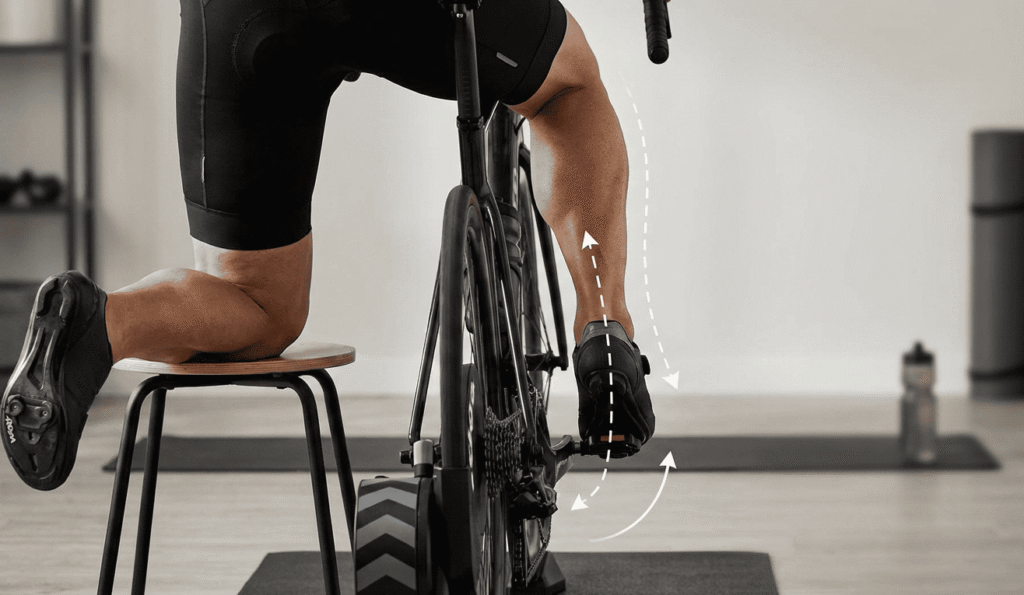
- Unclip one foot (rest it on the trainer frame or just let it hang, whatever feels stable)
- Pedal with your single leg for 30-60 seconds
- Focus hard on the complete pedal stroke: pulling through the bottom, pushing over the top
- Switch legs
- Complete 4-6 sets per leg
Your non-dominant leg is going to fatigue 30-40% faster at first. I’m not exaggerating—it’s genuinely shocking how much weaker it’ll be. But this gap closes fast with consistent practice.
Real-world application: Build this into your warm-ups (2-3 sets) and cool-downs (2-3 sets). It doesn’t take much time. Within 3 weeks, bilateral power output increases by somewhere around 8-12% because the weaker leg finally catches up and your overall pedal stroke efficiency improves.
Measure it: track how long you can maintain 150 watts on a single leg. When both legs match within 10% of each other, you’ve eliminated the imbalance. (And honestly, you’ll feel it—climbs that used to wreck you will suddenly feel… manageable.)
Strategy #4: Isometric Strength Holds at Dead Spots
Dead spots. Top and bottom of the pedal stroke. These are where power just… bleeds out. Most cyclists don’t even realize how much force they’re losing at these transition points.
Isometric holds at these specific positions build strength exactly where you’re weakest—it’s targeted in a way that regular riding can’t replicate.
Protocol:
- Position your crank arm at 12 o’clock (top dead center, basically)
- Apply downward pressure for 10-15 seconds at around 70-80% max effort (not a full sprint effort, but you should feel it)
- Rest 30 seconds
- Repeat at 6 o’clock (bottom dead center), this time pulling up
- Complete 3-4 sets per position, each leg
This hits your hip flexors, glutes, hamstrings—the exact muscles that give out during sustained climbing or when you’re trying to launch a sprint.
Real-world application: Do this 2-3 times weekly, either as a standalone micro-session or tacked onto the end of regular rides. Standing starts and sprint accelerations improve within 2 weeks (sometimes sooner) because you’re finally generating force through zones that were previously dead weight.
Side note—combine this with resistance bands looped around your upper thigh for an additional 15-20% recruitment increase. Game changer.
Strategy #5: Tempo Accumulation Blocks
Tempo riding… it’s that sweet spot zone where you’re building muscular endurance without frying your central nervous system. The kind of fatigue that delays recovery for days? Tempo work avoids that. But the acceleration technique here involves something called block periodization.
Standard approach scatters tempo efforts across weeks—a little here, a little there. Random.
Fast-forward method: concentrated 3-4 day tempo blocks where you stack the stress intentionally.
Block structure:
- Day 1: 2 x 20 minutes at 76-85% FTP, with a 5-minute recovery between sets
- Day 2: 3 x 15 minutes at 78-87% FTP, 4-minute recovery between
- Day 3: 1 x 40 minutes at 75-83% FTP (this one’s brutal mentally, not gonna lie)
- Day 4: Active recovery—just 30 minutes of easy spinning
- Days 5-7: Complete rest or cross-training (yoga, swimming, whatever)
What happens is this concentrated stress followed by extended recovery triggers supercompensation. Your mitochondrial density increases 18-25% faster than it would with distributed training. It’s like… instead of applying gentle pressure consistently, you’re applying intense pressure briefly, then backing off completely so your body can adapt.
Real-world application: Schedule these blocks every 3-4 weeks. Between blocks, just maintain with 1-2 moderate intensity rides weekly—nothing crazy. Cyclists who follow this pattern get threshold improvements in 6-8 weeks that normally take 12-16 weeks with traditional programming.
Key thing (and I can’t stress this enough): the recovery week isn’t optional. It’s not being lazy. Adaptation happens during rest, not during the stress itself.
Implementation Framework
Don’t try to do everything at once—that’s a recipe for burnout or injury or both.
Combine these systematically:
Week 1-2: Establish your baseline with single-leg drills (3x/week) plus one hill repeat session Week 3-4: Add in the cadence manipulation intervals (2x/week), keep doing the drills and hills Week 5: Execute your tempo block Week 6: Active recovery mode, maintain drills only Week 7-8: Full protocol—isometric holds (2x/week), cadence work (2x/week), hills (1x/week), drills pretty much daily
This sequence prevents overtraining (which is easier to do than most people think) while building comprehensive leg strength across all energy systems and muscle fiber types. It’s… it’s methodical, but that’s the point.
The Bottom Line
Every cycling leg workout you do should ruthlessly eliminate what doesn’t work and amplify what does. These five techniques remove the guesswork, they compress those adaptation timelines, and they deliver strength gains you can actually quantify in 4-8 weeks instead of the months-long slog most people endure.
You have the complete framework now. All of it. The question isn’t whether these methods work—the physiology is proven, the results are documented. The real question is whether you’ll actually implement them or keep cycling at the same watts you’ve been stuck at for… how long has it been? Months?
Stop wasting training time on protocols that were designed for general fitness, for people who just want to “stay in shape.” Start using techniques that were engineered specifically for performance.
Your move: Pick one strategy. Just one. Execute it for 14 days straight. Track the numbers—power output, heart rate, whatever metrics you have access to. Then come back and stack another strategy on top.
The cyclists who win consistently? They’re not necessarily the ones with the most natural talent (though that helps). They’re the ones who eliminate delays, who execute relentlessly, who don’t get distracted by shiny new training fads every other week.
Want more Info and tips ? Check our Full Cycling Training Guide !