
The Best Fluffy Pancakes recipe you will fall in love with. Full of tips and tricks to help you make the best pancakes.


Nobody’s going to tell you this straight, but here it is: the secret to cycling endurance isn’t about riding longer—it’s about riding slower.

I know, I know. Sounds completely backwards, right? Like someone telling you to eat more to lose weight (which, by the way, sometimes works but that’s a different conversation). You’ve been doing this all wrong. Every single cyclist I know obsesses over intensity. Pushing harder. Suffering more. Making their Strava files look like heart attack simulations. Meanwhile—and this is the part that’ll blow your mind—pro riders spend 75-80% of their training time at intensities so ridiculously easy it feels like you’re cheating. Like riding to the coffee shop with your grandma.
This is the game-changer that’s been hiding in plain sight: Zone 2 dominance paired with strategic high-intensity work creates these mitochondrial adaptations that literally transform your engine. At the cellular level. We’re talking about rebuilding your body’s power plant from the ground up.
But why does everyone miss this? Because slow feels wrong. Unproductive. Because our culture worships suffering—no pain, no gain, all that nonsense. The fitness industry? They’re selling you interval torture sessions, not patience.
Time to fix that.
The Secret: Mitochondrial Density Through Volume (Not Violence)
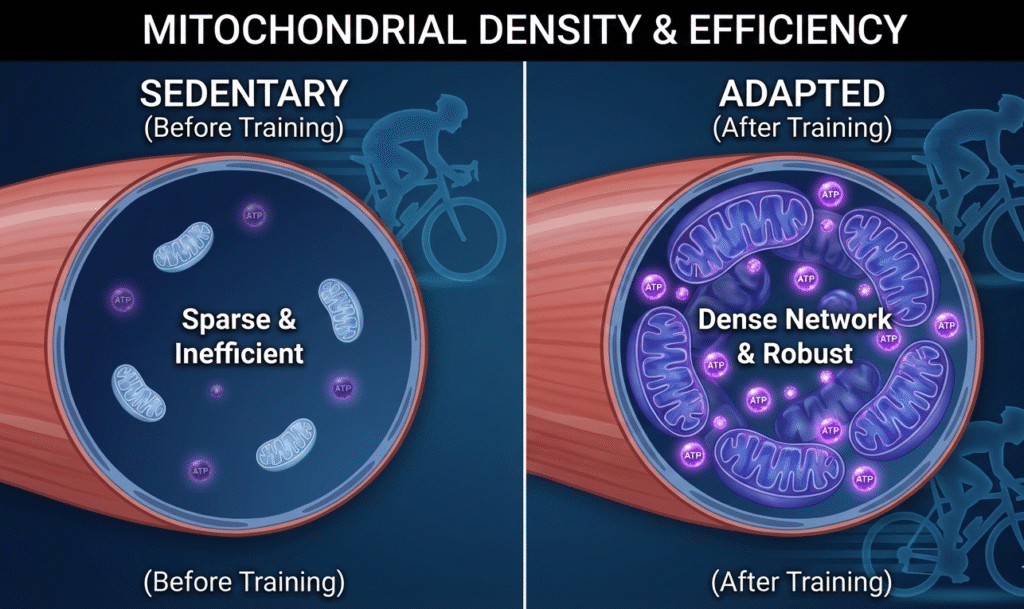
Your cycling endurance isn’t about willpower—though coaches love to make you think it is. It’s limited by your mitochondria’s ability to produce ATP efficiently using fat as fuel. Those little powerhouses in your cells? They’re the whole game.
Elite riders don’t just have bigger engines. They have fundamentally different engines that burn cleaner fuel, longer. It’s like comparing a hybrid car to a gas-guzzling truck from the ’90s.
When you ride in Zone 2 (56-75% of FTP), you trigger something called mitochondrial biogenesis—your cells literally build more powerhouses. More mitochondria = more endurance. Simple math. But here’s the cruel irony: ride too hard too often, and you suppress this adaptation. Your body gets better at suffering (which, admittedly, has its place) but not at actual endurance.
“I spent two years hammering every single ride at threshold,” Jerry told me last spring—he’s this category 3 racer from Colorado, always wore these neon yellow socks you could spot from a mile away. “Wondering why I’d completely blow up after 90 minutes like clockwork. Six months of proper Zone 2 work? I rode 5 hours at my old ‘hard’ pace without bonking. Same legs. Different engine.”
That stuck with me.
Why This Secret Stays Hidden (The Uncomfortable Truth)
Three reasons riders overlook the mitochondrial approach, and none of them are pretty:
- Ego disruption – riding easy means getting dropped on group rides initially, and nobody wants to be that person
- Delayed gratification – adaptations take 8-12 weeks to manifest significantly (our instant-gratification brains hate waiting)
- Counterintuitive effort – going slower to race faster violates every competitive instinct you have
The fitness industry doesn’t help matters. HIIT sells. “Ride easy for 3 hours” doesn’t exactly make for viral Instagram content, does it? Social media rewards suffering faces and dramatic post-ride collapse photos—not science. Here is how you can actually start HIIT Cycling.
Key Explanation #1: The Zone 2 Foundation (Where Magic Happens)
Zone 2 isn’t recovery. Let me repeat that because people constantly get this wrong: Zone 2 isn’t recovery. It’s construction. This is where you’re actively building the aerobic base that determines your sustainable power output.
Target metrics for Zone 2:
- 56-75% of FTP (Functional Threshold Power)
- Heart rate sitting at 60-70% of maximum
- Conversational pace—and I mean actually conversational, you should handle full sentences without gasping
- 2-6 hour duration per session (yes, really)
What’s happening physiologically while you’re spinning away feeling like you’re barely working? Your body is:
- Increasing mitochondrial density by 20-40% over 12 weeks
- Upregulating fat oxidation enzymes (fancy term for teaching your body to burn fat better)
- Expanding capillary networks by 15-25%
- Improving mitochondrial coupling efficiency
Implementation protocol (and stick to this):
- Dedicate 3-4 rides weekly to strict Zone 2—no cheating
- Start with 2-hour sessions, gradually progress to 4-6 hours
- Track power religiously because every single watt above 75% of FTP sabotages the adaptation
- Schedule these when you’re fresh, not as some afterthought recovery spin
How do you know it’s actually working? Your power at the same heart rate increases. Like, at 140 bpm you might hold 200 watts initially. Eight weeks later, that same 140 bpm yields 230 watts. That’s pure mitochondrial efficiency talking.
I remember testing this last fall—watching my power climb while my heart rate stayed flat felt almost supernatural.
Key Explanation #2: The Sweet Spot Multiplier
Zone 2 builds the foundation (we’ve established that), but Sweet Spot training (88-93% of FTP) accelerates your ceiling without compromising mitochondrial development. It’s the perfect middle ground that most riders completely ignore.
Sweet Spot exists in this metabolic sweet spot—see what they did there?—intense enough to stress lactate processing, easy enough to sustain for 20-60 minutes without creating the excessive fatigue that requires 3-4 days recovery.
Why it’s overlooked: It’s not sexy enough. Not threshold suffering, not VO2max that is too much commercialized —just this productive discomfort that doesn’t make for dramatic training stories.
Sweet Spot session structure (write this down):
- 2-3 intervals of 20-30 minutes each
- Recovery intervals 5-8 minutes at 50-60% FTP
- Total interval time should hit 40-90 minutes
- Frequency: 1-2 times weekly maximum
This training raises your lactate threshold while maintaining mitochondrial stimulus. You’re teaching your engine to run both efficiently and powerfully—which is exactly what you need for those long gravel events or century rides where you can’t just soft-pedal the whole way.
The critical mistake? Doing Sweet Spot when you should be doing Zone 2. One Sweet Spot session weekly is potent—really effective. Three sessions weekly destroys your aerobic development, leaves you perpetually fatigued, and turns you into one of those riders who’s always “tired but fit.”
Key Explanation #3: Polarized Training Architecture (The 80/20 Rule That Actually Works)
Here’s where the secret crystallizes into something actionable: 80% easy, 20% hard. Not 60/40. Not 50/50. Strict polarization—and yes, the percentages matter.
Elite riders discovered this through trial and error; science just confirmed what they already knew. Studies on Olympic cyclists consistently show this distribution maximizes both mitochondrial adaptations and high-end power development. It’s been replicated across sports too—runners, rowers, cross-country skiers all follow similar patterns.
Weekly structure for polarized cycling endurance:
- 3-4 sessions: Zone 2 (2-5 hours each) – this is your bread and butter
- 1-2 sessions: High-intensity (VO2max or threshold) – where you actually suffer
- 1-2 sessions: Recovery or complete rest (rest days are training days, remember that)
- Total weekly hours: 10-15 for serious development
The high-intensity work (1-2 sessions) can look like:
- 4-6 x 5-minute intervals at 105-120% FTP (these hurt)
- 3 x 8-minute threshold efforts at 95-105% FTP
- 30/30s: 30 seconds hard, 30 seconds easy, repeat 20-30 times until you question your life choices
Why does this work when moderate-intensity training fails so spectacularly? Because moderate intensity (80-90% FTP) provides insufficient stimulus for VO2max development while creating too much fatigue for optimal mitochondrial biogenesis. You end up stuck in the “grey zone”—too hard to build endurance, too easy to build top-end power. It’s the worst of both worlds.
Are you stuck in the grey zone right now? Honest question. If most rides feel “moderately hard” and you rarely go truly easy or brutally hard, you’re there. And you’re spinning your wheels (pun intended).
Key Explanation #4: Fat Oxidation Adaptation (Teaching Your Body to Burn Better Fuel)
Cycling endurance fundamentally depends on fat metabolism, and this is where things get really interesting from a physiological standpoint.
Your body stores 40,000+ calories as fat but only about 2,000 calories as glycogen. Think about that ratio for a second. Teaching your engine to burn fat at higher intensities is basically unlocking a massive fuel reservoir you’ve been ignoring. Performance transformation doesn’t even begin to cover it.
Zone 2 training increases fat oxidation rates at given intensities. Initially—and I’ve seen this pattern in myself and dozens of other riders—you might burn predominantly carbs above 60% FTP. After 12 weeks of consistent Zone 2 work? You’re burning 50% fat at 70% FTP. That’s a complete metabolic rewiring.
Testing fat oxidation progress (because data matters):
- Perform 60-minute fasted Zone 2 rides periodically
- Track perceived exertion and power stability throughout
- Monitor improved energy stability at hours 3-4 of long rides—this is where you’ll really notice the difference
Nutritional strategy to accelerate adaptation:
- Execute 1-2 Zone 2 sessions weekly in a fasted state (morning rides before breakfast work great)
- Limit carbohydrate to 30-40g per hour on Zone 2 rides
- Reserve heavy carbohydrate fueling (60-90g per hour) for high-intensity sessions only
This seems completely backwards, right? Won’t limiting carbs hurt performance? Short term, possibly—you might feel a bit flat initially. Long term, though, you’re building metabolic flexibility that allows 5-6 hour rides without bonking or having to consume 300+ grams of sugar like you’re running a mobile candy store.
Key Explanation #5: The Recovery Equation (Where Most People Fail)
Here’s what destroys most cycling endurance programs before they even get going: inadequate recovery between quality sessions. People just keep hammering.
High-intensity intervals create 24-72 hours of molecular signaling for adaptation. Your body’s literally remodeling itself during that time. Interrupt this with another hard session too soon, and you suppress the adaptation. It’s like repainting a wall before the first coat dries. Zone 2, on the other hand, creates minimal disruption—you can ride 4-5 hours and recover within 24 hours because you haven’t dug that deep metabolic hole.
Recovery markers to monitor (ignore these at your peril):
- Resting heart rate elevated 5+ bpm above normal: you’re under-recovered, back off
- Heart rate 10+ bpm higher for given Zone 2 power: fatigue is present, maybe take a rest day
- Sleep quality degraded 3+ consecutive nights: training load is excessive, seriously
The math is simple when you break it down: 1 high-intensity session requires 48-72 hours recovery. 1 Zone 2 session requires 12-24 hours. This is exactly why polarized training works so well—the volume comes from low-intensity work that doesn’t bury you in fatigue debt.
I learned this the hard way back in 2024 when I tried adding a third VO2max session per week. Lasted about 10 days before I was completely cooked.
Implementation Timeline (Your 12-Week Roadmap)
Weeks 1-4: Establish Zone 2 discipline (the hardest part mentally)
- 3 x 2-hour Zone 2 rides weekly
- 1 x threshold session to maintain top-end
- Accept slower speeds; trust the process; build the base
Weeks 5-8: Increase volume progressively
- 3 x 3-hour Zone 2 rides
- 1 x Sweet Spot, 1 x VO2max session
- Fat oxidation improves noticeably—you’ll feel different on long rides
9-12: Peak adaptation phase
- 2 x 4-hour, 1 x 2-hour Zone 2 rides
- 2 x quality intensity sessions
- Performance transformation becomes evident to everyone around you
Your Move (Because Reading Changes Nothing)
You now understand what separates riders who fade at 90 minutes from those crushing 6-hour epics without drama. The secret isn’t complexity—it’s discipline and patience.
Stop riding moderately hard every single session. Stop confusing intensity with productivity (they’re not the same thing). Start building mitochondrial density through massive Zone 2 volume. Add strategic intensity through polarized distribution.
Can you suppress your ego long enough to ride slow? Can you trust delayed gratification over instant suffering? Or can you commit 12 weeks to this protocol without getting distracted by the next shiny training fad?
The riders leaving you behind at hour four of the century aren’t tougher—they’re smarter. They built different engines while you were busy posting your suffering face on Instagram.
Your engine overhaul starts with tomorrow’s 2-hour Zone 2 ride. 56-75% of FTP. No excuses, no ego, no heroics. Just adaptation, quietly building in the background.
Transform your cycling endurance. Build the engine. Dominate distance.
The choice is yours—but honestly, you already know what you need to do.
Check our full Cycling Training Guide for more tips and info !








[…] this with a real cycling endurance workout structure — adding roughly 10–15 minutes to your long ride each week — and you start […]