
The Best Fluffy Pancakes recipe you will fall in love with. Full of tips and tricks to help you make the best pancakes.


The medieval alchemists — and look, people forget this — weren’t crackpots. They were the scientists of their era, obsessed with a single stubborn idea: that combining the right elements under the right conditions produces something that cannot be explained by simply adding the parts together. They failed, obviously. No gold. But the principle? Completely, stubbornly undefeated.
We’ve been running a version of that same experiment at Pedalynx. Not with sulfur and mercury, but with biology and timing and — stay with us here — the indoor cycling sprint. Three concepts. Seemingly unrelated. And when you fuse them deliberately, something shifts in the body that steady-state riding never touches. Not as metaphor. As measurable, trackable physiology.
Here’s the formula. No detours.
Element I: Neuromuscular Prime — The Brain Goes First, Always
Here’s the thing most coaches won’t say out loud: your legs aren’t actually the bottleneck. They’re not. Mental fatigue alone — no physical effort involved whatsoever — can tank endurance performance by up to 18%. We covered this in our indoor cycling mental strategies guide, and honestly, the number surprised even us when we first went through the research.
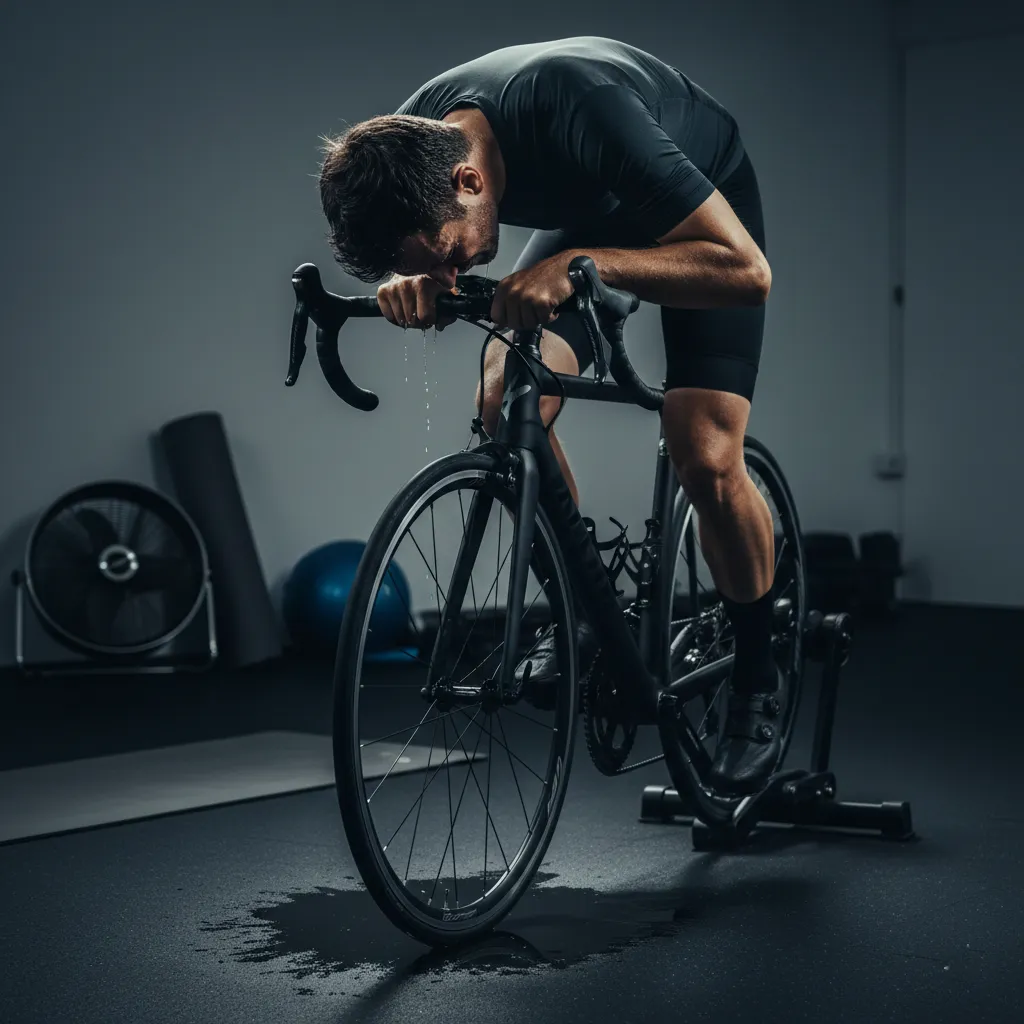
The default approach goes like this: suffer through the session, hope the endorphins show up eventually, repeat until consistency magically appears. It doesn’t work. Or — more precisely — it works until it doesn’t, and then one Tuesday evening you walk past the bike, glance at it, and suddenly remember you have emails. Very important emails.
What actually works is what we call the Architect Principle. You stop being the audience of your own effort. You design the mental environment before you clip in.
For indoor cycling sprints specifically, this looks like:
- Pre-ride: Name one psychological objective — stress discharge, sharp focus, simulated competition. One. Not three.
- A 3-word anchor — something like “locked, loose, lethal” — repeated at the start of every sprint. Write it on your hand if you have to.
- A 2-minute attention drill mid-session: collapse your awareness down to a single sensation. The burn in the left quad. The breath. Just that. Nothing else.
- The minute-20 reset — this is the boredom cliff, where most people mentally check out — a 10-second internal statement: “I control this. The discomfort is the point.”
Riders using structured mental frameworks show 40–60% higher consistency week over week. Not because they became more disciplined people. Because the experience itself changed categories. It stopped being something to survive.
Element II: Metabolic Switching — Rewriting What Your Cells Run On
Your mitochondria are, if we’re being honest, a little lazy by default. They run on glucose because glucose is easy — fast energy, no complicated negotiations. And standard cycling just reinforces that habit. You pedal, they burn sugar, everyone goes home.
The indoor cycling sprint breaks that agreement entirely.
In our breakdown of the HIIT cycling weight loss formula, we laid out what’s actually happening during 6–8 sprint intervals of 45 seconds at 95–100% max heart rate, each followed by 90–120 seconds of active recovery at 50–60% max HR. Your glycogen stores get demolished. Your mitochondria, now somewhat panicked, begin upregulating fat oxidation enzymes during every recovery window — preparing for whatever comes next. It’s a kind of productive cellular anxiety.
The numbers that came out of research between late 2024 and early 2025 are hard to ignore:
- Fat oxidation rates climb 27–43% compared to steady-state alternatives
- Afterburn (technically: EPOC) keeps your metabolism elevated for 24–48 hours post-session — an extra 150–300 calories daily, passively
- After 4–6 weeks, the mitochondria themselves multiply — mitochondrial biogenesis — more furnaces, more fuel capacity, completely restructured metabolic machinery
Our Afterburn Calculator
Metabolic Afterburn Calculator
Indoor sprints trigger EPOC — a hidden calorie burn that lasts up to 24 hours after your session ends. Find out exactly what you are leaving on the table.
Session Duration
45min
15m30m45m60m75m90m
Option A
Steady State
Endurance · 10 cal/min
Option B
Alchemist Sprints
HIIT · 13 cal/min
Fasted (12–14h since last meal)
Unlocks maximum metabolic switching + highest EPOC
Maximum Metabolic Switching Activated
Fasted sprints unlock the full Alchemist protocol — fat oxidation + EPOC at peak capacity.
Calorie Breakdown — Work vs. Afterburn
Work Burn
0cal
During session
Afterburn
0cal
Next 24 hours
Total
0cal
Full transmutation
🕑 Steady state is valuable for base fitness, but the afterburn window stays nearly closed. Your metabolism returns to baseline within minutes of finishing.
Pedalynx · EPOC estimates are approximate. Individual results vary with fitness level, diet and training history.
Perform these fasted — 12–14 hours post-meal — and the switching amplifies further. Which sounds almost too clean, too convenient. But that’s what the data shows.
This is why the indoor cycling sprint isn’t a calorie event. It’s closer to a software update.
Element III: Power Consistency — Precision Is the Variable Nobody Respects
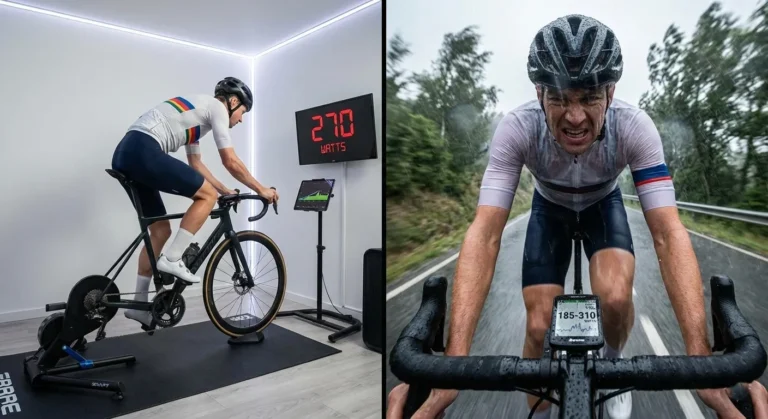
Outdoor intervals feel heroic. They also, frustratingly, don’t work as well — at least not for pure physiological adaptation. Headwinds slash output by 18–24%. A 1% gradient shift alters power demand by 30+ watts. Traffic breaks the average outdoor interval 2.3 times per session, which isn’t a dramatic stat until you realize you’re spending half your training time recovering from disruptions rather than adapting to stimulus.
We went deep on this in our indoor vs. outdoor HIIT piece, where we introduced the Power Consistency Coefficient — cardiovascular adaptation accelerates 3.2x faster when sprint intensity stays within ±2% of target power throughout the full work interval. Outdoors? You’re doing well to hold ±15%.
On a smart trainer in ERG mode, that ±2% is just… reality. Every pedal stroke. The trainer enforces it so you can focus entirely on the effort.
Practically, this means:
- 5-minute warm-up → 3–5 sprint intervals → 3-minute cooldown — simple, repeatable, scalable
- 45 minutes of controlled indoor sprinting outperforms 90 minutes of variable outdoor effort for adaptation
- 12 weeks of this precision builds what takes 18–22 weeks outdoors to develop — if the outdoor athlete even maintains enough consistency to get there
Your mitochondria respond to exact metabolic stress at exact thresholds for exact durations. Scenery doesn’t factor into that equation.
The Synthesis — What Happens When All Three Catch Fire Simultaneously
Here’s where it gets interesting, and maybe a little hard to explain linearly.
Each element alone is useful. Genuinely useful. But the interaction between them produces something the parts simply can’t account for on their own — and that’s the alchemical point we kept circling back to while writing this.
Think of it structurally: neuromuscular prime is the crucible — it contains and directs the heat. Without mental architecture, sprint efforts bleed focus and drift off target. Metabolic switching is the chemical reaction, the actual transmutation happening at cellular depth. Power consistency is the temperature control — because a reaction without stable conditions either burns out or never fully ignites.
When you enter a sprint session having designed your mental state, your nervous system fires with precision instead of static. That precision — and this is the part that surprised us — directly improves your ability to hold ±2% power variance. Distracted cyclists drift. Focused ones lock in. Locked-in consistency creates uninterrupted metabolic stress — the exact quality of stimulus that triggers mitochondrial switching. Mitochondrial switching, sustained across 6–8 weeks, builds the cellular infrastructure that makes future sprints measurably, verifiably faster.
Not additive. Exponential.
“I wasn’t doing more hours — I was doing smarter ones,” says Joaquin, 38, from Almería, Spain. “The mental side stopped me dreading it. The sprint structure gave me something real to aim at. Week 8, something just clicked — like my legs became a different machine. Down 9kg. FTP up 28 watts. I kept waiting for the formula to feel complicated. It never did.”
The Mistakes That Collapse the Crucible
The formula fails without proper containment. We’ve documented the exact failure points in our HIIT cycling mistakes breakdown — three patterns that quietly destroy results most riders never trace back to their actual source:
- Going maximum intensity every session — cortisol accumulates, fat metabolism stalls, the body shifts into preservation mode
- Treating nutrition as secondary — it’s 70% of the transformation equation, not a footnote
- Skipping recovery — the adaptation you’re training for lives in the 48–72 hours after the sprint, not during it
Limit sprint sessions to 2–3 per week. Build in 2–3 Zone 2 rides at 65–75% max HR around them. Hit 0.7–1g of protein per pound of bodyweight daily. Sleep 7–9 hours — and mean it.
If you’re starting from zero, our beginner HIIT cycling framework is where the protocol begins. Not because the formula is complicated — it isn’t — but because sequencing matters. You build the crucible before you light the fire.
Become the Alchemist
The medieval alchemists failed because they searched outward. Special minerals. Rare compounds. External magic. The transformation they were looking for was always a question of methodology, not material.
You have three elements now. A primed nervous system. A metabolism being retrained at the cellular level. Precision power delivery that compounds across weeks. The indoor cycling sprint is your crucible — the container where these three stop being separate things.
The only question that remains isn’t whether this works.
It’s whether you’ll keep treating your sessions as something to endure — or finally start designing them as something to master. Those aren’t the same activity. They never were.
Light the fire. Become the alchemist.
Read more In our Full Indoor Cycling Guide for more tips and info !





[…] at true Zone 2 (60–65% max HR, actually conversational), and 20% at genuine high intensity during indoor cycling sprint intervals where you’re managing maybe 3–5 words per breath, maximum — creates two completely […]
I was recommended this blog by my cousin. I am not sure whether this post is written by him as no one else know such detailed about my problem. You’re amazing! Thanks!