The Best Fluffy Pancakes recipe you will fall in love with. Full of tips and tricks to help you make the best pancakes.


You know that specific kind of frustration — the one that sits in your chest on a Wednesday evening when you’ve just finished another solid session, sweat still dripping, and you already know before you even check the numbers that nothing moved? Same watts. Same heart rate response. Everything. It’s not burnout exactly. It’s more like shouting into a room where the acoustics are broken.
That’s the indoor cycling plateau. And most riders respond to it by doing more of the thing that stopped working.

Here’s what we’ve seen — consistently, across every level of cyclist — plateau isn’t a fitness failure. It’s a methodology failure. Full stop. Your body adapted, efficiently and successfully, to the exact stimulus you keep repeating. And every week you spend grinding the same sessions is a week of adaptation potential that just… evaporates. Minimizing those wasted cycles — cutting directly to what actually shifts something — that’s the entire architecture of this piece.
Five strategies. No detours. Let’s go.
Strategy 1: Shatter the Middle — Stop Training at the Intensity That Does Nothing
The most reliable plateau generator we encounter is this: riders spending virtually all their time at moderate intensity. Not genuinely easy. Not genuinely hard. Just… somewhere in the murky middle that feels productive because it hurts a little.
It isn’t productive. It’s metabolic limbo.
The fix is structural and it’s almost annoyingly simple once you see it. Polarized training — 80% of weekly volume at true Zone 2 (60–65% max HR, actually conversational), and 20% at genuine high intensity during indoor cycling sprint intervals where you’re managing maybe 3–5 words per breath, maximum — creates two completely distinct adaptation signals that moderate training collapses into one blurry non-signal.
Practically:
- If you’re riding 5 hours weekly: 4 hours Zone 2, 1 hour structured sprints. Not approximately. Actually.
- Zone 2 should feel almost embarrassingly easy for the first 20 minutes
- Sprint intervals should feel, honestly, a little unreasonable — 90–100% max HR, no negotiating
Three weeks of this and your body encounters training stimuli it genuinely hasn’t processed before. That novelty — that unfamiliarity — is itself the mechanism. The plateau cracks not because you got fitter overnight, but because you finally stopped asking your body to solve the same equation it already solved months ago.
Strategy 2: Microdose the Progression — Tiny Increases, Enormous Compounding
Traditional progressive overload — the “add 10% weekly” gospel — sounds rigorous. In reality it’s a fast track to overtraining, accumulated fatigue, and the specific flavor of plateau that sends riders backward before they plateau at all.
We went deep on the alternative in our HIIT cycling weight loss formula breakdown. The concept: increases so incremental they feel almost pointless in isolation. Until week 10, when you look at where you started and genuinely can’t reconcile the gap.
The numbers that actually work:
- Sprint wattage up 5–8 watts per interval every 10 days — not weekly, every ten days
- 1 additional interval every 2 weeks, hard ceiling at 10 total intervals per session
- Recovery periods shortened by 5–10 seconds monthly while interval intensity stays constant
A rider starting at 6 intervals × 250 watts lands at 9 intervals × 285 watts after 12 weeks of this. That’s a 14% power increase and 50% volume increase — achieved without a single session that felt catastrophic. The body’s stress alarm never fully fires. Adaptation keeps accumulating. Cortisol stays manageable.
This is compounding progress. Categorically different from linear progress — and the only kind that survives long enough to break a plateau that’s been sitting there for months.
Strategy 3: Train When Your Biology Is Actually Ready — Circadian Timing Isn’t Optional
Most riders choose training times based on convenience or habit. Fair enough for maintenance. For breaking a genuine indoor cycling plateau — leaving adaptation on the table this way is, we’d argue, almost counterproductive.
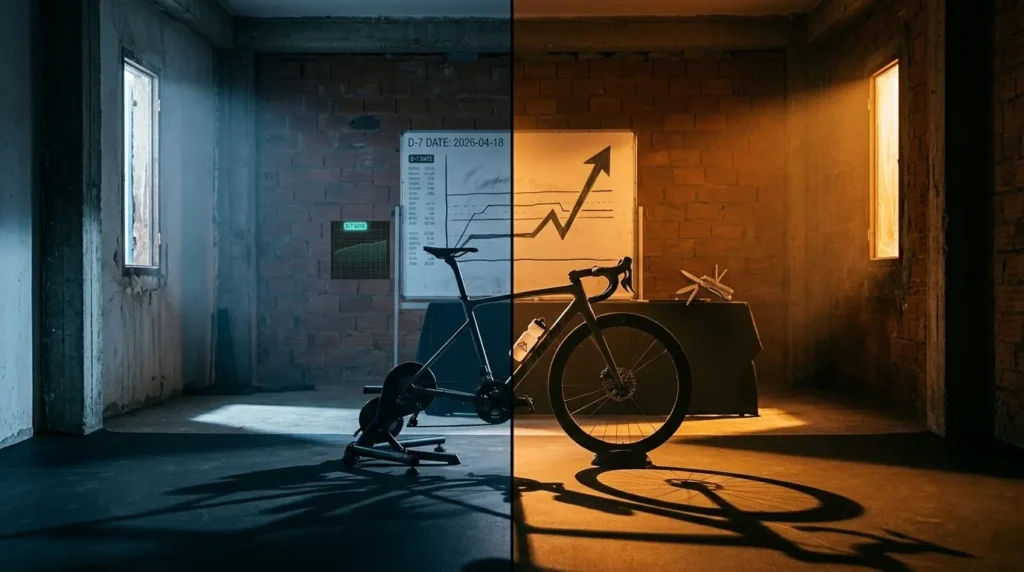
Two windows. Both documented, both measurably superior to training at random times:
- Morning (6–8 AM): Cortisol and growth hormone are naturally elevated. Insulin is suppressed from overnight fasting. Sprint intervals here — performed fasted at 12–14 hours post-meal — produce fat oxidation rates 27–43% higher than fed training. The body arrives already primed to switch fuel sources.
- Afternoon (4–6 PM): Core body temperature peaks. Neuromuscular coordination is sharpest. Power output runs 12–18% higher than morning for the same perceived effort — meaning your intervals hit a ceiling you literally cannot access at 7 AM.
As we detailed in the indoor sprint workout formula: 2 morning fasted sessions + 1 afternoon power session weekly creates a combined effect neither window produces alone. Morning sessions rewire fat metabolism. Afternoon sessions raise the raw power ceiling.
Riders who shift timing without changing anything else report FTP movement within 3–4 weeks. Same effort. Same structure. Different clock. That’s not magic — that’s just finally working with the biology instead of ignoring it.
Strategy 4: Fix the Mental Architecture — Because Yes, Your Brain Is Part of the Plateau
We know. This is the one that gets eye-rolls. We’re including it anyway — because mental fatigue alone, with zero physical exertion involved, degrades endurance performance by up to 18%. That number was surprising to us too when we first encountered the research.
If you’re negotiating with yourself at the 30-minute mark, dreading the bike by Tuesday, going through sessions in a kind of detached autopilot — there is a mental component to your plateau that no amount of wattage restructuring will fully address. We broke the whole framework down in our indoor cycling mental strategies guide. The condensed version:
- Before every session: One psychological objective. Focus. Stress discharge. Competitive simulation. One — not a list.
- A 3-word mental anchor at the start of each interval. “Sharp. Present. Locked.” Something with edges to it.
- Minute 20 — where most riders mentally dissolve — a 10-second reset: “I’m adapting right now. This is the mechanism, not the obstacle.”
- Post-session: Rate your mental performance 1–10 before you touch the metrics. Log it. Actually care about it.
Riders with intentional mental frameworks sustain structured training for an average of 18 weeks versus 6 weeks without. Three times longer. The plateau breaks — not through some dramatic physical breakthrough — but through the compounding effect of showing up mentally prepared, session after session, long after riders without structure have quietly abandoned the plan.
Strategy 5: Audit What’s Actively Holding You Back — And Stop Doing It
Sometimes the fastest route forward is just — stop doing the thing that’s working against you. We mapped the three biggest killers in our HIIT cycling mistakes piece, and almost every plateau we’ve ever seen maps cleanly onto at least one of them.
Going hard every session. Chronic high intensity accumulates cortisol, suppresses fat metabolism, and trains the body to resist the adaptation you’re desperately chasing. Cap genuine hard efforts at 2–3 sessions weekly. Everything else must be — actually, verifiably — easy.
Neglecting nutrition precision. Training is roughly 30% of the transformation equation. Nutrition is the other 70% — and most plateaued riders are either under-fueling (muscle gets cannibalized, metabolism tanks) or over-compensating post-ride and erasing the deficit entirely. The targets:
- 0.7–1g protein per pound of bodyweight daily — non-negotiable
- 30–60g complex carbs 2–3 hours pre-ride
- 20–40g simple carbs immediately post-sprint session
- Caloric deficit of 300–500 calories below maintenance — controlled, sustained, not aggressive
Skipping recovery. Adaptation — the actual physiological change you’re training for — lives in the 48–72 hours after the session, not during it. Riders who treat recovery seriously lose 2–3x more body fat than those who overtrain, despite doing 30% fewer total hours. Sleep 7–9 hours. Take 1–2 complete rest days weekly.
And if you’re still debating indoor versus outdoor for your interval work — our indoor vs outdoor HIIT breakdown is worth reading. Indoor sessions produce 23% lower cortisol than equivalent outdoor efforts. Faster recovery. Higher weekly training capacity. The controlled environment isn’t a compromise — for plateau-breaking specifically, it’s an advantage.
The Plateau Was Never Permanent
Filip, 34, from Scotland — 7 months at the same FTP. Riding 5 days weekly, working genuinely hard, completely stuck. He restructured using the polarized model, moved to 3 morning fasted sprint sessions weekly, applied microdosed progression, fixed protein to 175g daily at 175lbs bodyweight.
8 weeks. FTP up 31 watts. Weight down 6kg. Average power on his regular route up 11%.
“I wasn’t doing less,” he said. “I was finally doing the right things in the right sequence. The plateau wasn’t a wall — it was just a signal I’d stopped giving my body a reason to change.”
That’s the whole thing, honestly. Your body is not broken. It adapted — successfully, efficiently — to exactly what you gave it. Give it something structurally different and it responds. No choice in the matter.
Start with the beginner HIIT framework if the structure is unfamiliar. Layer in the sprint interval system. Fix the mental architecture. Respect recovery. Microdose the progression. Time the sessions deliberately.
The plateau was never the destination. It was just the last place you stopped changing something.
Go change something. Today.