
The Best Fluffy Pancakes recipe you will fall in love with. Full of tips and tricks to help you make the best pancakes.


Here’s the thing nobody says out loud — knowing the benefits of bike commuting doesn’t make you do it. You know. You’ve read the stats, you’ve done the rough math on fuel costs, you’ve told yourself “I really should start cycling to work” approximately 47 times since January. And yet. The car keys are still the default.
The gap between knowing and doing isn’t motivation. It’s friction. Tiny, stupid, avoidable friction — the unpacked bag, the outfit you haven’t figured out, the vague fear that you’ll show up to a 9am smelling like a locker room. Strip that friction out, piece by piece, and the benefits stop being theoretical. They become your Tuesday morning.
We’ve been deep in this stuff across a few posts now — the clothing system, the sweat problem, the honest psychological weirdness of being a bike commuter in a car world. What keeps surfacing: the riders who actually stick with it aren’t optimizing their gear. They’re optimizing their system. Small difference. Enormous result.
So. Here are 5 strategies that don’t just work — they compress your timeline to actually feeling them.
Strategy 1: The 3-Layer Rule (Decide Once, Never Again)
Most people’s morning routine is a negotiation. Is it cold enough for the heavy jacket? Will it warm up by 8:30? What if it rains on the way back but not the way there? This is exhausting and — more importantly — it’s the thing standing between you and the door.
Kill the negotiation.
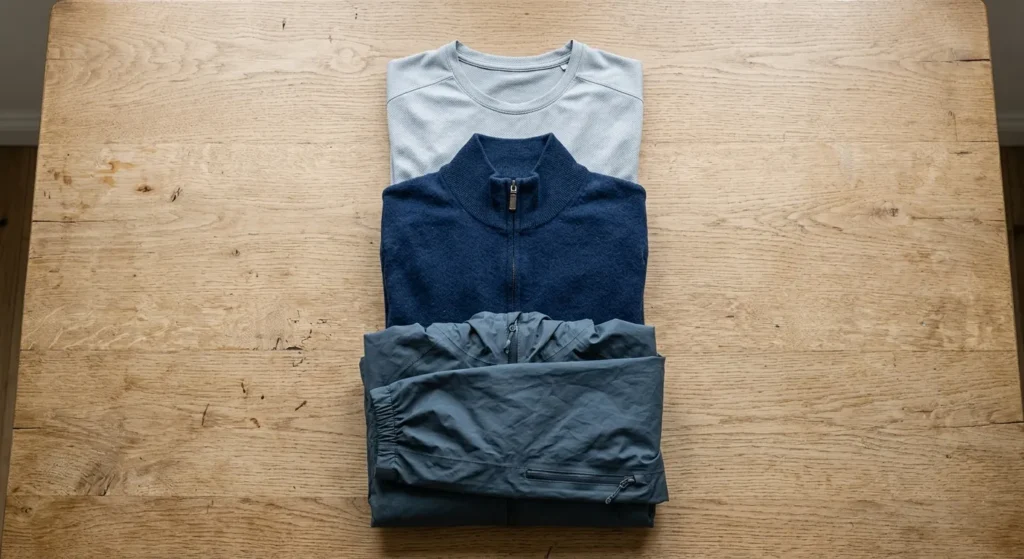
3 layers. Same system. Every ride.
- Base layer — literally any moisture-wicking athletic shirt you own already. Your 5K shirt from 2021 works fine, stop researching “cycling-specific” base layers that cost $89 when yours does the same job.
- Mid layer — one merino wool quarter-zip. Merino doesn’t smell even when you sweat (actual magic, we don’t make the rules), looks like a normal sweater at the office, adjusts in seconds.
- Shell — this is where you actually spend money. $180–$250 for a real rain jacket with pit zips and a long back hem. It replaces the 4 or 5 “maybe” jackets currently folded in your closet doing nothing.
As we laid out in our commuter cycling clothing guide, the decision fatigue is the enemy — not the weather. Three pieces, locked in. You’re not thinking about it at 7am, you’re just grabbing them and leaving.
Strategy 2: Two Pairs of Pants. That’s It. Seriously.
Okay this one is controversial and I’m prepared for the pushback. You don’t need cycling-specific pants for your commute. You don’t need padded shorts. And certainly you don’t need to change clothes twice a day like you’re maintaining a secret identity.
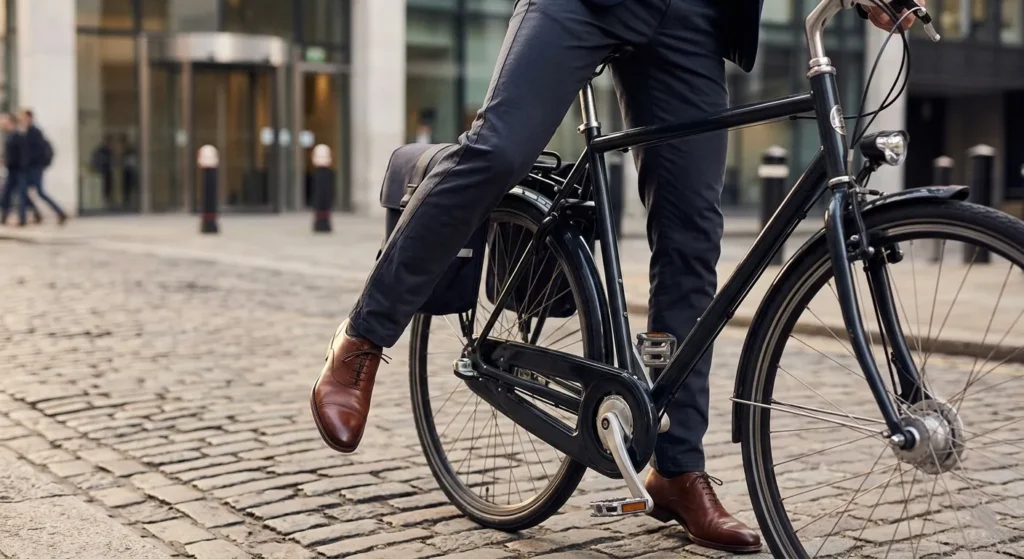
What you need: 2 pairs of pants with stretch fabric — 2–5% elastane is enough — a high enough rise that you’re not flashing anyone when you lean forward, and a dark color because chain grease is basically inevitable and you know it.
Technical chinos, stretchy jeans, whatever. They look like normal work trousers because they basically are. The point is they move with you AND they’re appropriate for your desk. No transition. No phone-booth-Superman moment in the office bathroom.
The math on this is almost offensive in how simple it is. Eliminating clothing transitions saves 30–40 minutes daily. Over a 5-day week that’s somewhere between 2.5 and 3.5 hours handed back to you. That’s a whole evening. For buying two slightly stretchy pairs of trousers.
Strategy 3: The Desk Drawer Kit (Set It Up Once, Forget About It)
Sweat stops more new commuters than traffic does. Not because it’s actually that hard to manage — but because when you haven’t solved it yet, it feels like an unsolvable problem. Like arriving at work damp is just the price of admission and you’re not sure you want to pay it.
You’re not. And you don’t have to.
The fix is permanent infrastructure, not daily packing. Bret — who rides in Manchester, which is not exactly a dry climate — put it simply:
“I kept overthinking the sweat thing and just never went. Then I left a full kit in my desk drawer on a Friday and started commuting Monday. Two months later I haven’t missed a day.”
That’s it. That’s the whole secret. Leave the stuff there.
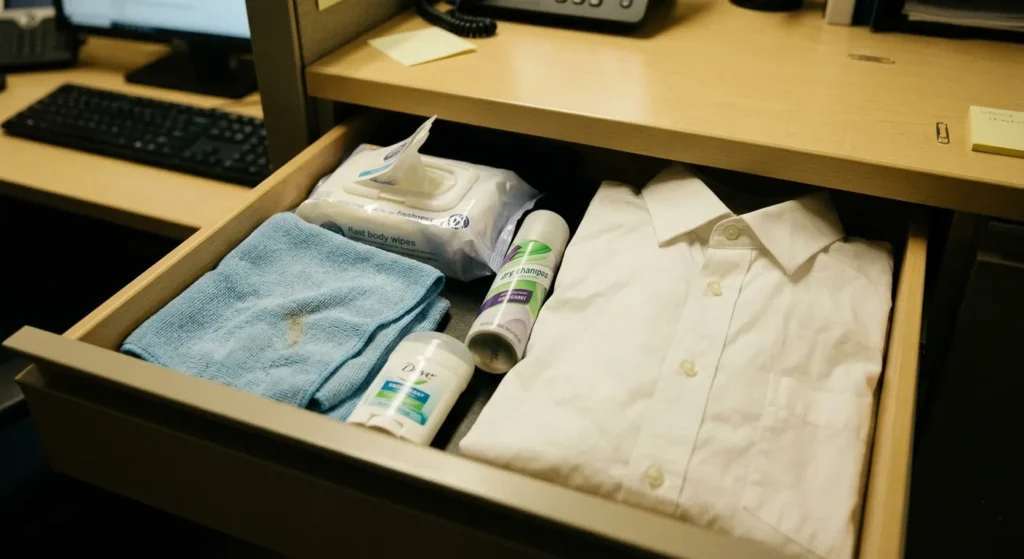
Here’s what the kit actually needs:
- Body wipes (Action Wipes, ShowerPill — either works) in the drawer, always
- Dry shampoo, travel-sized, restocked roughly monthly
- One spare shirt, underwear, socks — locker or deep desk drawer
- Antibacterial deodorant, unscented because your colleagues will thank you
- One small microfiber towel
The full refresh takes 5–10 minutes when everything is already there. We go into the full system in our cycling to work no-sweat guide if you want the detailed breakdown. But honestly — the strategy fits in a paragraph. The execution is one Friday afternoon.
Strategy 4: Stop Doing Honest Time Math Wrong
Everyone does this calculation the wrong way. They clock a best-case ride — 22 minutes, tailwind, no red lights — and compare it to their door-to-door drive. Then they declare it “basically the same” and feel good. And then a flat tyre happens and the whole mental model collapses and they don’t ride for two weeks.
Add 15 minutes to whatever your good-day time is. Full stop. If the ride takes 25 minutes clean, schedule 40. This isn’t pessimism — it’s the kind of buffer that makes cycling feel reliable instead of like a gamble you keep losing.
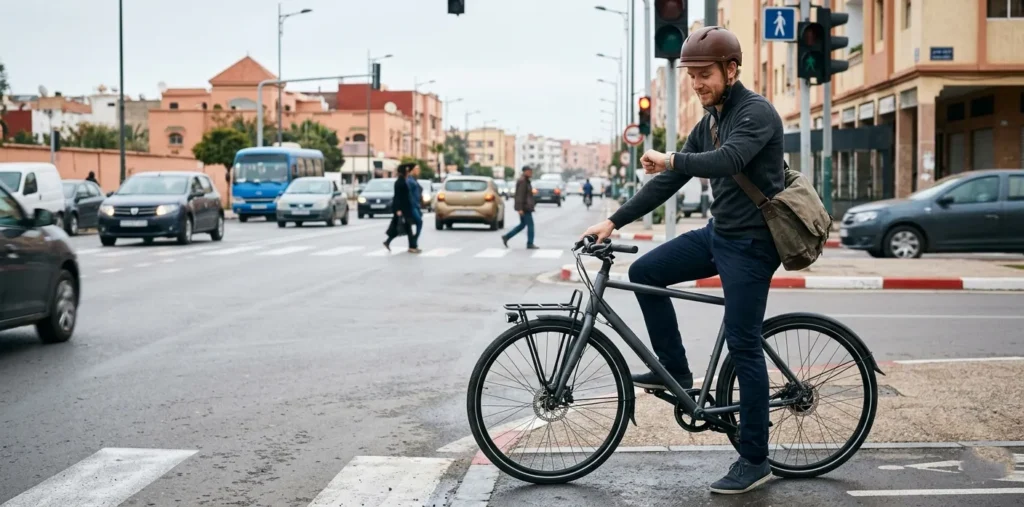
Also — and we said this plainly in our piece on the real pros and cons of bike commuting — add 10 minutes to your route if it routes around the intersection that terrifies you. Your collarbone doesn’t heal in a weekend. Your pride recovers from a detour immediately.
A few practical things that remove delay before it happens:
- One bag, permanently packed, that never gets fully emptied between rides
- Bike maintenance on Sundays — not reactively, not when something sounds wrong
- A genuine backup plan (bus pass, a colleague who drives your direction) used without guilt when it’s sleeting
The backup plan thing — people resist this like it’s admitting defeat. It’s not. It’s what keeps you riding in November when fair-weather-only people have already hung up their helmets.
Strategy 5: Make the Financial Win Visible. Concrete. Written Down.
The benefits of bike commuting include serious money. Like, embarrassing amounts of money that you’ve been handing to petrol stations and car parks without fully registering. The issue isn’t that the savings aren’t real — they’re very real — it’s that abstract savings feel abstract. They don’t change behavior the way a number written on paper does.
So write the number.
A 20km round-trip commute, 5 days a week — fuel alone runs €1,500–€2,500 annually depending on your car. Add parking at even a modest €4/day and you’re looking at another €800–€1,000 per year. Conservatively, switching to cycling on that route saves €2,000–€3,500 in year one. That’s not pocket change. That’s a flight somewhere you’ve been putting off, or a genuinely good road bike, or — here’s a thought — just keeping it and watching it compound.
Calculate your specific commute. Write the annual number. Stick it somewhere you’ll see it. The benefits of bike commuting are easiest to feel when they have a currency symbol in front of them.
Cycling vs Driving Calculator
Compare the real costs and benefits of cycling versus driving
🚴 Trip Details
km
days
kg
km/h
🚗 Car Details
L/100km
€/L
€
km/h
📊 Comparison Results
🚴 Cycling
Time per trip
30 min
Daily cost
€0.00
Monthly cost
€0.00
Annual cost
€0.00
Calories burned
600 cal
CO₂ emissions
0 kg
🚗 Driving
Time per trip
17 min
Daily cost
€7.56
Monthly cost
€164.02
Annual cost
€1,965.60
Calories burned
0 cal
CO₂ emissions
4.6 kg
💰 Your Annual Savings by Cycling
€1,966
Money Saved
156,000
Calories Burned
1,196
kg CO₂ Avoided
+67
Min/day difference
The Point Under All of This
None of these are complicated. That’s kind of the point — complexity is what’s been stopping you, not capability. Every strategy here removes one specific piece of friction that, left in place, quietly erodes your consistency until cycling is something you used to do for a few weeks last spring.
The compounding effect, when you actually remove the friction? It’s weird how fast it snowballs. You ride Tuesday because Monday was fine. You ride in the rain because you have the jacket. Then you arrive fresh because the kit is in the drawer. You don’t stress about the time because you built in buffer. And somewhere around week 4 or 5, you stop thinking of yourself as someone who’s “trying to cycle to work” and you’re just — a person who cycles to work.
That identity shift is quiet. And it’s worth more than any single strategy on this list.
Start with one. Implement it before Friday. Not next month, not after you figure out the perfect bag situation — pick the one that addresses your actual blocker and do that thing. The rest follows faster than you’d expect.
Dig deeper in our full Commuter Cycling Guide — practical, no fluff, built for people who actually want to ride.




[…] you’ve already read why bike commuting is worth it in the first place, you know the benefits stack up fast. But benefits mean nothing if the daily execution is a mess. […]
[…] get into the bigger picture of structuring your effort in our benefits of bike commuting guide — worth reading if you’re trying to actually build something sustainable, not just sprint […]