The Best Fluffy Pancakes recipe you will fall in love with. Full of tips and tricks to help you make the best pancakes.


Look—stop wasting hours on your bike chain maintenance, seriously. Every single minute you’re fumbling around with greasy rags and degreaser is time you could be out there actually riding. A dirty bike chain? It’s costing you 3-5 watts of power (which adds up faster than you think) and it’ll shorten your component life by 50%. Maybe more, honestly.
The difference between a 15-minute cleaning session and a 5-minute one isn’t about cutting corners—it’s technique, pure and simple. Though I’ll admit, when I first started maintaining my own bikes, I thought spending more time meant doing it “right.” Wrong.
Most cyclists—and I mean most—overcomplicate bike chain cleaning with unnecessary steps, redundant products you don’t actually need, and methods that worked maybe in the 90s but not anymore. This guide? It eliminates those delays and delivers what actually matters: smooth shifting, extended drivetrain life, and maximum power transfer to the road (or trail, whatever you’re into).
Strategy 1: The Two-Product System
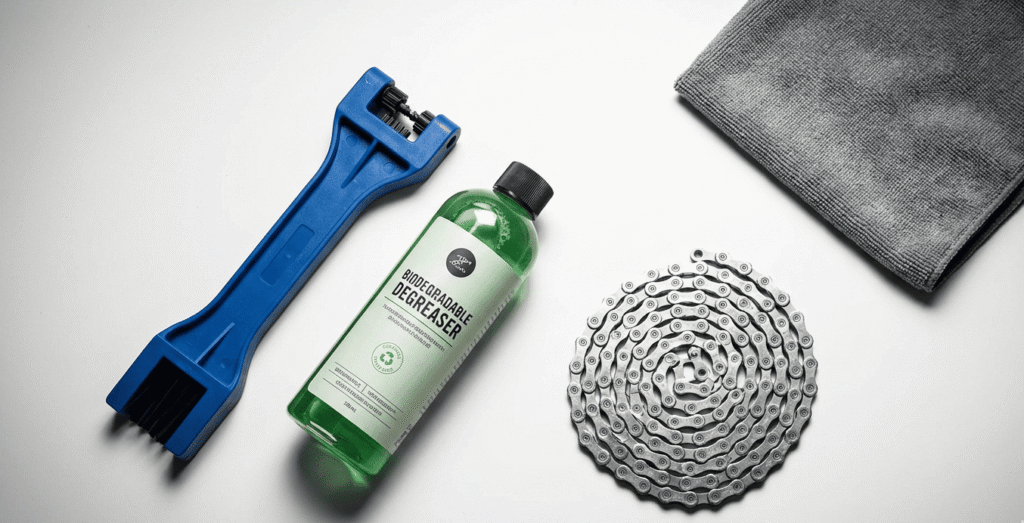
Forget the arsenal. All those brushes, degreasers, specialty cleaners cluttering up your workspace? You need exactly two things: a quality chain cleaning tool and a biodegradable degreaser. That’s it.
The chain cleaning tool does 90% of the work in 60 seconds—I’m not exaggerating here. You fill it with degreaser, clip it onto your bike chain, and backpedal 20-30 rotations. The rotating brushes hit all four sides of every link simultaneously, which is… well, it’s something that’s literally impossible with manual scrubbing no matter how motivated you are.
What this eliminates:
- Individual brush purchases (you’re looking at $8-15 each, adds up quick)
- Multiple cleaning angles and endless passes
- Degreaser waste from spray application—half of it ends up on your garage floor anyway
- Hand fatigue and that repetitive scrubbing motion that makes your wrist hurt
For road cyclists chasing those marginal gains (and let’s be honest, we all are), this method removes 95% of contaminants in under 2 minutes. MTB riders dealing with actual mud and grit—the stuff that really cakes on—need this same approach. The enclosed design contains the mess while the brushes penetrate that packed dirt that hand-cleaning just… doesn’t get to.
The hack: Use the same degreaser for your cassette and chainrings too. Pour the used chain cleaning solution into a parts-washing basin. One product, three applications. Efficient.
Strategy 2: The Rinse-Free Finish
Here’s where most people lose 10 minutes, maybe more if they’re really being thorough: rinsing, drying, waiting for complete evaporation before lubrication. Just skip it entirely—hear me out.
After degreasing your bike chain, wipe it down with a lint-free rag while backpedaling. Two passes remove the excess degreaser and all that suspended grime. Then apply your lubricant immediately to the damp chain. Yes, damp.
Why this works (and it does work):
- Residual degreaser evaporates as you apply lube
- Fresh lubricant actually displaces remaining moisture
- You avoid the 15-20 minute drying wait—which, who has time for that?
- Lubricant penetrates better into slightly open metal pores
“I used to wait 30 minutes between cleaning and lubing, thinking I needed a bone-dry chain,” says Jessie, a competitive XC racer from Colorado. “Switching to immediate lubrication cut my maintenance time to under 10 minutes total, and my chains last 2,000+ miles consistently.”
The critical detail here (don’t skip this): use 1 drop of lubricant per roller, not per link. Most cyclists over-lubricate by 300%—I see it all the time—attracting dirt that basically negates the entire cleaning process you just did. 100-120 drops covers a standard road bike chain completely, that’s all you need.
Strategy 3: Frequency Over Intensity
Deep cleaning your bike chain every 200 miles sounds responsible, right? Sounds like you’re taking care of your equipment. It’s actually counterproductive—and I learned this the hard way after destroying a perfectly good chain by over-maintaining it.
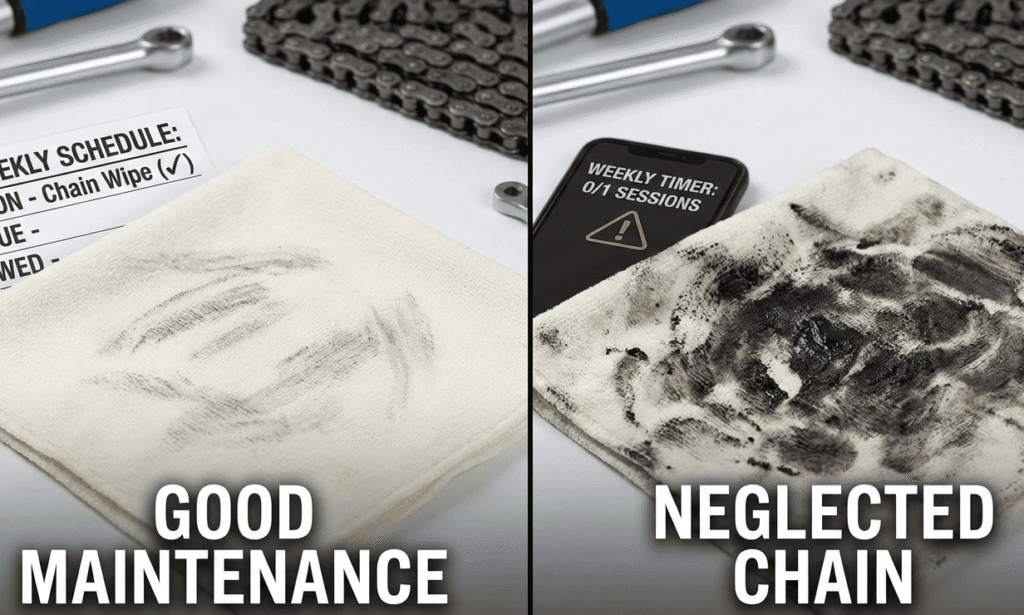
Light, frequent maintenance beats aggressive deep cleans every single time. Wipe your bike chain with a dry rag after every 3-4 rides (that’s 150-200 miles for road, 75-100 miles for MTB depending on conditions). This 90-second task removes surface contamination before it bonds with your lubricant and forms that grinding paste that sounds awful and feels worse.
Monthly schedule that actually works:
- Week 1: Quick wipe after rides
- Week 2: Quick wipe + fresh lube layer
- Week 3: Quick wipe after rides
- Week 4: Full degreaser clean + lube
This rotation keeps your bike chain 85-90% clean constantly—versus the 30-100% swing you get from letting it deteriorate then panic-cleaning. You’ll extend component life by 40% while spending 75% less time on maintenance. The math just works out better.
The measurement that matters: If your rag comes away black? You’ve waited too long between cleanings. Gray means you’re on schedule, you’re doing fine.
Strategy 4: The Lube-Specific Protocol
Not all lubricants are equal (wish someone had told me this years ago), and using the wrong cleaning method for your lube type costs you time and performance—both things we’re trying to maximize here.
Wet lubes—road cyclists in rain, MTB riders year-round basically—require full degreaser cleaning every 200-250 miles. They penetrate deep which is great, but attract contamination like crazy. Quick wipes between rides aren’t optional, they’re essential.
Dry/wax lubes (road cyclists in dry conditions, which is most of us most of the time) need the opposite approach. Degreasing strips the wax coating you literally just applied, which defeats the purpose. Instead, use the drip-on wax method: apply fresh lube every 100-150 miles without cleaning. The new wax layer actually flushes out old contamination as it penetrates—kind of brilliant when you think about it.
Every 500 miles, strip your bike chain completely and restart with fresh wax. This takes 20 minutes once but eliminates 8-10 cleaning sessions in between.
Hot wax immersion (this is advanced, but worth mentioning): Melt wax in a slow cooker, degrease your bike chain completely, then immerse for 10 minutes. This 30-minute process—mostly passive time where you’re just waiting—provides lubrication for 300+ miles with zero maintenance. You’ll need 2-3 chains to rotate (yeah, it’s an investment), but the time savings are 60% over traditional methods. I switched to this system in late 2024 and haven’t looked back.
Real-World Performance
These strategies stack, by the way. A road cyclist using the two-product system, rinse-free finish, and appropriate lube protocol reduces per-clean time from 30 minutes to 7 minutes—that’s a 77% improvement. Over a season (5,000 miles, approximately 20 cleans), you’re saving 7.6 hours. That’s an entire weekend ride you get back.
MTB riders see even better returns, honestly. The chain cleaning tool handles trail grime that would require 15 minutes of brush work—minimum. Combined with frequent light maintenance, you’ll spend 60% less time cleaning while your drivetrain lasts 30% longer. It’s almost ridiculous how much better this works.
The power meter data confirms it (because data doesn’t lie): a properly maintained bike chain versus a contaminated one shows 4-6 watt differences at 250 watts output. For a 40km time trial, that’s 15-25 seconds—literally the gap between podium and pack in most races.
Stop Delaying, Start Cleaning
Your bike chain maintenance routine shouldn’t be a project—it shouldn’t be this thing you dread or put off until next weekend. It’s a 5-minute task that protects a $3,000+ bike and maintains the efficiency you’ve paid for through training, through all those early morning rides and interval sessions.
Choose your products today. Set up your two-product system. Clean your bike chain once using these techniques and time yourself—actually time it. You’ll never go back to the old method, I guarantee it.
Your next ride is waiting. Stop reading and start cleaning—the right way, the fast way, the way that actually works.
Now Go check our Full Cycling Training Guide for more tips and info !