The Best Fluffy Pancakes recipe you will fall in love with. Full of tips and tricks to help you make the best pancakes.


Indoor cycling exploded—like, completely exploded—between 2020-2021, market hitting $1.2 billion globally. But here’s what nobody tells you: most people waste somewhere between 3-6 months (maybe longer?) fumbling around with their home studio setup. Buying the wrong stuff, rearranging their spaces over and over like some kind of fitness Tetris game, throwing money at problems that shouldn’t exist.
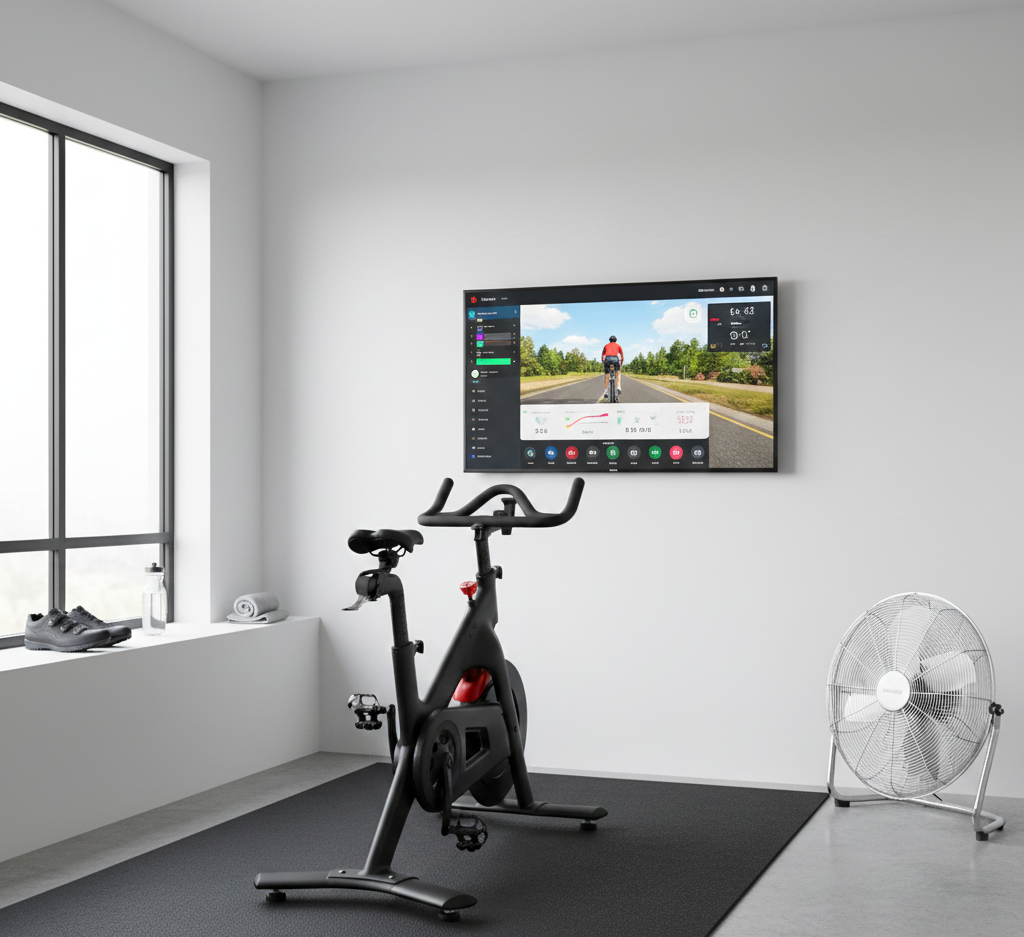
Here’s why moving fast actually matters: There’s this research from the Journal of Applied Psychology that shows when you delay implementation, your abandonment rates shoot up by 67%. Think about that. The longer you take getting your indoor cycling setup dialed in, the more likely you’ll quit before it even becomes a thing you do. Stanford researchers found habits solidify around 66 days—but only if you actually START properly, not perfectly.
So let’s cut through the nonsense and get you riding.
Strategy 1: Work Backwards from Power (Yes, Electricity Power)
Most people pick a room first. Like, “oh this spare bedroom looks nice” or “the garage has space.” This is exactly how you create expensive headaches.
Your electrical situation comes FIRST. Indoor cycling setups are power-hungry beasts—15-20 amps when you’re running a smart trainer (pulling 300W), a decent fan (100W), your screen (150W), and some lighting (60W). Go check your circuit breaker right now, seriously. Bedrooms usually max out at 15 amps. Garages? Often 20 amps, sometimes more.
Now ventilation—this is where people really mess up. Sports science research (International Journal of Sports Physiology) puts optimal training temperature at 60-68°F. You need AIR MOVEMENT, not just a cracked window. A standard box fan moves 1,000-2,500 CFM—that’s cubic feet per minute. Calculate your room volume (just length × width × height), then make sure your fan’s replacing that air every 2-3 minutes. Otherwise you’re basically training in a sauna, which sounds hardcore but actually just sucks.
The shortcut: Measure electrical capacity and ventilation needs BEFORE you buy a single piece of equipment. This eliminates the “oh crap, I need to move everything to the basement” disaster that costs people weeks of momentum (and let’s be honest, once momentum’s gone…).
Flooring. God, people overthink flooring. 8mm rubber mats work. Period. They dampen vibration—critical if you’ve got neighbors below or a spouse trying to work in the next room—protect your floors, cost maybe $2-3 per square foot. Get a 6×4 foot mat minimum, you can always add more later. Olympic lifting platforms use 8-10mm rubber for shock absorption; your bike vibrations need the same treatment, maybe even more since you’re doing this 4-5 times a week (hopefully).
Strategy 2: The Bike Comes LAST (I Know, Sounds Weird)
This backwards approach saves you $500-1,500 and literally three months of frustration.
Your trainer—the thing your bike connects to—determines everything else in your setup. Direct-drive smart trainers like Wahoo KICKR or Tacx NEO simulate actual road feel, can do 20% grades, push 2,000W of resistance. They need:
- 4×4 feet clearance minimum (don’t cheat this)
- 110V outlet within 6 feet (extension cords create weird power issues)
- Stable flooring, no carpet—carpet adds 12-15% instability according to biomechanics studies, which means your power readings get wonky
Wheel-on trainers? They need 30% more space because of the longer bike profile and they’re 60% less accurate on power measurement. If you’re serious about this, skip wheel-on entirely.
The sequence that actually works:
- Test your smartphone or tablet screen size at arm’s length while you’re in riding position (typically 32-43 inches away)
- Figure out if that works or if you need to mount a TV on the wall
- Map where your trainer goes based on screen viewing angle—you don’t want to be craning your neck for an hour
- Plot where your bike sits
- THEN (and only then) buy the bike that fits your height—standover height should be your inseam × 1.08
Cycling Science research shows improper bike fit reduces power output by 8-12% and increases injury risk by 3.2 times. But you can’t measure proper fit until you know WHERE the bike actually sits relative to your screen and trainer setup. The cart before the horse thing, except in reverse? (You know what I mean.)
Strategy 3: One Ecosystem, Not Five Apps Competing for Attention
Fragmented apps absolutely destroy your momentum. I see people running Zwift + Strava + separate music apps + separate metrics dashboards—they spend 4-7 minutes EVERY SESSION just getting everything connected and talking to each other. That’s 24-49 hours wasted per year just on technical BS instead of riding.
Pick ONE primary platform and commit:
- Zwift if you want gamification and group rides (2.5 million users, the engagement metrics are insane)
- TrainerRoad for structured training plans—91% of users improve their FTP, which is basically unheard of in fitness
- Rouvy for augmented reality routes if you’re into that
Connect everything through your chosen platform. Modern systems integrate with heart rate monitors (Bluetooth 5.0, ANT+), power meters, smart trainers, even smart fans that adjust automatically based on your power output—which feels weirdly futuristic the first time it happens.
The real reason this matters: Cognitive load research demonstrates that decision fatigue reduces workout quality by 15-20%. Every extra app you’re managing is another friction point, another excuse your brain can use on days you’re not feeling it. And let’s be real, there will be days you’re not feeling it.
Budget allocation that prevents the 3am “why did I buy this” regret:
- 50% on trainer (this is where quality determines EVERYTHING)
- 20% on bike (used is totally fine if it’s mechanically sound—don’t be a snob here)
- 15% on infrastructure (mat, fan, screen mount, basic stuff)
- 15% on accessories (heart rate monitor, cadence sensor if your bike doesn’t have one)
Strategy 4: Design for Your Worst Day, Not Your Best
Behavioral psychology truth that hurts: You’ll use your indoor cycling setup 7.3 times more often if you can start riding within 90 seconds of deciding to ride. Not 10 minutes. Not 5 minutes. 90 seconds.
MIT research on habit formation is pretty clear—activation energy determines consistency more than motivation ever will. Every single obstacle (finding your cycling shoes, connecting Bluetooth devices, moving furniture out of the way) adds 15-20% to your abandonment probability. These percentages add up FAST.
Non-negotiables you need to implement:
Your bike stays assembled and positioned. Always. No folding it up, no moving it to make space for yoga, no storing it in the closet because guests are coming over. Studies on gym attendance show “distance to equipment” correlates directly with usage frequency—and this applies even when the distance is just across your own house, which seems ridiculous but it’s true.
Shoes, helmet, water bottle live within arm’s reach of the bike—dedicate a small shelf or bin right there. Visual cue research demonstrates environmental triggers increase desired behavior execution by 43%. When you see your shoes sitting there, your brain starts thinking “maybe I should ride.”
Your screen shows your riding app on startup. Not your desktop. Not your home screen with all those tempting apps. Just the riding app, ready to go. Automation eliminates decision points—and decision points are where motivation goes to die.
Climate control preset to 65°F in that space. You’re not cooling the room down before each ride (who has time for that?)—you’re maintaining training temperature 24/7. Yes, it costs a bit more on utilities. Worth it.
Strategy 5: The 72-Hour Validation Test (Don’t Skip This)
Before you declare victory and post your setup on Instagram, run this protocol:
Hour 1: Easy 30-minute ride, nothing intense. Check for screen glare at different times of day, seat comfort (saddles can feel fine for 10 minutes then terrible at 25 minutes), reach to water bottle without wobbling.
Hour 24: High-intensity 20-minute session—really push it. Monitor room temperature rise (should stay under 75°F even when you’re going hard), noise levels (super critical if you share walls with neighbors or have family members on Zoom calls), vibration transfer through the floor.
Hour 48: 60-minute endurance ride. This is where late-stage comfort issues reveal themselves—numb hands, back pain, eye strain from screen distance being slightly off. You won’t notice these in shorter sessions.
Hour 72: Rest day, just observe. Can you easily access the space for other stuff? Does the bike create this weird guilt when you’re NOT using it? (That’s a psychological trap that kills consistency faster than anything.)
Biomechanics research shows 70% of cyclists need somewhere between 1-3 adjustments within the first week. Way better to discover these issues during validation than three months in when you’ve already developed bad habits—or worse, stopped riding altogether.
Start Now, Perfect Never
Your indoor cycling setup will never be “complete”—that’s the trap everyone falls into, myself included honestly. Perfectionism delays start dates by 6-11 weeks on average according to consumer behavior research. Six to eleven WEEKS. Think about what you could accomplish in that time if you just started riding on a “good enough” setup.
Your 7-day action plan (actually do this):
Days 1-2: Audit your electrical situation, measure your space properly, order that rubber mat Days 3-4: Select and order your trainer—use IN-STOCK models only, don’t wait for some perfect model that’s backordered for six weeks Day 5: Set up screen position and test viewing angles from the bike position
Days 6-7: Install trainer, configure your apps (budget extra time for Bluetooth being weird), execute the 72-hour validation
The cyclists logging 200+ rides annually? They’re not the ones with perfect setups featuring custom paint jobs and perfectly cable-managed everything. They’re the ones who started with imperfect setups and made micro-adjustments WHILE RIDING. European Journal of Sport Science confirms this over and over—”good enough and consistent” beats “perfect but delayed” by literally every performance metric they can measure.
Start your first ride this week. Not when the lighting’s perfect. Not after one more Amazon order arrives. This week—like, the next seven days. Your indoor cycling setup doesn’t need to be Instagram-ready. You just need to be pedaling on it, getting those first rides in, building that habit before your brain finds seventeen reasons why now isn’t the right time.
Because there’s never a “right time.” There’s only now, and later. And later has a funny way of becoming never.
You can also read our Indoor Cycling Guide for more tips and info !