The Best Fluffy Pancakes recipe you will fall in love with. Full of tips and tricks to help you make the best pancakes.

Time-Crunched Cycling Plans for Busy Cyclists
Maximize gains with minimal weekly hours.

Look, I get it. You see those Instagram cyclists logging 15-hour weeks and think “well, guess I’m screwed then” because you’ve got maybe—maybe—four hours between work, kids, that side project you keep meaning to finish, and trying to remember what your partner’s face looks like.
Most people? They take the long road because that’s what cycling culture tells them to do. Base miles. Volume. Consistency meaning everyday, all day. It’s almost like we’ve been gaslit into believing fitness is some kind of time-served sentence rather than… I don’t know, something that should actually fit into real life?
But here’s where it gets interesting (and I mean actually interesting, not Instagram-coach interesting).
Shortcut One: Go Hard or Go Home—No Really, Just Go Hard

This one’s gonna sting a bit. Those cozy Zone 2 rides everyone’s been preaching about since like 2019? They’re basically the least efficient thing you could do with your precious 45 minutes.
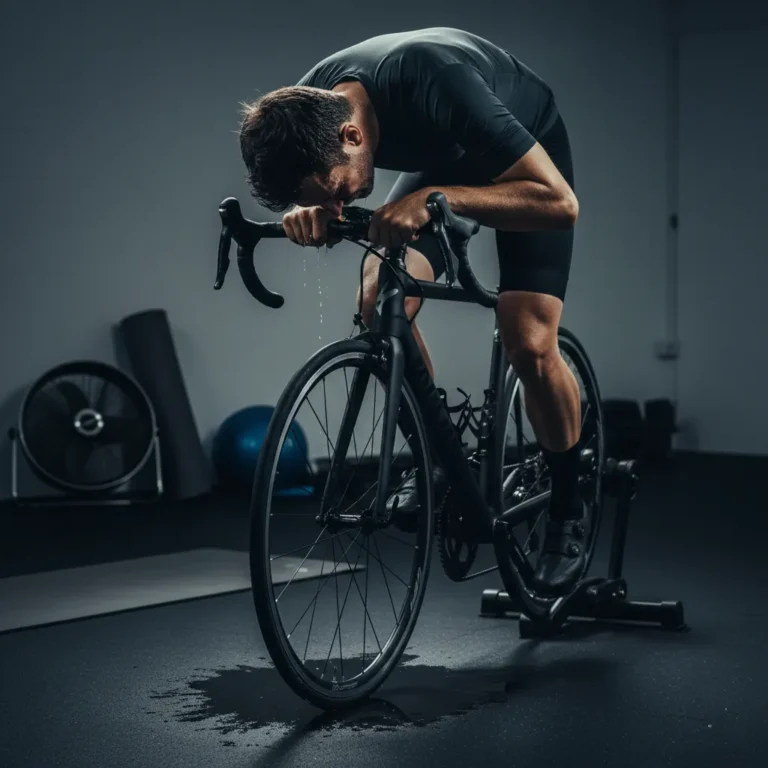
HIIT workouts—the 30 to 45-minute kind that make you question your life choices around minute 23—they deliver results that would otherwise need triple the time investment. We’re talking serious physiological adaptations: better VO2max, lactate threshold improvements, all that sciencey stuff that means you get faster without becoming a cycling hermit.
I remember Sarah (works in marketing, two kids, perpetually exhausted) who switched from hour-long moderate rides to three 40-minute HIIT sessions weekly. Her FTP jumped 18 watts in six weeks. Six weeks. That’s the kind of gain that normally requires—what, 10+ hours a week of traditional training?
The protocol’s simple but brutal: 10-minute warm-up, then 4-6 intervals of 4 minutes at 95-100% FTP (yes, it’s as awful as it sounds), 3-minute recoveries between, 5-minute cool-down. Done. 40 minutes total, and you’re cooked.
Sweet-spot training sits right in that goldilocks zone too—88-93% of threshold. Hard enough to trigger adaptation, manageable enough that you don’t need two days to recover. A 45-minute session with three 10-minute sweet-spot blocks? That’s legitimately more effective than two hours of Zone 2 meandering.
The catch—and there’s always a catch—is these workouts hurt. Like, genuinely uncomfortable. But isn’t discomfort just… I don’t know, the price of efficiency when you’re time-starved?
Shortcut Two: Less Is Legitimately More (No, For Real This Time)
Here’s where things get counterintuitive.
Three to four strategic workouts per week can absolutely demolish seven days of random riding. The cycling world has this weird volume addiction going on—more suffering equals better results, right? Except it doesn’t. It just equals more suffering and probably burnout and maybe some resentment toward your bike.
Think of your weekly energy like a phone battery (because everything’s a phone metaphor now, apparently). You’ve got limited charge—recovery capacity, time, mental bandwidth. Every workout drains it. But not all workouts give you equal returns on that drain.
A smart week might look like: Tuesday’s 40-minute HIIT session, Thursday’s 45-minute sweet-spot, Saturday’s 30-minute VO2max intervals, maybe Sunday’s 60-minute endurance ride if you’re feeling it and the kids are occupied and the universe aligns. That’s potentially three hours producing results that rival 8-10 hour programs.
Marcus—software engineer, previously attempting six-day training plans, constantly exhausted—switched to four focused sessions weekly and something shifted. Not just his power numbers (which went up), but his consistency improved because the workouts actually fit his life instead of consuming it. Three months later he completed his first virtual century at higher watts than he’d ever maintained before.
Every ride needs a purpose. No junk miles. If it doesn’t serve a specific goal? It doesn’t deserve your limited time, period.
And weirdly (or maybe not weirdly?) this minimalist approach is sustainable indefinitely. You can maintain this without sacrificing your career or relationships or sanity, and that consistency over months—years even—builds fitness that sporadic high-volume attempts never touch.
Shortcut Three: Sleep Is a Performance Drug (And It’s Free)
Biggest mistake time-crunched cyclists make? They optimize training, then completely sabotage recovery.
Your body doesn’t get fitter during workouts—it gets fitter during rest, when adaptations actually occur. For cyclists doing intense, focused sessions, recovery becomes the multiplier that makes everything else work. Or not work, if you ignore it.
Sleep matters more than another workout. Studies show athletes getting 7-9 hours experience significantly better power output, faster recovery, better focus during rides. For time-pressed cyclists, going to bed 30 minutes earlier might—and I’m serious here—deliver more gains than adding another session.
Hydration’s underrated too. Even mild dehydration (just 2% body weight loss) can tank your power output by 10-15%. For someone with a 250-watt FTP, that’s 25-37 watts just… gone. The fix? Drink water consistently. Revolutionary, I know.
Easy spin days are the most misunderstood tool in recovery. These aren’t junk miles—they’re active recovery promoting blood flow and waste removal without adding training stress. A 30-minute super-easy spin (like, talking-on-the-phone-easy) between intensity sessions accelerates recovery and lets you go harder in key workouts.
Jennifer (busy physician, sleeping maybe 5-6 hours, rarely hydrating properly) was hammering intense sessions but plateaued hard. When she committed to 7.5 hours of sleep and proper hydration, her power jumped 12 watts in two weeks—without changing her actual training. That’s wild.
So Here’s The Thing
You don’t need more hours. You need smarter hours—ruthless simplification, intense focus, and treating recovery as seriously as training itself.
The cyclists winning at the time-crunched game aren’t magically finding extra hours. They’re maximizing every minute they have, then recovering like it matters. Because it does.
Your transformation doesn’t require a lifestyle overhaul. Just a mindset shift about what actually drives results. The question isn’t whether you have enough time to get faster—it’s whether you’re ready to train smarter than you ever have.
Ready to implement these shortcuts with an actual proven system? Check My e-Book “INDOOR GAINS: THE ULTIMATE HOME CYCLING PLAN“ for the complete framework on maximizing performance with minimal weekly hours. Your breakthrough’s closer than you think and requires less time than you fear.
Also, you can check our Full Cycling Training Guide for more tips and info !