
The Best Fluffy Pancakes recipe you will fall in love with. Full of tips and tricks to help you make the best pancakes.


By the Pedalynx Team
There’s this old navigation concept — and bear with me here because it sounds like something your high school geography teacher would’ve droned on about — where a ship leaving New York, aimed at London, drifts just one degree off course. One. That’s it. Except by the time it crosses the Atlantic, it’s not slightly off. It ends up somewhere near Portugal. Or worse. The point isn’t about ships, obviously. It’s about how small, almost laughably small adjustments compound into something that changes the destination entirely.
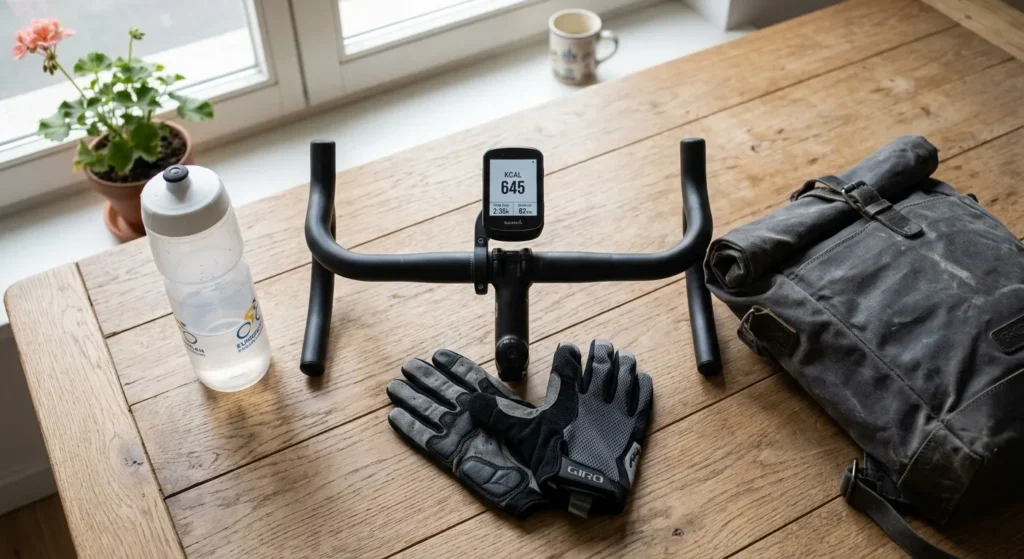
That’s what we’re talking about today with calories burned bike commuting. Not a training plan. Not a diet overhaul. One degree — and what happens when you actually commit to it.
Okay But First — The Numbers You Came Here For
Let’s get this out of the way because we know that’s half the reason you’re here. How many calories does bike commuting actually burn? The honest range is 400 to 700 calories per hour — and where you fall in that window depends on your bodyweight, pace, and whether you’re grinding up hills or floating along a flat riverside path.
Here’s a breakdown:
| Rider Weight | Casual Pace (~12 mph or 19kph) | Moderate Pace (14–16 mph or 22-25kph) | Hard Effort (18+ mph) |
|---|---|---|---|
| 130 lbs (59 kg) | ~390 cal/hr | ~470 cal/hr | ~620 cal/hr |
| 155 lbs (70 kg) | ~460 cal/hr | ~560 cal/hr | ~740 cal/hr |
| 185 lbs (84 kg) | ~550 cal/hr | ~670 cal/hr | ~880 cal/hr |
Based on MET values, Compendium of Physical Activities (Ainsworth et al.)
So for a typical 5-mile commute each way — which, depending on your city, takes somewhere between 20 and 35 minutes — you’re looking at roughly 150 to 250 calories per leg. Round trip? That’s 300 to 500 calories a day, five days a week, just from getting yourself to work. No gym. No membership fee. And no one watching you struggle on an elliptical.
At 3,500 calories per pound of fat, the math is almost uncomfortably simple.
Weight-Loss Calculator by Commute Distance
Cycling vs Driving Calculator
Compare the real costs and benefits of cycling versus driving
🚴 Trip Details
km
days
kg
km/h
🚗 Car Details
L/100km
€/L
€
km/h
📊 Comparison Results
🚴 Cycling
Time per trip
30 min
Daily cost
€0.00
Monthly cost
€0.00
Annual cost
€0.00
Calories burned
600 cal
CO₂ emissions
0 kg
🚗 Driving
Time per trip
17 min
Daily cost
€7.56
Monthly cost
€164.02
Annual cost
€1,965.60
Calories burned
0 cal
CO₂ emissions
4.6 kg
💰 Your Annual Savings by Cycling
€1,966
Money Saved
156,000
Calories Burned
1,196
kg CO₂ Avoided
+67
Min/day difference
The 5 One-Degree Shifts (This Is the Actual Meat of It)
Here’s where most articles go soft on you. They’ll say things like “just stay consistent!” or “find your why!” — which, fine, but also not helpful at all. What we’ve found — and honestly, what the research backs up — is that it’s never the big overhauls that move the needle. It’s the one-degree stuff. Quiet, borderline invisible, wildly compounding.
Shift #1 — Change What You Call the Ride
This one is so simple it almost feels like a trick. It’s not.
Cyclists who identify their commute as a training block — not a commute, not just getting to work — average 15 to 17 mph. Those who call it a commute? 11 to 13 mph. Same roads. Same bikes. And same distance. The only variable is the word they used in their head before clipping in.
Research in Psychology of Sport and Exercise links self-labeling directly to output. It’s not motivation. It’s cognitive framing. Framing yourself as an athlete — even just for 30 minutes — physically changes how hard you push. That gap? About 60 to 100 extra calories per ride. Multiply by five days, fifty weeks. That’s roughly 2 additional pounds of fat per year from a thought you had before putting your helmet on.
Which is either beautiful or slightly unsettling, depending on your mood.
Shift #2 — One Sprint. Just One.
Not a HIIT workout. Not intervals plural. One hard effort per leg — 90 seconds, full push, at something that makes you genuinely uncomfortable. A hill, a long stretch after a red light, a headwind you’ve been avoiding. That’s 3 minutes of total high effort per round trip.
The reason this matters disproportionately to its size is EPOC — Excess Post-Exercise Oxygen Consumption, which is science’s way of saying your body keeps burning calories at an elevated rate for up to 24 hours after intense effort. A single 90-second sprint can generate an extra 50 to 80 calorie burn through the rest of your day. Across five commute days, that’s a near-invisible 250 to 400 calorie surplus you didn’t know you had.
It doesn’t feel like much when you’re doing it. That’s sort of the point.
We get into the bigger picture of structuring your effort in our benefits of bike commuting guide — worth reading if you’re trying to actually build something sustainable, not just sprint twice and burn out.
Shift #3 — Dress Like You Mean It (Even If You Don’t Yet)
Okay, this one gets pushback. Every time. People hear “wear proper cycling kit” and immediately picture spandex, clipless pedals, a very serious expression — and they opt out. Understandable. But here’s the thing they’re missing:

Riders in performance-appropriate clothing maintain aerodynamic positioning 15 to 20% more consistently than those in street clothes. That’s not aesthetic. That’s biomechanics. Street clothes create drag, restrict movement, and subconsciously signal to your brain that this is a casual activity — which feeds back into Shift #1.
You don’t need to spend a fortune. Padded shorts and a breathable jersey change everything. If you’re not sure where to start — or what’s actually worth buying versus what’s marketing nonsense — we broke it down pretty thoroughly in our commuter cycling clothing guide.
Shift #4 — Eat After the Morning Ride, Not Before
This is the shift that sounds the most like a diet tip and is actually just timing.
Riding in a mild fasted state — meaning you wake up, drink water, ride, then eat — increases fat oxidation during low-to-moderate effort by 20 to 30%, according to studies in the Journal of Nutrition. Your overnight fast (let’s call it 10 to 12 hours) leaves you glycogen-depleted enough that your body preferentially burns fat to fuel a moderate commute ride.
Your commute is 30 to 45 minutes. The body can absolutely handle that. The calorie total doesn’t change dramatically — but what those calories are being pulled from does. And over weeks, that adds up in ways the scale eventually admits.
(Caveat: if you have any blood sugar regulation issues or you’re going out hard, eat something light. This isn’t fasting dogma, it’s a small timing tweak.)
Shift #5 — Track One Thing. Not Everything.
The instinct when starting a fitness routine is to monitor all of it — speed, heart rate, cadence, calories, elevation, sleep, who knows what else. Apps love this. It makes you feel productive. It is, in practice, the fastest way to overwhelm yourself into quitting.
One metric. Per week. That’s the shift.
A 2019 study in JAMA Internal Medicine found that single-metric tracking produced 2.4 times better long-term adherence compared to tracking multiple variables. Commuters who track just one number ride an average of 18% more days per month than those who track everything or nothing.
Week one: average speed. Week two: heart rate zone. Third Week: commute time. Build the habit of looking at one thing before you build the habit of analyzing everything. The data will still be there when you’re ready for it.
So What Does “Lose Weight Biking to Work” Actually Look Like?
Here’s the real answer to the question — and we’re not going to dress it up.
To lose 1 pound per week from cycling alone, you need roughly a 500-calorie daily deficit. A 10-mile round trip at moderate effort burns 400 to 500 calories. Apply the five shifts above — particularly the sprint, the fasted timing, and the mental reframe — and you’re at or past that target without touching your diet.
Want to move faster?
- Cut 200 to 300 calories per day from food (not crash diet territory — just awareness)
- Ride 5 days a week over 2 brutal ones; consistency beats intensity almost every time
- Add 1 mile per week progressively — by month three you’re burning 30 to 40% more than when you started
The full picture on whether commuting is actually worth it as a primary fitness strategy — including the honest downsides — is in our pros and cons breakdown. Read it. We didn’t pull punches.
The 4-Week Plan — No Fluff
| Week | Focus | What You’re Building |
|---|---|---|
| Week 1 | Ride at natural pace. Track distance only. | Baseline data + habit installation |
| Week 2 | Add one 90-second effort each direction | Calorie burn increase + EPOC trigger |
| Week 3 | Eat after morning commute. Monitor energy | Fat oxidation shift + body awareness |
| Week 4 | Add 1 mile to one commute leg. Upgrade one piece of kit | Progression + performance identity |
By the end of Week 4 you won’t have overhauled your life. You’ll have adjusted the compass. By one degree. And the destination, give it time, will look completely different.
Willy Said It Better Than We Could
“I wasn’t even trying to lose weight honestly — I just started timing myself on the hill near the office. Then I added one sprint. Then I stopped eating before the ride. Eight weeks later I was down 11 lbs and I genuinely hadn’t done anything dramatic.” — Willy, 6-mile daily commuter
Eleven pounds. One hill. One sprint. One timing change. That’s the math of one degree, lived out.
Here’s Your Move
You’ve got the numbers now — 400 to 700 cal/hr, 300 to 500 calories per round trip, the realistic path to 1 lb/week from a commute you’re probably already making. The five shifts. The plan. The proof.
So — which one degree is yours?
Pick it tonight. Ride with it tomorrow. Don’t pick two. Don’t restructure everything. One degree. The compounding is patient; it’ll wait for you to start.
Dig deeper on Pedalynx:







[…] per hour depending on pace, terrain, and body weight. We went deep on the exact numbers in our calories burned bike commuting breakdown — the range is wider than most people think, and it actually works in your favor. Over 30 days of […]