
The Best Fluffy Pancakes recipe you will fall in love with. Full of tips and tricks to help you make the best pancakes.


There’s a version of your morning commute that doesn’t feel like a small act of survival. Most cyclists haven’t found it yet — not because it doesn’t exist, but because nobody handed them the right map. And we mean that literally, actually, but also kind of figuratively. Safe bike commuting isn’t hard. It’s just under-engineered by almost everyone who attempts it.
Here’s what nobody says out loud: the commute itself rarely fails you. It’s the 10 minutes before it that do. The frantic light-charging. The “is it going to rain?” scroll-through of three different apps. The moment you realize your rear blinky has been on for four hours and is now producing the light output of a dying firefly. These aren’t bad luck moments. They’re system failures. And systems, unlike luck, can be fixed.
We put this together because we’ve ridden through both sides of it — chaotic and dialed-in — and the gap between the two is smaller than you’d think. It’s just specific. So here it is, no filler.
1. Your Visibility Setup Is Probably Half-Finished (Fix It Once, Forever)
Let’s be direct — a single blinky light clipped to your seatpost is not a visibility system. It’s a gesture. A well-intentioned, deeply insufficient gesture that a parked car’s bumper could block at the worst possible moment.
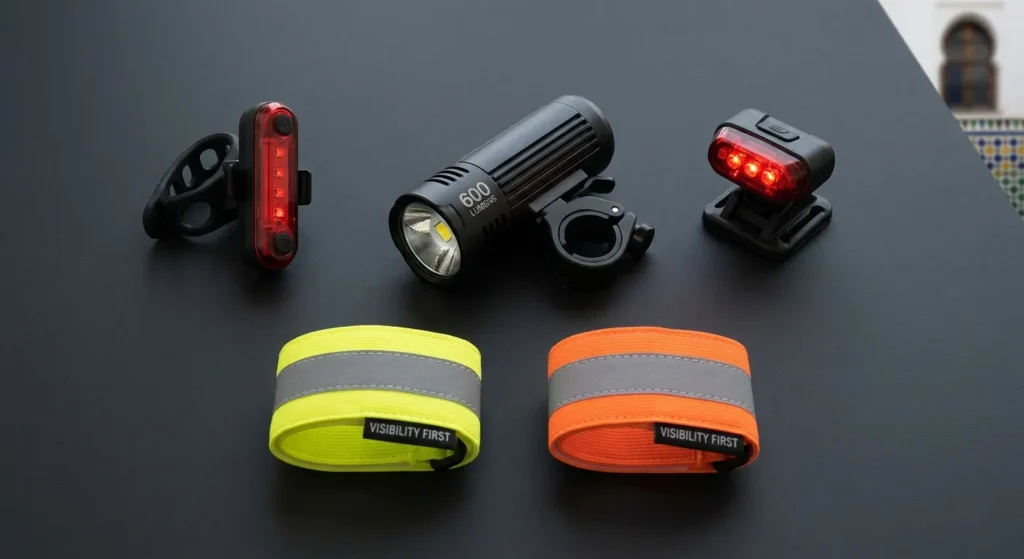
We went deep on this in our night cycling safety guide, and the conclusion is uncomfortable for anyone who thought they’d already sorted this: most riders are running one layer of visibility when they need four.
Here’s what the actual floor looks like:
- Front light: 400–600 lumens minimum for lit urban streets — jump to 800+ if your route dips into any unlit stretches
- Rear lights: you need two — one seatpost unit at 50+ lumens, one helmet-mounted at 30+ lumens (moving lights register faster in a driver’s brain, full stop)
- Reflective ankle bands: costs under €10, takes 30 seconds to put on, and creates a biological motion pattern drivers recognise before they consciously register you’re there
- Battery discipline: charge every 2 nights on a fixed schedule — not when you remember, when you remember is already too late sometimes
Set this up once. Not twice, once. After that it just… runs. That’s the whole point.
2. Your Day Route and Your Night Route Should Not Be the Same Road
This one feels like extra homework. It isn’t — or rather, it is homework you do once and never again, which is a completely different thing.
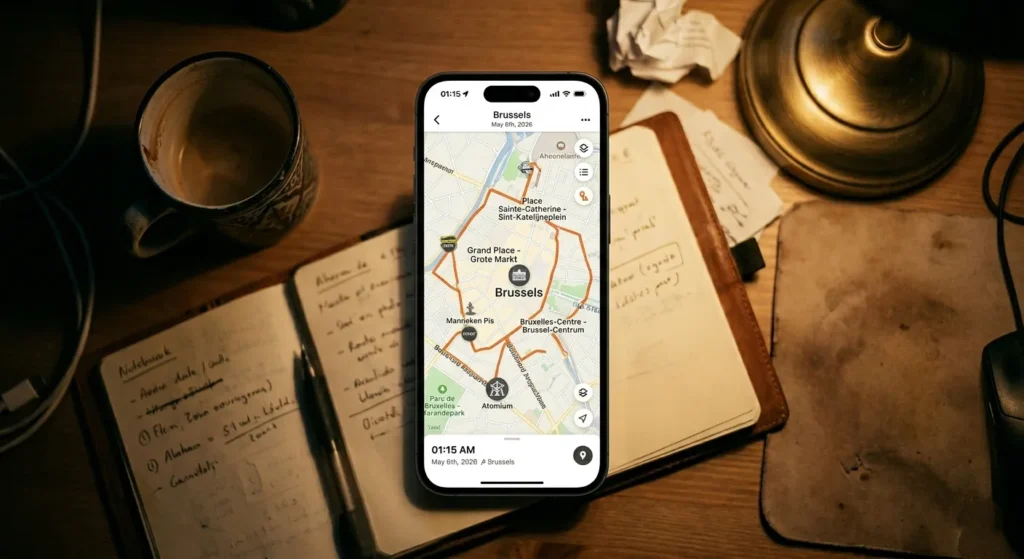
Roads shift personality after dark. A perfectly manageable arterial street at 8am, decent bike lane, predictable traffic, plenty of ambient light — that same road at 9:15pm is quieter, darker, and populated by drivers who are more tired and less attentive. The geometry hasn’t changed. The risk profile absolutely has.
Komoot is where we’d start. Pull up your commute corridor, select your cycling profile, and build a route that prioritises lit roads, protected infrastructure, fewer uncontrolled junctions. Save it. Name it “Night Route” or something you’ll actually remember. Switch to it automatically after 7pm.
One session. 20 to 30 minutes, maximum. That’s the upfront cost for a permanent reduction in nightly guesswork. The ROI on that is — honestly absurd, when you think about it.
3. Stop Using Weather Apps. They Don’t Know Your Route Exists.
Okay this is the one that gets people slightly annoyed when we bring it up, because everyone thinks they’ve already solved the weather problem. You haven’t. Not if you’re using a standard weather app.
Wind speed is not wind impact. A 25 km/h reading means something completely different depending on whether it’s pushing you from behind or grinding into your face for 14 kilometres straight. Generic apps give you the number. They don’t give you what it means for your body, your timing, your kit choices.
VeloVane is the tool almost nobody in the commuting space talks about — which is maddening, frankly, because it solves this exact thing. Route-specific wind prediction. Headwind vs. tailwind broken down for your actual path. Projected effort level. Even kit suggestions, which sounds trivial until you’ve shown up to a morning meeting looking like you dried your clothes in a wind tunnel.
- Check it the night before — takes 20 seconds, genuinely
- If it flags a heavy headwind, leave 10 minutes earlier. Not “maybe earlier.” Earlier.
- Pair it with solid layering choices and the guesswork at the door drops to almost zero
One commuter we spoke to — Meunier, rides daily, been doing it for years — said it fixed his arrival problem in the first week. “Now I check it every morning, takes me maybe 20 seconds.” And honestly, that tracks.
4. Your Phone Should Not Be in Your Hand at Any Point During the Ride
Mid-ride navigation checks are a risk that compounds in low-light conditions and gets quietly worse every time you do it without consequence. The consequences are just… deferred. Not cancelled.
We tested this stack specifically: Komoot for pre-planned offline routes (download takes 90 seconds, works with no signal), and Bike Citizens for live urban navigation with routing logic that actually understands cycling infrastructure — not car-first logic dressed up in a bike icon.
The difference in practice:
- Turn-by-turn voice nav keeps your phone in your pocket the entire ride
- Bike Citizens routes you through quiet parallel streets, not the roundabout that’s technically 40 seconds faster but requires eye contact with six lanes of traffic
- Riders consistently trim 4 to 8 minutes off their commutes just by switching — same fitness, same bike, different routing brain
Hands on bars. Eyes on road. Phone in pocket. That’s what safe bike commuting actually looks like from the outside.
5. Move 30–40cm Toward the Center. Right Now. No Equipment Required.
Without purchase. No setup nor app. Just a decision.
At night — and in low visibility generally — ride 30 to 40 centimetres further from parked cars than your daytime default. Not because dooring is suddenly more likely after dark, but because a driver pulling out of a side street needs processing time to read your trajectory. Your lateral position is what buys them that time.
Combine it with:
- Speed reduction of 15–20% on unfamiliar stretches after dark — your reaction distance stays the same; the hazards just hide better
- Eye contact at every junction before you move — don’t assume being lit means being seen
- Bell at least 5 metres before approaching pedestrians on shared paths
This is the behavioral layer. The thing no light or app or jacket replaces. And it costs nothing except the awareness to apply it every single time, which — look, some nights you’ll forget. That’s fine. Most nights is already a massive upgrade over zero nights.
Do This Before Your Next Ride. Not Next Week.
We’re going to be direct about something: safe bike commuting doesn’t require a personality overhaul or a new bike or three months of habit-building. It requires closing five specific gaps, most of which take under an hour to address total:
- Visibility system — built once, runs permanently
- Night route — planned once, switched to automatically
- Wind intelligence — checked in 20 seconds the night before
- Offline navigation — phone in pocket, eyes on road
- Lane positioning — a decision, not a product
45 minutes of setup. Every commute after that runs cleaner, safer, faster. Pick the gap on this list that you haven’t closed yet — just one — and close it before you ride next. That’s the only move that matters right now. Everything else follows.
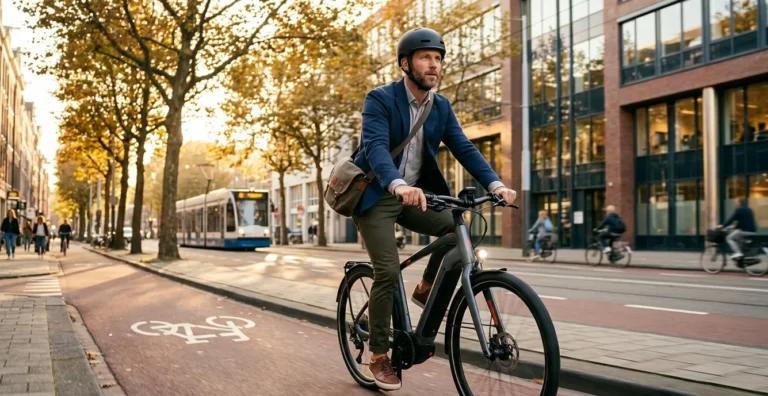
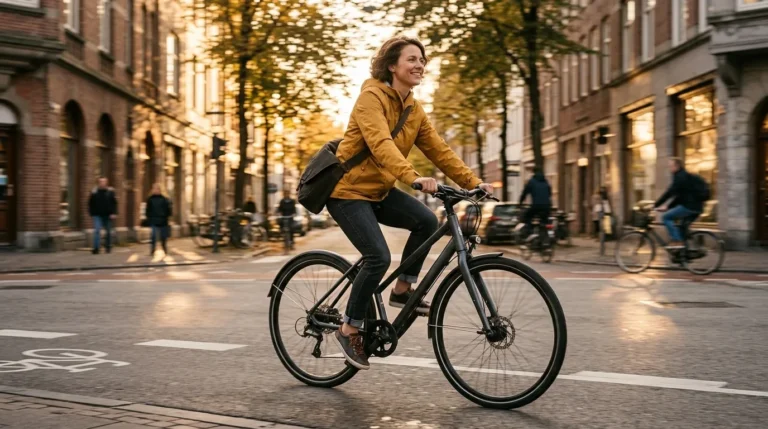




[…] — especially if you’re new to riding in traffic — we put together a detailed resource on safe bike commuting strategies that’s worth reading before your first […]