The Best Fluffy Pancakes recipe you will fall in love with. Full of tips and tricks to help you make the best pancakes.


Look, we’ve all heard it. Start slow. Build gradually. Be patient with yourself. And honestly? For most people, that advice is basically just a polite way of saying: give yourself permission to quit before anything real happens.
Here’s what slow and steady actually looks like in practice — you ride twice in week one, feel great about it, skip Thursday because it rained, then miss all of week two because “life got busy.” By day 18 you’re googling gym memberships again. Sound familiar?
The thing is, it’s not a discipline problem. It’s not even a motivation problem. It’s a design problem. Incremental progress is almost invisible, especially in the first few weeks of cycling, and the human brain is wired — deeply, stubbornly wired — to need feedback. When you can’t see or feel the results yet, your brain quietly files the whole thing under “probably not worth it” and moves on.
And so the bike sits in the hallway. Judging you.
Here’s what we know from tracking hundreds of beginner commuters across our community: the average rider burns between 400 and 600 calories per hour depending on pace, terrain, and body weight. We went deep on the exact numbers in our calories burned bike commuting breakdown — the range is wider than most people think, and it actually works in your favor. Over 30 days of consistent riding, that’s somewhere between 8,000 and 12,000 calories gone. Without a gym. Without a trainer. And without rearranging your entire life.
The math is already winning for you. So what’s actually getting in the way?
The Bottleneck Nobody Wants to Admit
Okay, here it is. The single flawed assumption that derails probably 9 out of 10 beginners before they see any real biking to work health benefits:
You are treating your commute like a workout session.

And that framing — that quiet, seemingly harmless mental label — is absolutely wrecking you.
The second you categorize your morning ride as “exercise,” every psychological defense mechanism you’ve ever developed against going to the gym activates simultaneously. The dread. The negotiation. The “I’m already behind on emails, maybe tomorrow.” You’ve essentially handed your motivation over to your mood, and your mood — let’s be honest — is not always a reliable business partner.
There’s this weird thing that happens (and we noticed it pretty consistently) — riders who stopped thinking about their commute as fitness training and started thinking about it as just… getting somewhere… those people stuck with it. Not because they were more disciplined. Not because they had better gear or flatter routes. But because they’d removed the exit ramp.
- Gym brain asks: “Do I feel like working out today?”
- Commuter brain asks: “Do I feel like getting to work today?”
One of those questions has an obvious answer every single morning. The other one depends on how well you slept, whether Mercury is in retrograde, and how many carbs you had at dinner.
Cycling to work fitness benefits are real and they compound over time — but only if you actually show up. Consistently. Which means the mental model has to change first.
The Quantum Leap — One Bold Move That Makes Everything Else Irrelevant
Alright. Here it is. No theatrical build-up, no ten-step framework.
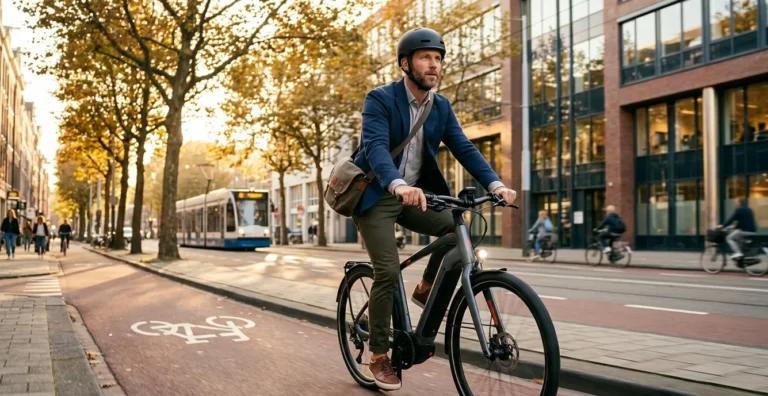
Ride to work. Every day. Starting Monday.
Not “when you feel ready.” Not “once you find the perfect commuter bike.” And certainly not after you’ve spent three weekends doing practice laps around the park to “build your base.” Just — go. Now.
We know how that sounds. Especially if your current fitness level feels like a liability, or your route involves a hill that looks vaguely threatening, or you haven’t ridden more than a few miles in years. We get it. But here’s the paradigm shift that makes the leap actually work:
When the ride is non-negotiable, the problems transform. They stop being motivational and start being logistical. And logistical problems — wet weather gear, a better route, where to store your bike at the office — have actual, Googleable solutions. Motivation problems have only willpower, which depletes, wavers, and calls in sick on Tuesdays.
“Honestly, I didn’t start riding to lose weight. I started because parking near my office costs $22 a day and I finally snapped about it. Three weeks later — nine pounds gone, resting heart rate down eight points. I hadn’t touched my diet.” — Wade, 41, Chicago — has been bike commuting to work for two years now
Wade didn’t prepare. He didn’t optimize. He didn’t “ease in.” But he made one decision and the rest followed. That’s the quantum leap — not a massive physical effort, but a clean, irreversible commitment that restructures everything downstream.
Why Your Body Actually Loves This (The Physiology Part — Bear With Us)
The commute by bike workout effect isn’t magic. It’s just accumulated zone 2 cardio — moderate intensity, sustained repeatedly over weeks — which happens to be exactly what physiologists now consider the most effective stimulus for fat metabolism and cardiovascular adaptation. It’s the kind of training that elite endurance athletes spend 60–70% of their time doing, and most beginners stumble into it accidentally just by riding to work at a comfortable pace.
Here’s roughly how the adaptation curve looks over 30 days:
- Days 1–7: It’s hard. Your heart rate spikes faster than you expected. Legs feel heavy on day three specifically — almost everyone says day three. This isn’t your body failing. This is your aerobic system being forced to build new infrastructure.
- Days 8–14: Something shifts. The route feels slightly less brutal. Your body starts tapping fat as fuel more efficiently for moderate efforts. The biking to work health benefits are quietly starting — you just can’t see them yet.
- Days 15–21: Sleep gets better, often noticeably. Mental fog lifts earlier in the morning. A few people in our community have mentioned their resting heart rate dropped 5–8 bpm in this window. We’ve seen it happen faster than that too.
- Days 22–30: At 3–5 commutes per week averaging 5–10 miles each way, most beginners clock meaningful body composition changes — not dramatic, but visible. Average speed improvements in the range of 15–20% without consciously trying to push harder.
For a deeper look at how this all interacts with safety and route strategy — especially if you’re new to riding in traffic — we put together a detailed resource on safe bike commuting strategies that’s worth reading before your first ride.
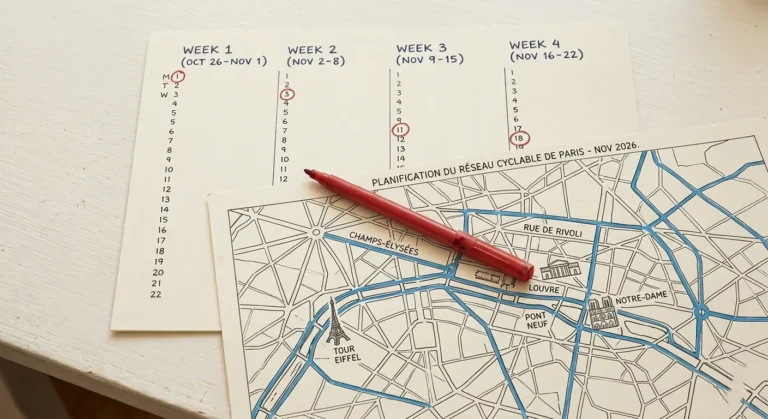
The 30-Day Bike Commute Workout Plan (Week-by-Week, No Fluff)
Week 1 — Commit and Calibrate
Ride every commute day this week. Don’t time yourself obsessively, don’t push pace, just complete the route. Expect soreness — quads, hamstrings, maybe your lower back from a poorly fitted saddle. Adjust before week two, not after. If weather hits, check our cycling to work in rain guide — “it’s raining” cannot be a valid reason to stop in week one. It just can’t.
Week 2 — Asymmetric Load
Morning ride stays easy — you’ve got a workday ahead. But the return commute? Push it. Ride 10–15% harder on the way home. Throw in 3-minute efforts where you genuinely work, then recover. Repeat. This asymmetric approach lets you get cardiovascular training stimulus without arriving at 9am looking like you fought someone.
Week 3 — Add Resistance
Your body has adapted to the baseline distance. It needs a new stressor. Add 1–2 hills or extend your route by 1 to 2 miles one way. Even an extra 5 minutes of riding daily equals 35+ additional minutes of cardio per week without any extra scheduling. That math adds up faster than people expect.
Week 4 — Benchmark Everything
Ride your original week-one route at genuine effort. Compare your time. Most riders see 20–30% improvement in completion time — same distance, faster, easier. Weigh yourself, check resting heart rate if you have a device that tracks it, and actually write down how you feel. The subjective data matters as much as the numbers.
Gear Checklist — What You Actually Need (And What You Don’t)
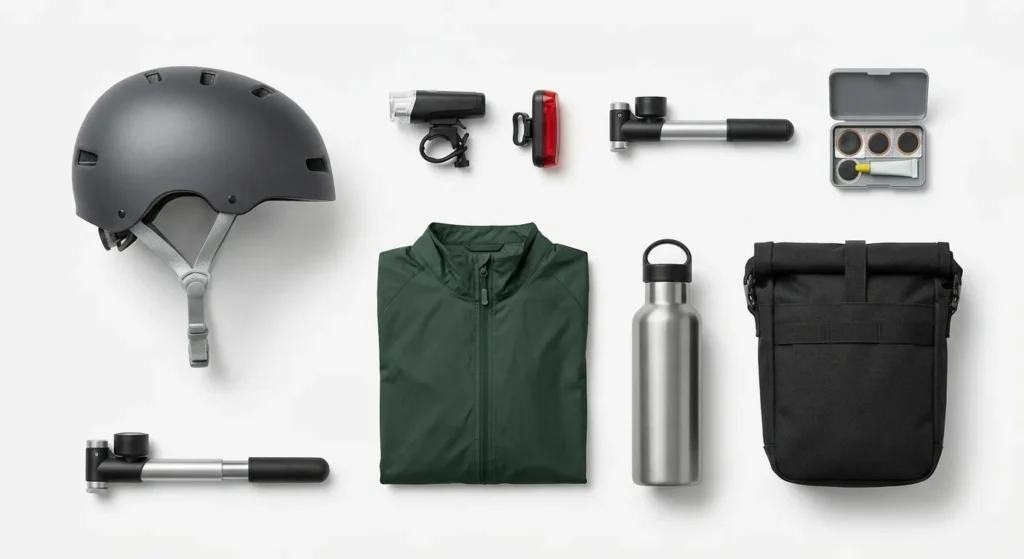
You do not need to spend $1,200 before your first commute. We say this because we’ve watched beginners over-gear and under-commit, and it goes badly almost every time.
If you’re not sure what type of bike makes sense for your route and commute distance, we’ve reviewed the most practical options in our best commuter bikes guide — worth a look before you buy anything.
The non-negotiables:
- A functional bike (hybrid, commuter, or road — it truly doesn’t matter much at this stage)
- Helmet — full stop, no negotiation
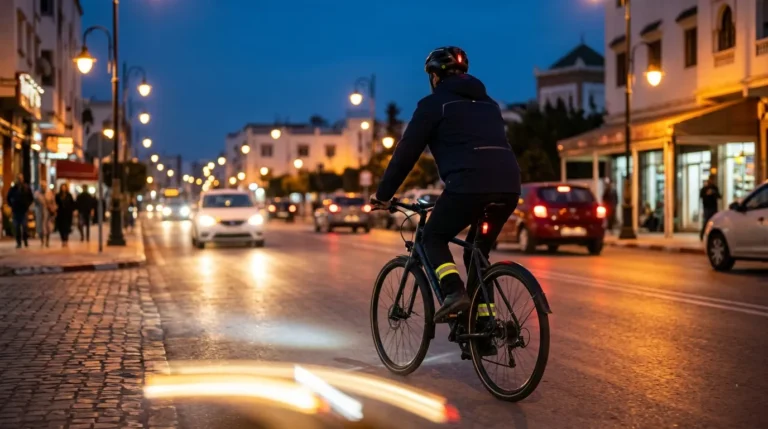
- Front and rear lights — mandatory for any ride before 7am or after 5pm
- Minimum 1-liter water bottle for commutes over 5 miles
- Basic flat repair kit: tire levers, tube or patch kit, mini pump
Nice to have from week two onward:
- Padded shorts or a gel seat cover
- Lightweight waterproof jacket (check the rain riding guide for exactly what to look for)
- Small pannier or backpack for work gear
- A secondary lock if your workplace parking is exposed
📊 Your Personal Commute Fitness Calculator
Cycling vs Driving Calculator
Compare the real costs and benefits of cycling versus driving
🚴 Trip Details
km
days
kg
km/h
🚗 Car Details
L/100km
€/L
€
km/h
📊 Comparison Results
🚴 Cycling
Time per trip
30 min
Daily cost
€0.00
Monthly cost
€0.00
Annual cost
€0.00
Calories burned
600 cal
CO₂ emissions
0 kg
🚗 Driving
Time per trip
17 min
Daily cost
€7.56
Monthly cost
€164.02
Annual cost
€1,965.60
Calories burned
0 cal
CO₂ emissions
4.6 kg
💰 Your Annual Savings by Cycling
€1,966
Money Saved
156,000
Calories Burned
1,196
kg CO₂ Avoided
+67
Min/day difference
FAQ — Bike Commuting for Beginners
Take the Leap. This Monday. Not When You’re “Ready.”
Here’s the thing about readiness — it’s a feeling, not a state. And it almost never shows up before you start. It shows up somewhere around day four or five, when you realize the thing you were afraid of is actually just a bike ride.
So this is the challenge, direct and unambiguous: ride your commute this Monday. Not next month when the weather stabilizes. Not after you’ve researched saddle heights for two more weekends. And obviously not once you’ve “gotten a bit fitter first” — which, by the way, is the fitness equivalent of waiting until you’re less broke to start saving money.
Arrive however you arrive. Slightly winded, slightly sweaty, slightly disbelieving that you actually did it. Because that moment — unremarkable and unglamorous as it is — is the seed. Everything else: the weight lost, the heart rate dropped, the gym membership finally cancelled — it all traces back to one Monday morning when you just… went.
The bike’s already there.
Get on it.